
1. Chapter at a Glance
From the pin in your hair to the rails under a train, almost everything we use contains minerals. A mineral is a homogeneous, naturally occurring substance with a definable internal structure. Minerals are finite and non-renewable, so their conservation is essential. This chapter covers how minerals occur, the major ferrous, non-ferrous and non-metallic minerals of India, the hazards of mining, and conventional and non-conventional energy resources.
2. Mode of Occurrence of Minerals
| Occurrence | How formed | Examples |
|---|---|---|
| Veins and lodes (igneous and metamorphic rocks) | Molten material forced through cracks and joints solidifies | Tin, copper, zinc, lead |
| Beds or layers (sedimentary rocks) | Deposition, accumulation and concentration in horizontal strata | Coal, some iron ore; gypsum, potash salt, sodium salt (by evaporation in arid regions) |
| Decomposition of surface rocks | Soluble parts removed, leaving weathered ore | Bauxite |
| Placer deposits | Alluvial deposits in sands of valley floors and hill bases | Gold, silver, tin, platinum |
| Ocean waters | Dissolved in sea water | Common salt, magnesium, bromine; ocean beds rich in manganese nodules |
Most minerals are found in the old crystalline rocks of peninsular India; the Rajasthan rock systems have copper, zinc and others; the alluvial northern plains have very few useful minerals; and the western and eastern sedimentary basins hold most petroleum.
3. Ferrous Minerals
Ferrous minerals (containing iron) account for about three-fourths of the value of metallic minerals produced and are the base of metallurgical industries.
Iron ore
Magnetite is the finest ore (up to 70% iron) with excellent magnetic qualities, valuable for the electrical industry. Hematite is the most important industrial ore by quantity (50–60% iron).
| Iron ore belt | Key mines / features |
|---|---|
| Odisha–Jharkhand | High-grade hematite at Badampahar (Mayurbhanj, Kendujhar); Gua and Noamundi (Singhbhum, Jharkhand) |
| Durg–Bastar–Chandrapur (Chhattisgarh–Maharashtra) | Bailadila range — 14 deposits of super high-grade hematite; the hills look like an ox's hump; ore exported to Japan and South Korea through Visakhapatnam port |
| Ballari–Chitradurga–Chikkamagaluru–Tumakuru (Karnataka) | Kudremukh mines in the Western Ghats — once a 100% export unit; ore sent as slurry by pipeline to a port near Mangaluru |
| Maharashtra–Goa | Goa and Ratnagiri; ore not of very high quality but efficiently exploited and exported through Marmagao port |
Manganese
Used mainly for steel and ferro-manganese alloy — about 10 kg of manganese is needed per tonne of steel. Also used in bleaching powder, insecticides and paints. Odisha is the largest producer.
4. Non-ferrous and Non-metallic Minerals
| Mineral | Uses | Where |
|---|---|---|
| Copper | Malleable, ductile, good conductor — electrical cables, electronics, chemicals | Balaghat (MP), Khetri (Rajasthan), Singhbhum (Jharkhand); India is critically deficient |
| Bauxite (aluminium ore) | Aluminium combines strength like iron with lightness and conductivity | Amarkantak plateau, Maikal hills, Bilaspur–Katni plateau; Odisha is the largest producer (Panchpatmali deposits, Koraput) |
| Mica | Splits into thin sheets; excellent di-electric strength, low power loss, insulation — electrical and electronic industries | Northern edge of Chota Nagpur — Koderma–Gaya–Hazaribagh belt (Jharkhand); Ajmer (Rajasthan); Nellore (Andhra Pradesh) |
| Limestone | Basic raw material for cement; smelting iron ore in blast furnaces | Sedimentary rocks across most geological formations |
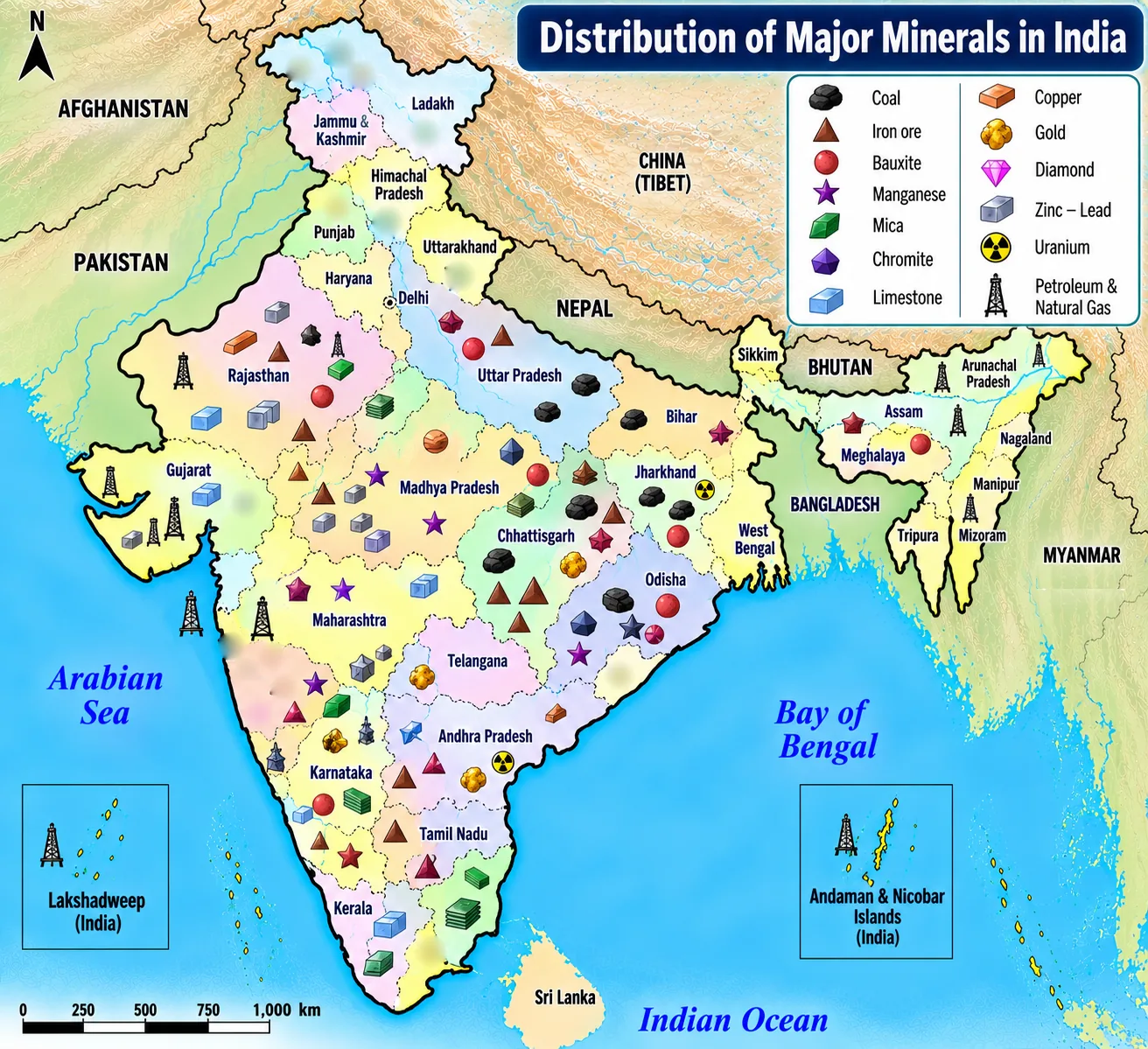
Miners breathe dust and noxious fumes and risk pulmonary (lung) diseases; mine roofs may collapse, flood or catch fire. Water sources get contaminated, and dumping of waste and slurry degrades land, soil and streams. Stricter safety rules and environmental laws are needed.
Conserving minerals
Mineral formation takes millions of years, while we use them quickly. We must use them in a planned, sustainable way: improved technologies to use low-grade ores at low cost, recycling of metals (especially scrap), and using substitutes.
5. Conventional Energy Sources
Coal
| Type | Features |
|---|---|
| Peat | Decaying plants in swamps; low carbon, high moisture, low heat |
| Lignite | Low-grade brown coal, soft, high moisture; main reserves at Neyveli (Tamil Nadu); used for electricity |
| Bituminous | Buried deep, high temperatures; most popular commercial coal; high-grade metallurgical (coking) coal for blast furnaces |
| Anthracite | Highest quality hard coal |
Gondwana coal (a little over 200 million years old) is found mainly in the Damodar valley (Jharia, Raniganj, Bokaro — important coalfields) and the Godavari, Mahanadi, Son and Wardha valleys. Tertiary coal (about 55 million years old) is found in Meghalaya, Assam, Arunachal Pradesh and Nagaland. Coal is bulky and loses weight on use, so heavy industries and thermal power plants are located on or near coalfields.
Petroleum
Petroleum provides fuel for heat and lighting, lubricants for machinery and raw materials for many industries; refineries are "nodal industries" for synthetic textiles, fertilisers and chemicals. Most petroleum occurs in anticlines and fault traps in tertiary rock formations. According to the textbook, about 63% of India's production came from Mumbai High, 18% from Gujarat (Ankeleshwar is the most important field) and 16% from Assam — Digboi (India's oldest), Naharkatiya and Moran-Hugrijan.
Natural gas
A clean, environment-friendly fuel and feedstock for fertilisers and petrochemicals. Large reserves: Krishna–Godavari basin, Mumbai High, Gulf of Khambhat and the Andaman and Nicobar Islands. The Hazira–Vijaipur–Jagdishpur (HVJ) pipeline links Mumbai High and Bassein with fertiliser, power and industrial complexes in western and northern India. CNG is popular as a vehicle fuel.
Electricity
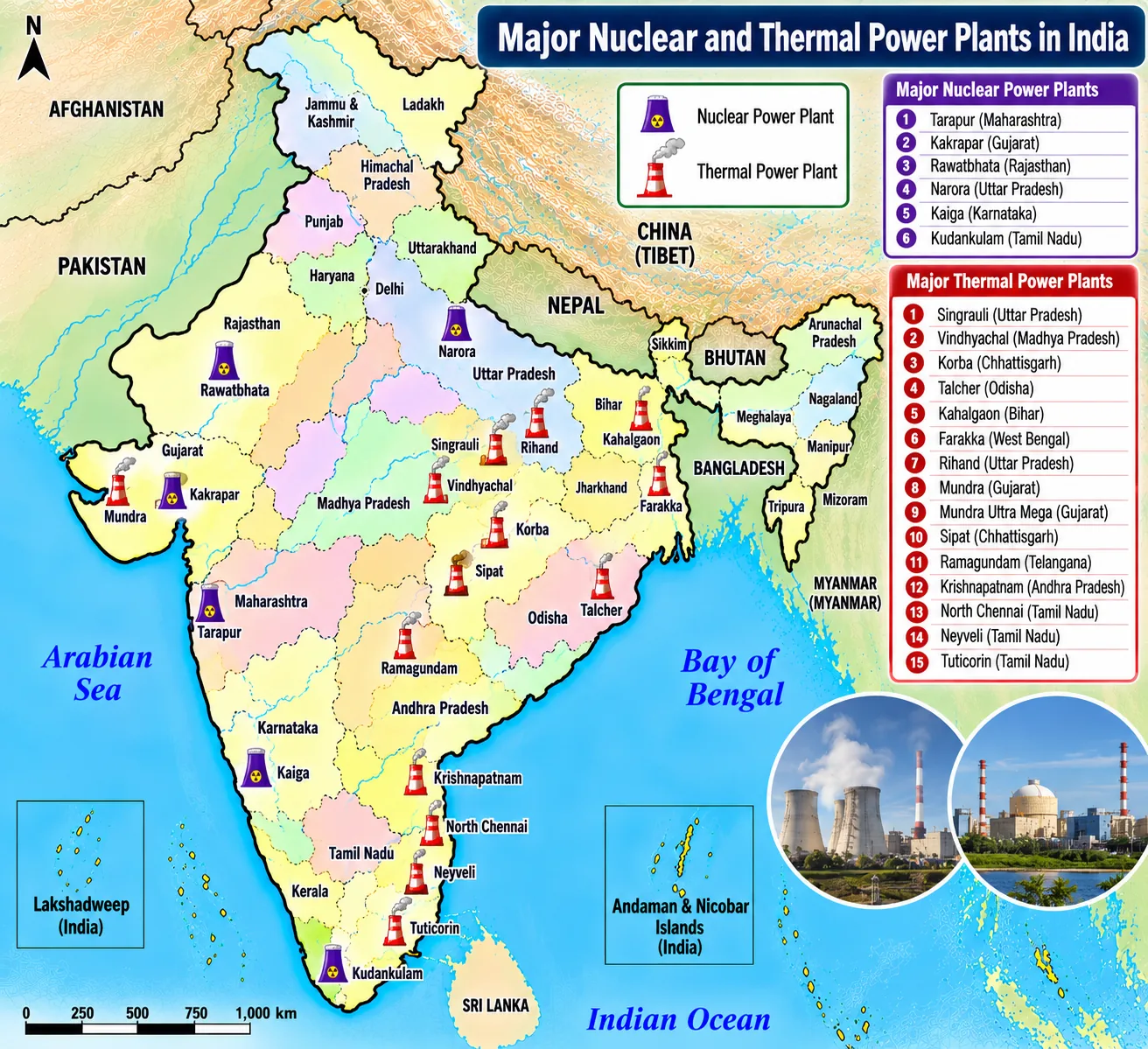
Hydroelectricity uses fast-flowing water — a renewable source (Bhakra Nangal, Damodar Valley Corporation, Kopili Hydel Project). Thermal electricity uses coal, petroleum and natural gas — non-renewable and polluting.
6. Non-conventional Energy Sources
| Source | Details |
|---|---|
| Nuclear (atomic) | Energy from altering atomic structure; uranium and thorium from Jharkhand and the Aravalli range (Rajasthan); monazite sands of Kerala are rich in thorium. Plants: Narora, Rawatbhata, Kakrapar, Tarapur, Kaiga, Kalpakkam, Kudankulam |
| Solar | India is a tropical country with huge potential; photovoltaic technology converts sunlight into electricity. The textbook example: a solar plant near Madhapur, Bhuj (Gujarat) used solar energy to sterilise milk cans. Today giant solar parks such as Bhadla (Rajasthan) are among the world's largest |
| Wind | The largest wind farm cluster lies from Nagercoil to Madurai (Tamil Nadu); also Andhra Pradesh, Karnataka, Gujarat, Kerala, Maharashtra, Lakshadweep; Jaisalmer is known for wind farms |
| Biogas | Shrubs, farm waste, animal and human waste decomposed; gobar gas plants give energy and improved manure, and reduce burning of dung cakes and fuelwood |
| Tidal | Floodgate dams across inlets; potential in the Gulf of Khambhat, Gulf of Kachchh (Gujarat) and the Sundarbans (West Bengal) |
| Geothermal | Heat from the Earth's interior; experimental projects in the Parvati valley near Manikaran (Himachal Pradesh) and the Puga valley (Ladakh) |
Energy is basic to development, and India's demand keeps rising. We need a twin approach: promote non-conventional sources and use energy efficiently — public transport instead of private vehicles, switching off unused lights, power-saving devices, and renewable sources. By mid-2025, about half of India's installed electricity capacity came from non-fossil sources (renewables, hydro and nuclear) — a big shift, though coal still produces most of the electricity actually generated.
7. Master Table: Key Terms
| Term | Meaning |
|---|---|
| Mineral | Natural homogeneous substance with definite structure |
| Ore | Mineral mixed with other elements, mined for a metal |
| Ferrous | Containing iron |
| Placer deposit | Minerals in alluvial sands |
| Magnetite / Hematite | Best iron ore / most-used iron ore |
| Lignite | Low-grade brown coal |
| Gondwana coal | ~200-million-year-old coal of Damodar valley |
| Anticline | Upfold of rock layers that traps oil |
| HVJ pipeline | Hazira–Vijaipur–Jagdishpur gas pipeline |
| Monazite | Kerala sands rich in thorium |
| Geothermal energy | Heat from inside the Earth |
8. Master Summary Table
| Mineral / source | Key locations |
|---|---|
| Iron ore | Odisha–Jharkhand, Bailadila, Kudremukh, Goa |
| Manganese | Odisha (largest) |
| Copper | Balaghat, Khetri, Singhbhum |
| Bauxite | Odisha (Panchpatmali), Amarkantak, Maikal hills |
| Mica | Koderma–Gaya–Hazaribagh, Ajmer, Nellore |
| Coal | Jharia, Raniganj, Bokaro (Gondwana); Meghalaya (Tertiary); Neyveli (lignite) |
| Petroleum | Mumbai High, Ankeleshwar, Digboi |
| Natural gas | K–G basin, Mumbai High, Gulf of Khambhat |
Chart — share of petroleum production (textbook figures, %):
9. Mind Map
- Veins, beds, placers
- Weathering, oceans
- Iron ore belts
- Manganese
- Copper, bauxite
- Mica, limestone
- Coal, oil, gas
- Hydro, thermal
- Nuclear, solar, wind
- Biogas, tidal, geothermal
10. Tips and Tricks
- Iron ore belts "O-D-B-M": Odisha–Jharkhand, Durg–Bastar–Chandrapur, Ballari belt (Karnataka), Maharashtra–Goa.
- Magnetite = Maximum iron (70%); Hematite = Heavily used.
- Mica belt K-G-H: Koderma, Gaya, Hazaribagh.
- Coal quality ladder: P-L-B-A — Peat, Lignite, Bituminous, Anthracite.
- Digboi is the oldest oilfield; Mumbai High is the largest producer.
- Neyveli has lignite, not anthracite.
- Kerala's monazite gives thorium, not uranium.
11. Important One-liners
- Magnetite contains up to 70% iron.
- Bailadila hills look like an ox's hump.
- Kudremukh ore went to the coast as slurry.
- Odisha is the largest producer of manganese and bauxite.
- About 10 kg of manganese is needed per tonne of steel.
- Koderma is famous for mica.
- Jharia and Raniganj are Gondwana coalfields.
- Digboi is India's oldest oilfield.
- The HVJ pipeline carries natural gas.
- Nagercoil–Madurai has the largest wind farm cluster.
- Manikaran and Puga have geothermal projects.
12. Previous-Year-Pattern Questions with Detailed Answers
Which is the finest iron ore?
- Hematite
- Magnetite
- Limonite
- Siderite
Show answer
Magnetite has up to 70% iron and excellent magnetic qualities. Hematite (50–60%) is the most used industrially; limonite and siderite are lower-grade.
Answer: (B)
Where are lignite reserves mainly found?
- Jharia
- Neyveli
- Raniganj
- Digboi
Show answer
Neyveli (Tamil Nadu) has the main lignite reserves. Jharia and Raniganj have bituminous coal; Digboi is an oilfield.
Answer: (B)
Why is mica important for the electrical industry?
Show answer
It splits into thin sheets and has excellent di-electric strength, low power loss, insulating properties and resistance to high voltage.
Answer: Excellent insulator
Describe the four iron ore belts of India.
Show answer
(1) Odisha–Jharkhand: Badampahar, Gua, Noamundi. (2) Durg–Bastar–Chandrapur: Bailadila super high-grade hematite, exported via Visakhapatnam. (3) Ballari–Chitradurga–Chikkamagaluru–Tumakuru: Kudremukh, slurry to Mangaluru. (4) Maharashtra–Goa: Goa and Ratnagiri, exported via Marmagao.
Answer: Odisha–Jharkhand, Durg–Bastar–Chandrapur, Karnataka belt, Maharashtra–Goa
Distinguish between Gondwana and Tertiary coal.
Show answer
Gondwana coal is about 200 million years old, mostly bituminous metallurgical coal, found in the Damodar, Godavari, Mahanadi, Son and Wardha valleys. Tertiary coal is about 55 million years old, younger and of lower quality, found in the north-east (Meghalaya, Assam, Arunachal, Nagaland).
Answer: Older, better, peninsular vs younger, north-eastern
How does petroleum occur in rocks?
Show answer
Most petroleum is found in anticlines and fault traps in tertiary rocks. In an anticline (upfold), oil and gas collect at the crest because a porous layer is capped by a non-porous layer that stops them from escaping or leaking downward. Oil floats above water and gas above oil.
Answer: Trapped in upfolds and faults under impermeable layers
Why should we conserve mineral resources?
Show answer
Minerals take millions of years to form and are non-renewable; reserves are being used up fast; deeper mining raises costs and lowers quality; and mining harms land and health. Conservation through recycling, better technology for low-grade ores and substitutes ensures availability for the future.
Answer: Finite, slow to form, fast being used up
"Non-conventional sources are the future of India's energy." Justify.
Show answer
Fossil fuels are limited, imported (oil) and polluting; India's energy demand keeps rising. India has abundant sunshine (solar parks like Bhadla), strong winds (Tamil Nadu, Gujarat, Rajasthan), biomass and potential for tidal and geothermal energy. These are renewable, cleaner and available locally, supporting energy security and climate goals — already about half of installed capacity is non-fossil.
Answer: Renewable, clean, abundant and secure
Explain the hazards of mining for miners and the environment.
Show answer
Miners inhale dust and fumes causing lung diseases; roofs may collapse; mines may flood or catch fire. Mining pollutes water sources, dumps waste and slurry, degrades land and soil, and increases stream and river pollution. Safety laws, protective equipment and land restoration are needed.
Answer: Health risks, accidents and land/water degradation
How do biogas plants benefit rural India?
Show answer
Gobar gas plants convert cattle dung and farm waste into gas for cooking and lighting, giving more heat than burning dung cakes directly. They leave behind rich manure, reduce smoke in kitchens (better health for women), save fuelwood and forests, and keep villages cleaner.
Answer: Fuel + manure + health + forest saving
Why are thermal power plants located near coalfields or ports?
Show answer
Coal is bulky and loses weight when burnt, so transporting it far is costly; locating plants at coalfields (Singrauli, Korba, Talcher) saves transport. Coastal plants (Mundra, Tuticorin) use imported coal arriving at ports. Both also need large amounts of water for cooling.
Answer: To reduce cost of carrying bulky coal
13. Quick Revision Summary
- Occurrence: veins/lodes, beds, weathering (bauxite), placers, oceans; peninsula has most minerals.
- Iron ore: magnetite vs hematite; four belts; manganese (Odisha).
- Copper (Balaghat, Khetri, Singhbhum); bauxite (Odisha); mica (Koderma); limestone (cement).
- Coal: peat → lignite (Neyveli) → bituminous → anthracite; Gondwana vs Tertiary.
- Petroleum: Mumbai High, Ankeleshwar, Digboi; gas: K–G basin, HVJ pipeline, CNG.
- Non-conventional: nuclear (uranium, thorium), solar, wind (Nagercoil), biogas, tidal (Khambhat), geothermal (Manikaran, Puga).