
1. Chapter at a Glance
Manufacturing is the production of goods in large quantities after processing raw materials into more valuable products — paper from wood, sugar from cane, iron and steel from iron ore, aluminium from bauxite. It belongs to the secondary sector. A country's economic strength is often judged by its manufacturing. This chapter explains why manufacturing matters, what decides where industries locate, how industries are classified, the major agro-based and mineral-based industries of India, and the problem of industrial pollution.
2. Importance of Manufacturing
- Helps modernise agriculture (machines, fertilisers) and reduces heavy dependence on farm incomes by creating jobs in secondary and tertiary sectors.
- Helps remove unemployment and poverty; public sector industries and joint ventures were set up partly to bring development to backward and tribal areas and reduce regional disparities.
- Exports of manufactured goods expand trade and earn foreign exchange.
- Agriculture and industry are interdependent: agro-industries depend on farm raw materials, and agriculture depends on industry for irrigation pumps, fertilisers, pesticides, plastics, PVC pipes and machines.
As the textbook notes, manufacturing's share in GDP stagnated at about 17% (out of about 27% for all industry, the other 10% being mining, quarrying, electricity and gas), which is low compared with some East Asian economies. The National Manufacturing Competitiveness Council (NMCC) was set up to raise growth through appropriate policies; later programmes like Make in India (2014) and production-linked incentives aim to expand it further.
3. Industrial Location
Industries try to locate where the cost of production is lowest. Factors: availability of raw material, labour, capital, power and market. Often industries grow near a city because of agglomeration economies — benefits from being close to other industries, banks, insurance, transport, markets and skilled workers. Before independence most industries were at port cities (Mumbai, Kolkata, Chennai), creating industrial pockets surrounded by agricultural hinterlands.
4. Classification of Industries
| Basis | Types | Examples |
|---|---|---|
| Source of raw material | Agro-based / Mineral-based | Cotton, jute, silk, woollen, sugar, edible oil / iron and steel, cement, aluminium, machine tools, petrochemicals |
| Main role | Basic (key) / Consumer | Iron and steel, copper smelting, aluminium smelting (supply other industries) / sugar, toothpaste, paper, sewing machines, fans |
| Capital investment | Small-scale / Large-scale | Defined by maximum investment allowed in assets (limits revised from time to time) |
| Ownership | Public / Private / Joint / Cooperative | BHEL, SAIL / TISCO, Dabur / Oil India Ltd. / sugar factories in Maharashtra, coir in Kerala |
| Bulk and weight of raw material and goods | Heavy / Light | Iron and steel / electrical goods |
5. Agro-based Industries
Cotton textiles
- In ancient India cotton was spun and woven by hand; after the 18th century power looms came into use. Indian handicrafts suffered under British rule as English mill-made cloth flooded markets.
- The first successful cotton mill was set up in Mumbai in 1854. Early concentration in Maharashtra and Gujarat: cotton-growing belt, Mumbai port, markets, transport, cheap labour and a moist climate. Today mills are spread widely; spinning is concentrated in Maharashtra, Gujarat and Tamil Nadu.
- India is strong in spinning yarn, but weaving, dyeing and finishing are less modern; much yarn is exported while the industry also faces problems like old machinery, erratic power supply and competition from synthetic fibres. The textile sector is a major employer, second only to agriculture.
Jute textiles
- India is the largest producer of raw jute and jute goods. The first jute mill was set up near Kolkata at Rishra in 1859. After Partition the jute mills stayed in India while three-fourths of the jute-producing area went to Bangladesh (then East Pakistan).
- Most mills lie along the Hugli river in West Bengal: jute-producing areas nearby, cheap water transport, rail and road networks, abundant water for processing, cheap labour, and Kolkata as an urban centre with banking and port facilities.
- The National Jute Policy (2005) aimed to raise productivity, quality and prices for farmers. Growing global concern for eco-friendly, biodegradable materials gives jute new opportunities.
Sugar
- India is one of the world's largest producers of sugar and the largest producer of gur and khandsari.
- Raw material is bulky and its sucrose content falls quickly after harvest, so mills locate near cane fields. They are spread over UP, Bihar, Maharashtra, Karnataka, Tamil Nadu, Andhra Pradesh, Gujarat, Punjab, Haryana and MP.
- Mills have been shifting to the south and west (especially Maharashtra) because cane there has higher sucrose content, the cooler climate allows a longer crushing season, and cooperatives are more successful.
- Challenges: seasonal work, old inefficient methods, transport delays, and the need to make better use of bagasse (fibre left after crushing).
6. Mineral-based Industries
Iron and steel
Iron and steel is a basic industry: all heavy, medium and light industries depend on it for machinery. It is a heavy industry — raw materials and finished goods are bulky, so transport costs are high. Iron ore, coking coal and limestone are needed roughly in a ratio of 4 : 2 : 1, with some manganese to harden the steel.
- Raw materials are mined and transported.
- Iron ore is smelted in a blast furnace with coke and limestone to produce pig iron.
- Pig iron is refined in a steel-making furnace (oxygen or electric), and the molten steel is cast.
- Steel is rolled into sheets, bars, rods, pipes, tubes and wire.
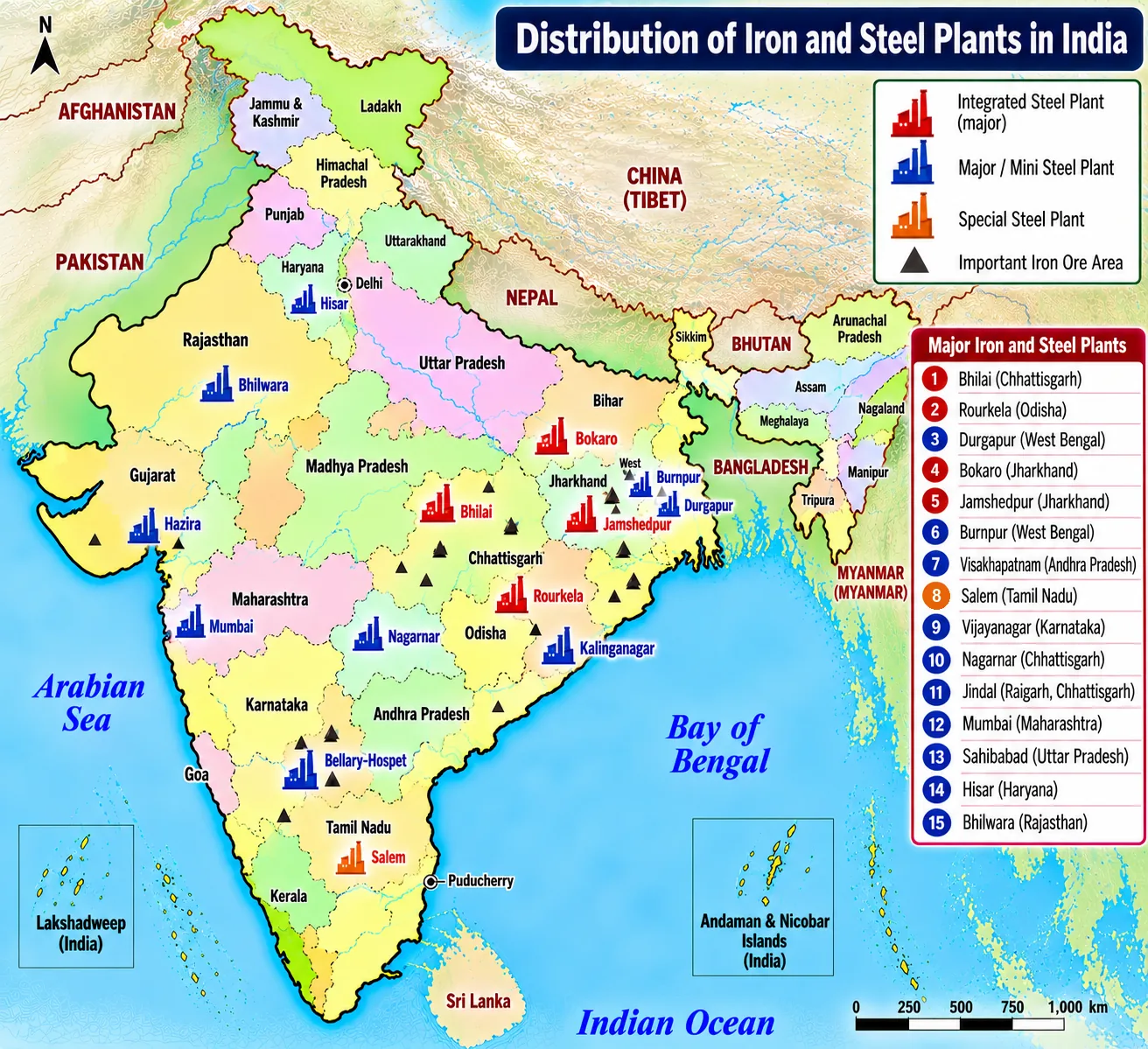
Steel is produced in integrated steel plants (handle everything from raw materials to steel shaping) and mini steel plants (smaller, using electric furnaces with steel scrap and sponge iron to make mild and alloy steel). India is now the world's second-largest producer of crude steel (after China), but per capita consumption is still low. Most public sector plants are marketed by the Steel Authority of India Limited (SAIL); TISCO is a major private company.
The plateau has most of the steel industries because of low-cost iron ore, high-grade raw materials close by, cheap labour, and vast growth potential in the home market. Plants: Jamshedpur (TISCO, 1907), Burnpur (IISCO), Durgapur (with British collaboration), Rourkela (German collaboration), Bhilai and Bokaro (Soviet collaboration). In the south: Visakhapatnam (Rashtriya Ispat Nigam — first coastal plant, with a port for export), Vijayanagar, Bhadravati and the special steel plant at Salem.
Aluminium smelting
The second most important metallurgical industry. Aluminium is light, corrosion-resistant, a good conductor and malleable — used in aircraft, utensils and wires; it often substitutes steel, copper, zinc and lead. Bauxite (a dark reddish clay) is the raw material. Regular supply of electricity and assured raw material at low cost are key location factors. Plants are in Odisha, West Bengal, Kerala, Uttar Pradesh, Chhattisgarh, Maharashtra and Tamil Nadu.
Chemical industries
One of the fastest-growing industries. Inorganic chemicals: sulphuric acid (for fertilisers, synthetic fibres, plastics, adhesives, paints, dyes), nitric acid, alkalis, soda ash and caustic soda (for glass, soaps, detergents, paper). Organic chemicals: petrochemicals used for synthetic fibres, rubber, plastics, dyes, drugs and pharmaceuticals — located near oil refineries. The chemical industry is its own largest consumer.
Fertilisers
Nitrogenous (mainly urea), phosphatic, ammonium phosphate (DAP) and complex fertilisers. India is a major producer of nitrogenous fertilisers. After the Green Revolution the industry expanded; Gujarat, Tamil Nadu, Uttar Pradesh, Punjab and Kerala produce about half the output.
Cement
Needs bulky, heavy raw materials — limestone, silica and gypsum — plus coal, power and rail transport. The first cement plant was set up in Chennai in 1904. Plants in Gujarat are located to access Gulf markets. India is the world's second-largest cement producer.
Automobiles and IT
Automobile hubs: Delhi–Gurugram, Mumbai, Pune, Chennai, Kolkata, Lucknow, Indore, Hyderabad, Jamshedpur and Bengaluru. Information technology and electronics: Bengaluru is called the electronic capital of India; Mumbai, Delhi, Hyderabad, Pune, Chennai, Kolkata, Lucknow and Coimbatore are other centres, supported by Software Technology Parks. The IT sector has created many jobs, including for women, and earns foreign exchange.
7. Industrial Pollution and Its Control
| Type | Sources | Effects |
|---|---|---|
| Air | Sulphur dioxide, carbon monoxide, smoke, dust from chemical and paper factories, brick kilns, refineries, smelters | Harms health, animals, plants, buildings; toxic gas leaks can be fatal |
| Water | Organic and inorganic effluents from paper, pulp, chemical, textile, dyeing, refineries, tanneries, electroplating; fly ash, phospho-gypsum, slag | Toxic rivers, harm to aquatic life and drinking water |
| Thermal | Hot water from factories and power plants | Kills aquatic organisms |
| Noise | Machines, generators, saws, drills | Hearing impairment, stress, high blood pressure |
| Land/soil | Dumping of waste, slag, glass, salts | Soil becomes useless; toxins seep into groundwater |
- Minimise water use and reuse and recycle water; harvest rainwater.
- Treat hot water and effluents before release (primary — mechanical; secondary — biological; tertiary — biological, chemical and physical).
- Control air pollution with smokestacks fitted with electrostatic precipitators, fabric filters, scrubbers and inertial separators; use oil or gas instead of coal.
- Reduce noise with silencers, sound-absorbing materials and ear protection.
- NTPC example: its Ramagundam plant gained ISO 14001 certification for environmental management — optimum use of equipment, minimal waste through ash utilisation, green belts and ecological monitoring.
8. Master Table: Key Terms
| Term | Meaning |
|---|---|
| Manufacturing | Processing raw materials into more valuable goods |
| Agglomeration economies | Benefits of industries clustering together |
| Basic industry | Supplies raw material/products to other industries |
| Integrated steel plant | Handles every stage from raw material to steel products |
| Mini steel plant | Uses scrap and sponge iron in electric furnaces |
| Pig iron | Iron from the blast furnace |
| Bagasse | Fibre left after crushing sugarcane |
| Petrochemicals | Chemicals made from crude oil |
| Electrostatic precipitator | Device that removes dust from smoke |
| SAIL | Steel Authority of India Limited |
| NMCC | National Manufacturing Competitiveness Council |
9. Master Summary Table
| Industry | Key location factor | Main centres |
|---|---|---|
| Cotton textiles | Raw cotton, port, market, humid climate | Mumbai, Ahmedabad, Coimbatore |
| Jute | Jute fields, water, Kolkata port | Hugli basin |
| Sugar | Near cane fields (sucrose loss) | UP, Maharashtra, Karnataka |
| Iron and steel | Ore, coal, limestone together | Chota Nagpur plateau, Visakhapatnam |
| Aluminium | Cheap electricity, bauxite | Odisha, Chhattisgarh |
| Cement | Limestone, rail, markets | MP, Rajasthan, AP, Gujarat |
| IT | Skilled people, infrastructure | Bengaluru, Hyderabad, Pune |
Chart — steel raw material ratio:
10. Mind Map
- Jobs, exports
- Helps agriculture
- Raw material, power
- Labour, market
- Cotton, jute
- Sugar
- Steel, aluminium
- Chemicals, cement
- Air, water, noise
- ESP, recycling, NTPC
11. Tips and Tricks
- Steel plant partners: Bhilai & Bokaro — Big Soviet brothers; Rourkela — Rhine (Germany); Durgapur — Dover (UK).
- First mills: cotton 1854 Mumbai; jute 1859 Rishra — "54 then 59".
- Steel ratio 4-2-1: ore, coal, limestone.
- Sugar mills locate near fields because cane loses sucrose, not because it is light.
- Mini steel plants use scrap and sponge iron, not iron ore directly.
- Aluminium plants need cheap power more than anything else.
12. Important One-liners
- The first cotton mill was set up in Mumbai in 1854.
- The first jute mill was at Rishra near Kolkata in 1859.
- Most jute mills lie along the Hugli.
- Sugar mills are shifting to Maharashtra and the south.
- Iron and steel is a basic industry.
- TISCO at Jamshedpur was founded in 1907.
- India is the second-largest producer of crude steel.
- Bhilai was built with Soviet help.
- The first cement plant came up in Chennai in 1904.
- Bengaluru is the electronic capital of India.
- Electrostatic precipitators reduce air pollution.
13. Previous-Year-Pattern Questions with Detailed Answers
Which is a basic industry?
- Sugar
- Iron and steel
- Toothpaste
- Sewing machines
Show answer
Iron and steel supplies raw material to other industries. Sugar, toothpaste and sewing machines are consumer industries.
Answer: (B)
The Rourkela steel plant was set up with the help of:
- USSR
- UK
- Germany
- USA
Show answer
Rourkela was built with German collaboration. Bhilai and Bokaro had Soviet help; Durgapur had British help.
Answer: (C)
What are agglomeration economies?
Show answer
Advantages industries get by locating near each other and near cities — shared transport, banking, insurance, markets, skilled labour and services.
Answer: Benefits of clustering
Why are most jute mills located along the Hugli?
Show answer
Jute-growing areas are close by; cheap water transport plus rail and road networks; plenty of water for processing raw jute; cheap labour from West Bengal and neighbouring States; and Kolkata provides banking, insurance and port facilities for export.
Answer: Raw material, water, transport, labour, Kolkata port
Why are sugar mills shifting to the southern and western States?
Show answer
Cane there has higher sucrose content; the cooler climate allows a longer crushing season; and cooperatives in Maharashtra and the south are more successful.
Answer: Higher sucrose, longer season, strong cooperatives
Distinguish between integrated and mini steel plants.
Show answer
Integrated plants are large and handle every stage — from putting raw materials together to making steel and shaping it. Mini plants are smaller, use electric furnaces with steel scrap and sponge iron, have re-rollers using steel ingots, and produce mild and alloy steel of given specifications.
Answer: Full process from ore vs small electric-furnace units
How are agriculture and industry interdependent?
Show answer
Agro-industries (textiles, sugar, oil, jute) use farm produce, giving farmers markets. Agriculture uses industrial products — irrigation pumps, fertilisers, pesticides, PVC pipes, machines and tools — that raise productivity. Growth in one supports the other.
Answer: Each supplies inputs or markets to the other
Why is the Chota Nagpur plateau the centre of India's iron and steel industry?
Show answer
It has rich deposits of high-grade iron ore, coking coal (Jharia, Raniganj, Bokaro), limestone, manganese and dolomite close together; cheap labour; good rail links; water from rivers like the Damodar and Subarnarekha; and access to Kolkata port and large markets. So plants at Jamshedpur, Bokaro, Durgapur, Burnpur, Rourkela and Bhilai cluster there.
Answer: All raw materials close together, plus labour and transport
Suggest measures to control industrial pollution of fresh water.
Show answer
Minimise water use and recycle it in stages; harvest rainwater; treat hot water and effluents before release through primary (screening, grinding, sedimentation), secondary (biological) and tertiary (biological, chemical and physical) treatment; regulate over-drawing of groundwater by industries.
Answer: Reduce, recycle, treat before discharge
What problems does the Indian iron and steel industry face?
Show answer
High cost and limited availability of coking coal (much is imported), lower labour productivity in older plants, irregular energy supply, poor infrastructure in some areas, and competition from cheaper imports. Liberalisation and private investment, modernisation and R&D have helped, but more efficient and greener technology is needed.
Answer: Coking coal, productivity, power, infrastructure
How did NTPC show that industry can protect the environment?
Show answer
NTPC adopted optimum use of equipment with latest technology, minimised waste by using fly ash, built green belts for ecological balance, reduced pollution through ash pond management and liquid waste control, and monitored ecology; its Ramagundam plant got ISO 14001 certification for environmental management.
Answer: Technology, waste use, green belts, monitoring
14. Quick Revision Summary
- Manufacturing: jobs, exports, links with agriculture; ~17% of GDP; NMCC, Make in India.
- Location: raw material, labour, capital, power, market; agglomeration economies.
- Classification: raw material, role, capital, ownership, bulk.
- Agro: cotton (Mumbai 1854), jute (Rishra 1859, Hugli), sugar (shifting south).
- Mineral: iron and steel (4:2:1, Chota Nagpur, SAIL, 2nd largest producer), aluminium, chemicals, fertilisers, cement (Chennai 1904), automobiles, IT (Bengaluru).
- Pollution: air, water, thermal, noise, land; treatment, ESPs, NTPC example.