
1. Chapter at a Glance
An electric bell rings, a crane lifts scrap iron, an iron presses clothes and a heater warms a room — all using electricity. When electric current flows through a wire, it produces two important effects: the wire behaves like a magnet (magnetic effect) and the wire gets hot (heating effect). This chapter explores both effects and their uses, safety devices like fuses and MCBs, and how cells and batteries produce electricity from chemicals.
- Magnetic effect of current — compass deflection; electromagnets and their uses.
- Heating effect of current — heaters, irons, bulbs; factors affecting heating.
- Electric fuse and MCB — safety against overloading and short circuits.
- How a cell generates electricity — voltaic cell, dry cell, batteries.
2. Does an Electric Current Have a Magnetic Effect?
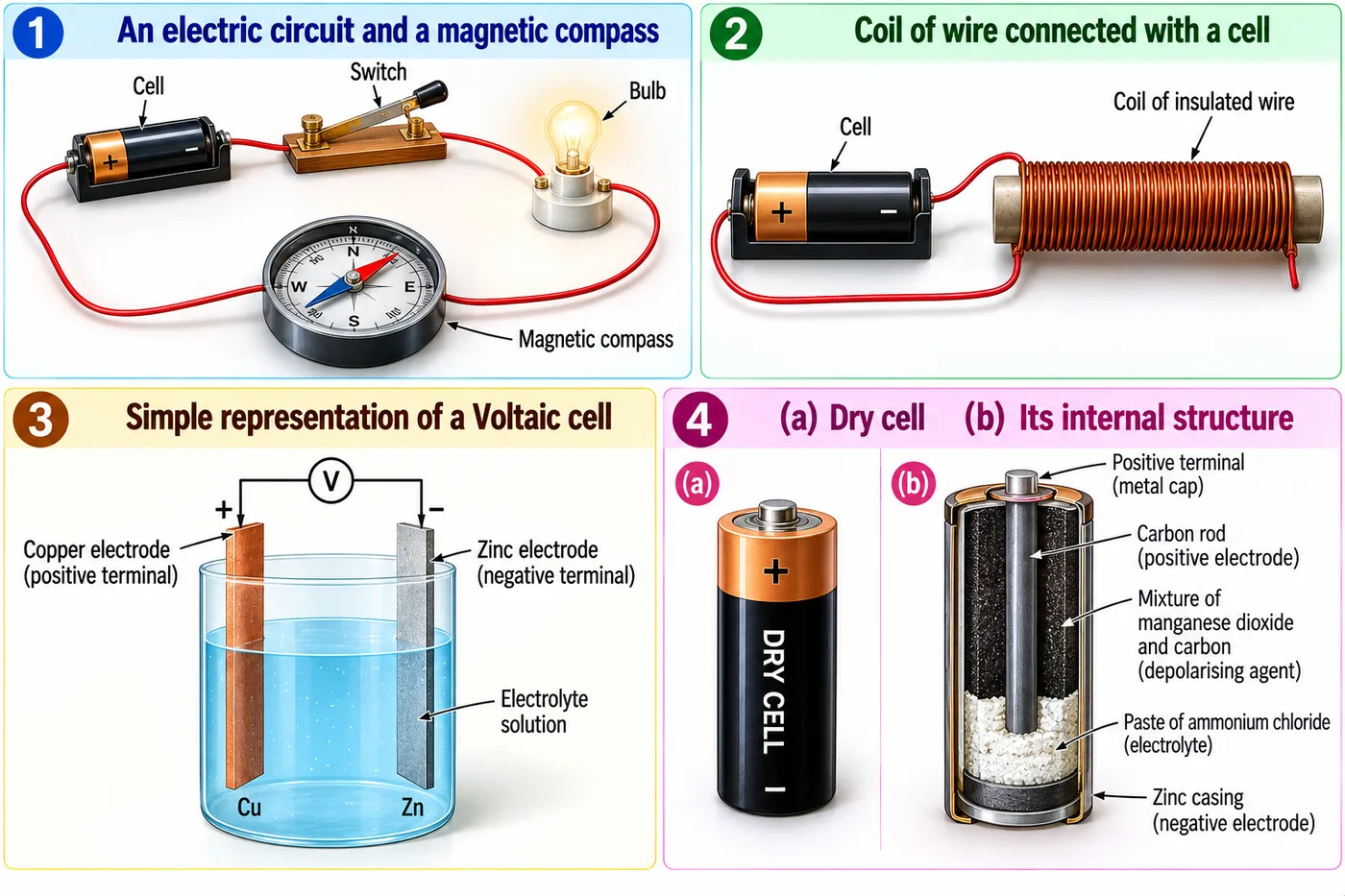
Place a magnetic compass under a straight wire connected to a cell through a switch. When the switch is ON, the compass needle deflects; when it is OFF, the needle returns to north–south. Reversing the current deflects the needle the other way. So a current-carrying wire behaves like a magnet. This was discovered by Hans Christian Oersted in 1820.
Electromagnet
Wind an insulated copper wire many times around an iron nail (to make a coil) and connect its ends to a cell. The nail now attracts pins and clips. Switch off the current — the pins fall. Such a temporary magnet made by passing current through a coil around a soft iron core is an electromagnet.
| Feature | Electromagnet | Permanent magnet |
|---|---|---|
| Magnetism | Only while current flows | Always |
| Strength | Can be increased (more turns, more current) | Fixed |
| Poles | Can be reversed by reversing current | Fixed |
Strength of an electromagnet increases with more turns of the coil, more current (more cells) and a soft iron core.
Uses: cranes lifting scrap iron; electric bells; separating iron from waste; loudspeakers, motors, MRI machines; doctors use small electromagnets to remove iron particles from the eye.
3. Does a Current-carrying Wire Get Hot?
Connect a thin wire (like a nichrome wire) to a cell for a few seconds and touch it carefully — it becomes warm. When current flows through a wire, the wire gets heated. This is the heating effect of electric current.
- The amount of heat depends on the material, length and thickness of the wire and on the current and the time for which it flows.
- Nichrome (an alloy of nickel and chromium) heats up a lot and does not melt easily, so it is used in heating elements of electric irons, room heaters, toasters, kettles and geysers.
- In an incandescent bulb, a tungsten filament gets so hot that it glows and gives light — but much energy is wasted as heat. LED bulbs and tube lights waste less energy.
Heating is unwanted in electric wires, motors, computers and phones. Overloaded wires can overheat, melt their insulation and cause fires.
4. Safety Devices — Fuse and MCB
An electric fuse is a safety device containing a short, thin wire of a material with a low melting point. If too much current flows (because of overloading — too many appliances on one socket — or a short circuit — live and neutral wires touching), the fuse wire heats up, melts and breaks the circuit, preventing fire and damage.
Modern homes use MCBs (miniature circuit breakers) — switches that automatically turn off when current exceeds a safe limit; they can simply be switched on again after the fault is fixed.
- Never replace a fuse wire with a thicker wire or a copper wire.
- Use appliances and wires with the ISI mark.
- Do not overload sockets with many plugs.
- Switch off the main supply before any repair; never touch switches with wet hands.
5. How Does a Battery Generate Electricity?
In 1800, Alessandro Volta made the first battery. A voltaic cell has two different metals — copper (positive terminal) and zinc (negative terminal) — dipped in a solution called an electrolyte (such as dilute acid or salt solution). A chemical reaction between the zinc and the electrolyte produces electricity, which flows through a wire connected outside. You can even make a simple cell with a lemon or potato and two different metal strips — it can light a small LED.
A dry cell, used in torches and remote controls, has:
- a zinc container — the negative terminal;
- a carbon (graphite) rod with a metal cap in the centre — the positive terminal;
- a moist paste of ammonium chloride as the electrolyte, with a mixture of manganese dioxide and carbon around the rod.
A dry cell gives about 1.5 volts. Joining cells in a series makes a battery with a higher voltage. When the chemicals are used up, the cell stops working. Rechargeable batteries (in mobiles, laptops and electric vehicles) can be recharged many times. Used cells must be disposed of properly, as they contain harmful chemicals.
6. Master Table: Key Terms
| Term | Meaning |
|---|---|
| Magnetic effect | Current-carrying wire behaves like a magnet (Oersted, 1820) |
| Electromagnet | Coil + soft iron core; magnet only while current flows |
| Heating effect | Wire gets hot when current flows |
| Nichrome | Alloy used in heating elements |
| Fuse | Low-melting-point wire that breaks circuit on excess current |
| MCB | Automatic switch that trips on excess current |
| Short circuit | Live and neutral wires touch; huge current |
| Electrolyte | Solution/paste in which the cell’s reaction occurs |
| Dry cell | Zinc case (−), carbon rod (+), ammonium chloride paste; ~1.5 V |
7. Master Summary Table
| Effect | Desirable use | Undesirable result |
|---|---|---|
| Magnetic | Cranes, bells, motors | Can disturb compasses near wires |
| Heating | Iron, heater, kettle, fuse | Energy loss, overheating, fires |
| Chemical (in cells) | Portable electricity | Harmful waste if thrown carelessly |
Chart — what makes an electromagnet stronger (qualitative):
8. Mind Map
- Compass deflects
- Electromagnet, uses
- Nichrome, filament
- Iron, heater
- Fuse, MCB
- ISI mark, no overload
- Voltaic cell
- Dry cell, battery
9. Tips and Tricks
- Electromagnet strength: “More Turns, More Current, Iron Core”.
- Dry cell: Zinc = Zero (negative), Carbon = Cap (positive).
- Fuse rule: “weakest link melts first” — a fuse wire has a low melting point so it breaks before wiring overheats.
- Saying an electromagnet stays a magnet after switching off.
- Using a thick copper wire as fuse — it will not melt and gives no protection.
- Calling the carbon rod the negative terminal of a dry cell.
10. Important One-liners
- A current-carrying wire deflects a compass needle.
- Oersted discovered the magnetic effect of current.
- An electromagnet works only while current flows.
- More turns and more current make a stronger electromagnet.
- Heating elements are made of nichrome.
- A fuse wire melts when excess current flows.
- MCBs switch off automatically on overload.
- Volta made the first electric battery.
- In a dry cell, zinc is negative and the carbon rod is positive.
11. Exam-pattern Questions with Detailed Answers
The heating element of an electric iron is made of:
- Copper
- Nichrome
- Aluminium
- Iron
Show answer
Nichrome heats up strongly without melting or oxidising easily; copper and aluminium are used for connecting wires.
Answer: (B) Nichrome
What happens to a compass needle placed near a wire carrying current?
Show answer
It deflects, because the current produces a magnetic effect around the wire.
Answer: It deflects
Name the negative terminal of a dry cell.
Show answer
The zinc container is the negative terminal; the carbon rod with metal cap is positive.
Answer: Zinc container
How can the strength of an electromagnet be increased?
Show answer
By increasing the number of turns in the coil, increasing the current (more cells) and using a soft iron core.
Answer: More turns, more current, iron core
Why are electromagnets used in cranes instead of permanent magnets?
Show answer
An electromagnet can be switched on to lift scrap iron and switched off to drop it at the desired place. Its strength can be made very large. A permanent magnet cannot release the load easily.
Answer: Can be switched on and off; very strong
What is a short circuit? How does a fuse protect a house during one?
Show answer
A short circuit occurs when live and neutral wires touch directly, causing a very large current. The fuse wire, having a low melting point, heats up, melts and breaks the circuit, stopping the current before wires overheat and cause fire.
Answer: Fuse melts and breaks circuit
Why are LED bulbs better than incandescent bulbs?
Show answer
Incandescent bulbs give light by heating a filament, wasting most energy as heat. LEDs convert more electricity into light, use less power, stay cool and last longer.
Answer: Less heat waste, energy-efficient
Describe a voltaic cell.
Show answer
Two different metals — copper (positive) and zinc (negative) — dipped in an electrolyte such as dilute acid. A chemical reaction produces electricity that flows through an external wire connecting the metals.
Answer: Cu and Zn in an electrolyte; chemical reaction gives current
An electrician replaces a blown fuse with a thick copper wire. Why is this dangerous?
Show answer
Copper has a high melting point and a thick wire will not melt even when excess current flows. During overloading or short circuit, current will keep flowing, wires and appliances can overheat, and a fire may start. The safety function of the fuse is lost.
Answer: It will not melt — no protection
When the direction of current in a wire is reversed, the compass needle deflects the other way. What does this tell you?
Show answer
The magnetic effect has a direction that depends on the direction of current. Reversing current reverses the magnetic effect (and the poles of an electromagnet).
Answer: Direction of magnetic effect depends on current direction
Why must used cells and batteries not be thrown in ordinary garbage?
Show answer
They contain chemicals and metals (like zinc, manganese, and in some batteries lead, mercury or lithium) that can leak into soil and water, harming living things. They should be given to e-waste collection centres for safe recycling.
Answer: Harmful chemicals pollute soil and water
12. Quick Revision Summary
- Current produces a magnetic effect (Oersted): compass deflects; electromagnets — stronger with more turns, more current, iron core.
- Current produces heat: nichrome elements in irons and heaters; bulbs waste heat; LEDs save energy.
- Fuse (low melting point) and MCB protect against overloading and short circuits; use ISI-marked items.
- Voltaic cell: Cu (+), Zn (−) in electrolyte; dry cell: zinc case (−), carbon rod (+), ammonium chloride paste, ~1.5 V.
- Cells joined make a battery; dispose of them safely.