
1. Chapter at a Glance
Kicking a football, opening a door, squeezing a lemon, a magnet pulling a pin, an apple falling from a tree — in each case a force is at work. This chapter explains what a force is, what it can do, how forces always act in pairs between objects, the different types of forces (contact and non-contact), friction, weight and how it is measured with a spring balance, and why some objects float while others sink.
- Force as a push or pull; its magnitude, direction and SI unit (newton).
- Effects of force: change in speed, direction or shape.
- Forces arise from interactions; net force when several forces act.
- Contact forces (muscular, friction, normal) and non-contact forces (magnetic, electrostatic, gravitational).
- Weight, mass and the spring balance; floating, sinking and buoyant force.
2. What Is a Force?
A force is a push or a pull on an object. A force always has a magnitude (how strong) and a direction. The SI unit of force is the newton (N). A force is shown by an arrow: the arrow points in the direction of the force, and its length shows its strength.
3. What Can a Force Do?
- Move a stationary object — pushing a box.
- Stop a moving object — a goalkeeper catching a ball.
- Change speed — pedalling harder makes a cycle go faster; brakes slow it.
- Change direction — a batter hits a ball back.
- Change shape — pressing clay, stretching a rubber band, squeezing a sponge.
Sometimes a force is applied but nothing moves — pushing a wall. The wall does not move because other forces balance our push.
4. Forces Are Interactions
A force arises only when two objects interact. When you push a wall, the wall also pushes you back. When a boat is rowed, the oars push water backwards and water pushes the boat forward. Forces always act in pairs, on two different objects.
When several forces act on one object, they combine into a net force:
- Forces in the same direction add up (two people pushing a car together).
- Forces in opposite directions subtract; the object moves in the direction of the larger force (tug of war).
- If opposite forces are equal, the net force is zero — the forces are balanced and the motion does not change.
Team A pulls a rope with 500 N to the left; Team B pulls with 450 N to the right. Net force = 500 − 450 = 50 N to the left, so the rope moves left. If A pulls 300 N and B pulls 200 N in the same direction on a cart, net force = 500 N.
5. Types of Forces
Contact forces — act only when objects touch
- Muscular force — by our muscles (lifting, walking, bullocks pulling carts).
- Friction — opposes motion between two surfaces in contact.
- Normal force — push of a surface on an object resting on it (the table holding up a book).
Non-contact forces — act from a distance
- Magnetic force — a magnet attracts iron or repels another magnet without touching.
- Electrostatic force — a comb rubbed on dry hair attracts bits of paper (charged objects attract or repel).
- Gravitational force (gravity) — every object attracts every other object; the Earth pulls everything towards its centre, so objects fall and we stay on the ground.
6. Friction
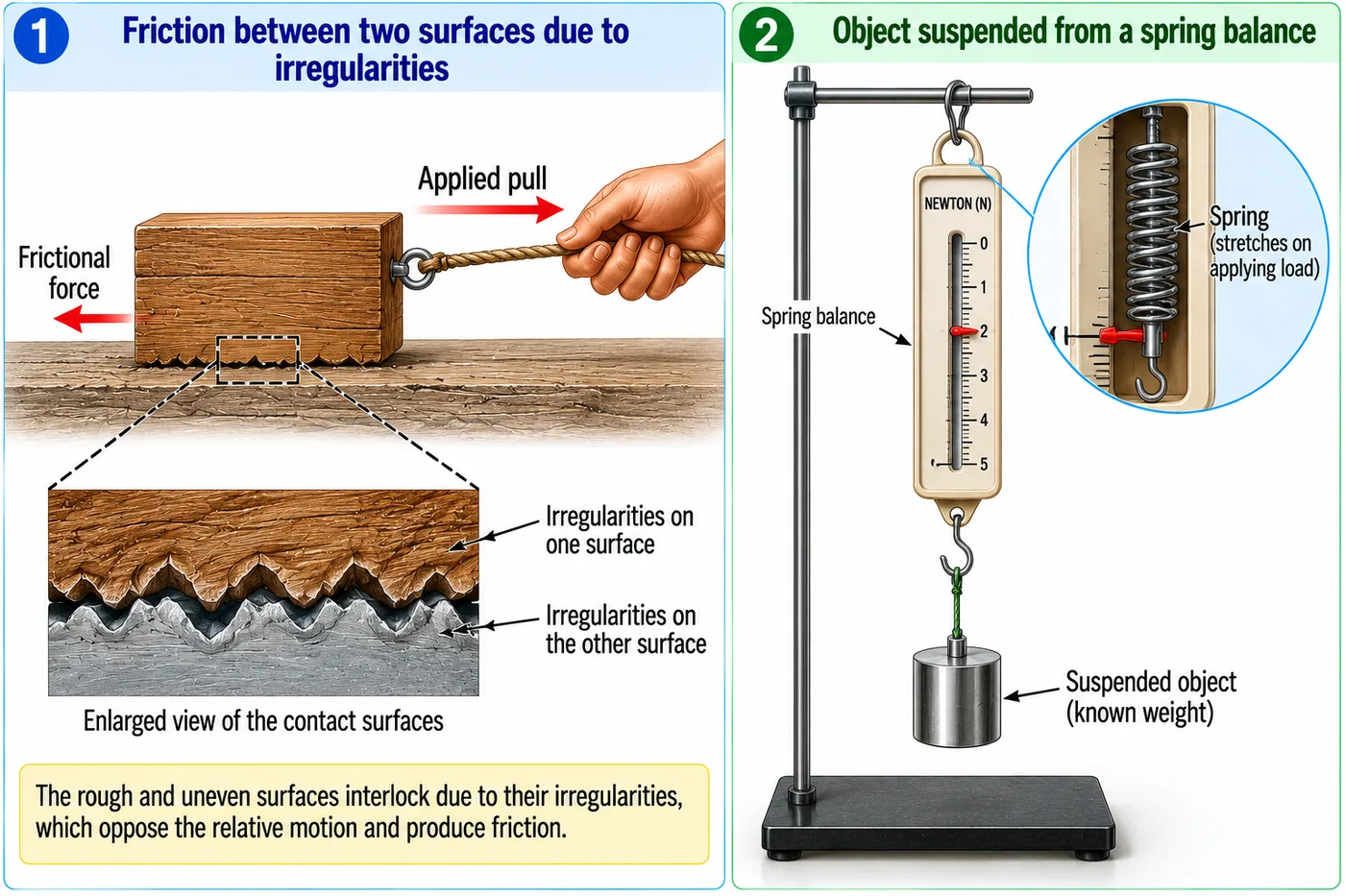
Friction is the force that opposes the relative motion between two surfaces in contact. It acts opposite to the direction of motion. It arises because even smooth-looking surfaces have tiny irregularities that lock into each other.
- Rough surfaces → more friction; smooth surfaces → less friction.
- Friction is greater when the surfaces are pressed together harder.
- Useful: lets us walk, write, hold things, brake vehicles, light a matchstick.
- Harmful: wears out shoes, tyres and machine parts; wastes energy as heat.
- Reduce: lubricants (oil, grease), ball bearings, polishing, streamlined shapes. Increase: treads on tyres and shoe soles, sand on slippery roads.
7. Weight and Its Measurement
The weight of an object is the force with which the Earth pulls it towards its centre. Since weight is a force, it is measured in newtons with a spring balance. The spring stretches more for a heavier object, and a pointer shows the reading on a scale.
| Mass | Weight |
|---|---|
| Amount of matter in an object | Force of gravity on the object |
| Measured in kilogram (kg) with a beam balance | Measured in newton (N) with a spring balance |
| Same everywhere | Changes with place (less on the Moon) |
On the Earth, a mass of 1 kg weighs about 9.8 N (roughly 10 N). On the Moon, gravity is about one-sixth of the Earth’s, so the same object weighs about one-sixth as much, though its mass is unchanged.
A bag has a mass of 6 kg. Weight on Earth ≈ 6 × 9.8 = 58.8 N. Weight on the Moon ≈ 58.8 ÷ 6 = 9.8 N. Its mass stays 6 kg in both places.
8. Floating and Sinking
Push an empty plastic bottle into water — you feel water pushing it up. This upward force exerted by a liquid on an object immersed in it is the buoyant force (upthrust).
- If the buoyant force can balance the object’s weight, the object floats (wood, a ship, ice).
- If the weight is greater than the largest buoyant force possible, the object sinks (a stone, an iron nail).
- Objects that are lighter for their size than water (less dense) float; you will learn about density in Chapter 9.
9. Master Table: Key Terms and Formulas
| Term | Meaning / formula |
|---|---|
| Force | Push or pull; SI unit newton (N) |
| Net force (same direction) | F₁ + F₂ |
| Net force (opposite directions) | Larger − smaller, in direction of larger |
| Friction | Opposes relative motion of surfaces in contact |
| Weight | Force of gravity; ≈ mass (kg) × 9.8 N |
| Weight on Moon | ≈ 1/6 of weight on Earth |
| Buoyant force | Upward force of a liquid on an immersed object |
10. Master Summary Table
| Force | Contact / non-contact | Example |
|---|---|---|
| Muscular | Contact | Lifting a bag |
| Friction | Contact | Rolling ball slows down |
| Normal | Contact | Table supporting a book |
| Magnetic | Non-contact | Magnet pulls a pin |
| Electrostatic | Non-contact | Charged comb lifts paper |
| Gravitational | Non-contact | Fruit falls to the ground |
11. Mind Map
- Push or pull, newton
- Speed, direction, shape
- Muscular, friction
- Normal force
- Magnetic, electrostatic
- Gravity
- Spring balance
- Buoyant force
12. Tips and Tricks
- Non-contact forces: “MEG” — Magnetic, Electrostatic, Gravitational.
- Mass in kg on a beam balance; weight in N on a spring balance.
- Friction always points opposite to motion (or attempted motion).
- Saying “my weight is 40 kg” in science — that is mass; weight is about 392 N.
- Thinking friction is always harmful.
- Saying force is needed to keep an object moving on a frictionless surface — it is needed only to change motion.
13. Important One-liners
- A force is a push or a pull.
- The SI unit of force is the newton.
- A force can change speed, direction or shape.
- Forces arise from interactions and act in pairs.
- Friction opposes motion between surfaces.
- Gravity, magnetic and electrostatic forces act without contact.
- Weight is measured with a spring balance.
- Weight on the Moon is about one-sixth of that on Earth.
- An object floats when buoyant force balances its weight.
14. Exam-pattern Questions with Detailed Answers
Which of these is a non-contact force?
- Friction
- Muscular force
- Gravitational force
- Normal force
Show answer
Gravity acts without contact; the others need touching surfaces.
Answer: (C) Gravitational force
Name the instrument used to measure weight.
Show answer
A spring balance measures force, including weight, in newtons.
Answer: Spring balance
Give two effects of force with examples.
Show answer
Change of shape — pressing a ball of dough flattens it. Change of direction — a bat hitting a ball sends it back.
Answer: Change of shape; change of direction
Two forces of 30 N and 20 N act on a box in opposite directions. Find the net force and the direction of motion.
Show answer
Net force = 30 − 20 = 10 N, in the direction of the 30 N force; the box moves that way.
Answer: 10 N towards the larger force
Why do tyres and shoe soles have grooves (treads)?
Show answer
Treads increase friction and grip with the ground, preventing slipping, especially on wet surfaces.
Answer: To increase friction and grip
An astronaut has a mass of 60 kg. What are her mass and approximate weight on the Moon? (Take g on Earth ≈ 10 N per kg.)
Show answer
Mass stays 60 kg. Weight on Earth ≈ 600 N; on the Moon ≈ 600 ÷ 6 = 100 N.
Answer: 60 kg; about 100 N
Why does a comb rubbed in dry hair attract small pieces of paper?
Show answer
Rubbing charges the comb with static electricity. The charged comb exerts an electrostatic force, a non-contact force, on the paper bits and attracts them.
Answer: Electrostatic force from a charged comb
List two ways to reduce friction in machines.
Show answer
Using lubricants such as oil and grease; using ball bearings between moving parts; polishing surfaces.
Answer: Lubricants, ball bearings
A heavy box is pushed but does not move. Is any force acting? Explain using the idea of balanced forces.
Show answer
Yes. Our push acts forward, and friction from the floor acts backward with an equal force. The forces are balanced, so the net force is zero and the box stays at rest. If we push harder than the maximum friction, it starts moving.
Answer: Push is balanced by friction; net force zero
A ship made of iron floats, but an iron nail sinks. Explain.
Show answer
The ship is hollow and pushes aside a very large volume of water, so the buoyant force on it is large enough to balance its weight. A solid nail pushes aside only a tiny volume of water; the buoyant force is less than its weight, so it sinks.
Answer: Hollow shape gives large buoyant force
While rowing, the oar pushes water backwards. Why does the boat move forward?
Show answer
Forces act in pairs. When the oar pushes water backwards, the water pushes the oar (and boat) forwards with an equal force in the opposite direction, so the boat moves forward.
Answer: Water pushes back on the oar — paired forces
15. Quick Revision Summary
- Force: push or pull, unit newton; changes speed, direction or shape.
- Forces arise from interactions, act in pairs; net force adds or subtracts.
- Contact: muscular, friction, normal. Non-contact: magnetic, electrostatic, gravity.
- Friction opposes motion; increase with treads, reduce with lubricants and bearings.
- Weight = gravity’s pull (N), measured by a spring balance; Moon weight ≈ 1/6; buoyant force decides floating or sinking.