
1. Chapter at a Glance
Why does a sharp knife cut better than a blunt one? Why are dam walls thicker at the bottom? Why do winds blow, and how do thunderstorms and cyclones form? The answer begins with one idea — pressure. This chapter explains pressure in solids, liquids and air, how differences in air pressure create winds, and how thunderstorms, lightning and cyclones form, along with the safety measures that save lives.
- Pressure = force ÷ area; its SI unit pascal.
- Pressure in liquids increases with depth; liquids push in all directions.
- Air exerts pressure; high-speed air has lower pressure.
- Winds blow from high pressure to low pressure; uneven heating of the Earth.
- Thunderstorms, lightning, cyclones — formation, effects and safety.
2. Pressure: Definition and Examples
Pressure is the force acting on a unit area of a surface.
Pressure = Force ÷ Area on which it acts
The SI unit of pressure is the pascal (Pa); 1 Pa = 1 N/m². For the same force, a smaller area gives greater pressure.
- Knives and needles have sharp edges and points — small area, large pressure, easy cutting.
- School bags have broad straps — large area, less pressure on shoulders.
- Heavy trucks and tractors have wide tyres; camels have broad feet for walking on sand.
- It is easier to push a pin with a pointed end than with its flat head.
A box weighing 200 N rests on a face of area 0.5 m². Pressure = 200 ÷ 0.5 = 400 Pa. If it rests on a smaller face of area 0.1 m², pressure = 200 ÷ 0.1 = 2000 Pa — five times more.
3. Pressure Exerted by Liquids
- Liquids exert pressure on the bottom and the walls of their container.
- Liquid pressure increases with depth: in a bottle with holes at different heights, water spurts farthest from the lowest hole.
- At the same depth, a liquid exerts equal pressure in all directions.
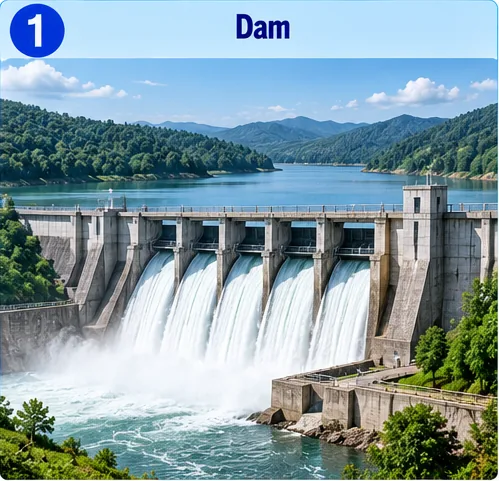
That is why dam walls are made thicker at the bottom — to withstand the much greater water pressure at depth. Deep-sea divers wear special suits for the same reason.
4. Pressure Exerted by Air
Air has weight and presses on everything around us — this is atmospheric pressure. We do not feel crushed because the pressure inside our bodies balances it.
- A rubber sucker sticks to a smooth surface when air is pressed out from under it — the outside air pressure holds it.
- Drinking through a straw: sucking lowers the air pressure inside the straw, and atmospheric pressure pushes the liquid up.
- Air pressure decreases with height — climbers find it harder to breathe on high mountains.
High-speed winds and air pressure
Blow air over the top of a strip of paper held below your lips — the paper rises. Fast-moving air has lower pressure. During storms, high-speed winds above a roof lower the pressure over it, while normal pressure below pushes the roof up — so weak roofs can be blown off.
5. Formation of Wind
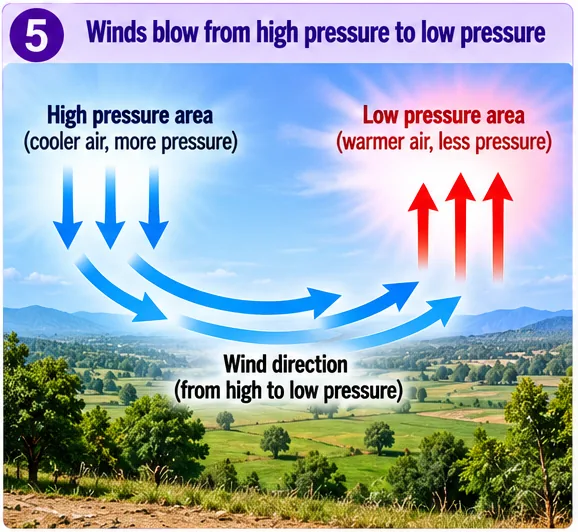
Wind is moving air. Air always moves from a region of higher pressure to a region of lower pressure. The greater the pressure difference, the faster the wind.
Pressure differences arise mainly from uneven heating of the Earth. Warm air expands, becomes lighter and rises, leaving low pressure below; cooler, heavier air from surrounding high-pressure regions flows in.
- Land and sea breezes — daily differences in heating of land and water.
- Monsoon winds — in summer, land in India heats strongly, forming low pressure; moist winds from the oceans blow towards it and bring rain.
- Heated air near the equator rises; cooler air from the poles moves towards it, creating global wind patterns.
6. Thunderstorms and Lightning
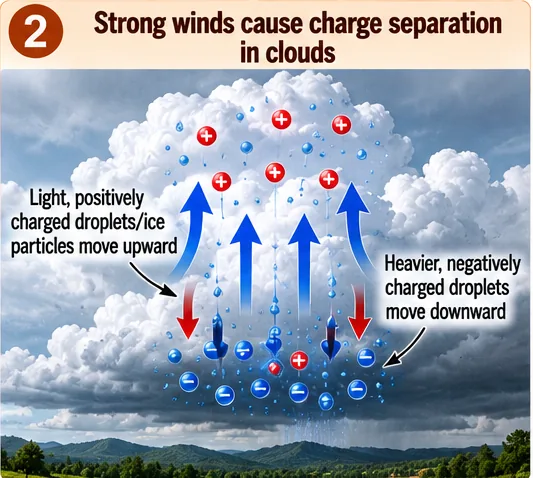
In hot, humid weather, warm moist air rises rapidly, cools and forms tall clouds. Strong upward winds and falling raindrops or ice particles rub against one another, and electric charges separate: lighter, positively charged particles collect at the top of the cloud, and heavier negatively charged ones near the bottom.
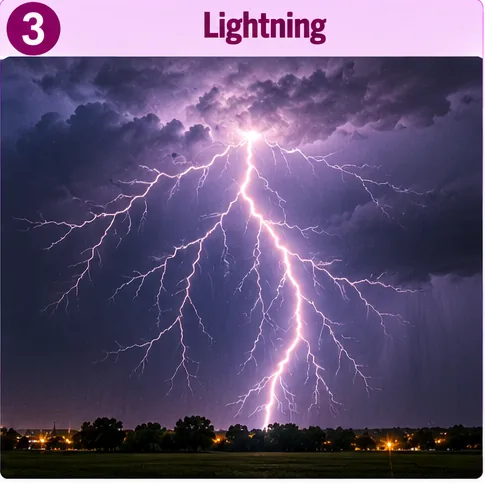
When the accumulated charge becomes very large, the air can no longer prevent its flow, and a huge spark jumps between clouds or between a cloud and the ground — lightning. It heats the air enormously, making it expand suddenly and produce the sound of thunder. We see the flash before we hear the thunder because light travels much faster than sound.
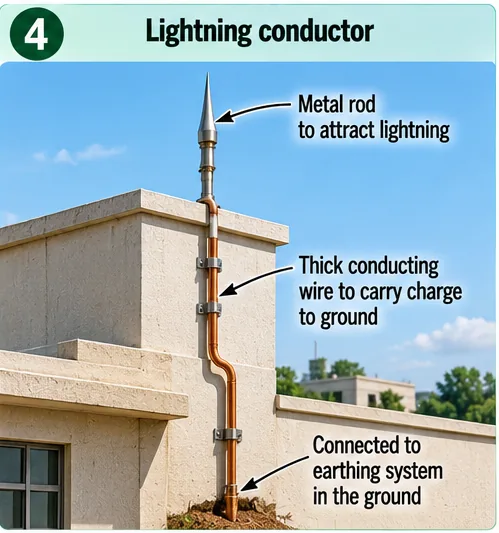
- Stay indoors or inside a closed car or bus; avoid open fields, tall trees, poles and water bodies.
- If caught outside, squat low on the balls of your feet with head tucked; do not lie flat.
- Do not use corded phones or touch electrical wiring and taps; unplug appliances.
- Tall buildings use lightning conductors — metal rods connected by thick wire to the earth.
7. Cyclones: Formation and Effects
Over warm tropical seas (surface water above about 26 °C), warm moist air rises rapidly. As water vapour condenses into clouds, it releases heat, which warms the air further and makes it rise even faster. Air rushes in towards the low-pressure centre from all sides and begins to spin. This huge, rotating system of very strong winds, heavy rain and thunderstorms is a cyclone. Its calm centre is the eye.
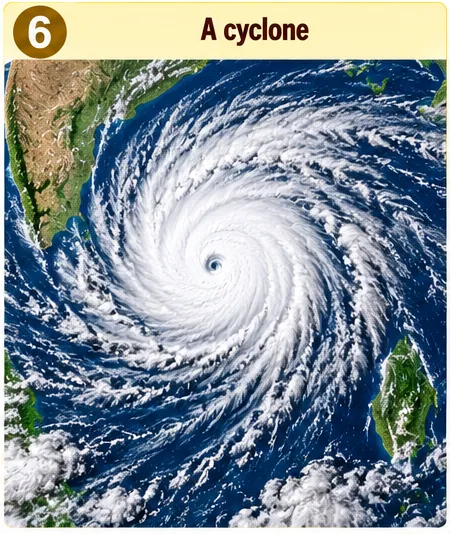
- Effects: destructive winds, very heavy rain and floods, high storm surges (sea water flooding coasts), damage to houses, crops, power lines and loss of life.
- Similar storms are called hurricanes (Atlantic) and typhoons (Pacific).
- India’s east coast (Odisha, Andhra Pradesh, Tamil Nadu, West Bengal) faces more cyclones from the Bay of Bengal.
The India Meteorological Department (IMD) tracks cyclones with satellites and radar and issues early warnings. People should follow warnings, move to cyclone shelters, store water, food and medicines, keep a battery radio, and avoid going to the sea. Planting mangroves and trees along coasts reduces damage.
8. Master Table: Formulas and Key Terms
| Term | Meaning / formula |
|---|---|
| Pressure | Force ÷ Area; SI unit pascal (Pa) = N/m² |
| Liquid pressure | Increases with depth; acts in all directions |
| Atmospheric pressure | Pressure exerted by the air around us |
| Wind | Moving air, from high to low pressure |
| Fast-moving air | Has lower pressure |
| Lightning | Electric discharge between charged clouds or cloud and ground |
| Cyclone | Rotating storm around a low-pressure centre (eye) |
| Lightning conductor | Metal rod and wire carrying charge to the earth |
9. Master Summary Table
| Situation | Pressure idea |
|---|---|
| Sharp knife cuts easily | Small area → large pressure |
| Wide straps on bags | Large area → small pressure |
| Dam wall thick at base | Liquid pressure increases with depth |
| Drinking with a straw | Atmospheric pressure pushes liquid up |
| Roof blown off in storm | Fast wind above → low pressure |
| Monsoon winds | Air moves to low pressure over hot land |
10. Mind Map
- Force ÷ area, pascal
- Sharp vs broad
- Depth increases pressure
- Atmospheric pressure
- High → low pressure
- Uneven heating, monsoon
- Lightning, thunder
- Cyclones, safety
11. Tips and Tricks
- “Less area, more pressure” — think of a nail’s tip.
- Wind direction: always “High to Low”, like water flowing downhill.
- Flash first, then thunder — count seconds × ~1/3 ≈ distance in km.
- Thinking pressure and force are the same — pressure depends on area.
- Saying fast-moving air has higher pressure — it has lower pressure.
- Sheltering under a tall tree during lightning — very dangerous.
12. Important One-liners
- Pressure is force per unit area.
- The SI unit of pressure is the pascal.
- Liquid pressure increases with depth.
- Air exerts pressure in all directions.
- Wind blows from high to low pressure.
- Fast-moving air has low pressure.
- Lightning is an electric discharge between clouds or cloud and ground.
- Lightning conductors protect tall buildings.
- Cyclones form over warm seas around a low-pressure centre called the eye.
- IMD issues cyclone warnings in India.
13. Exam-pattern Questions with Detailed Answers
The SI unit of pressure is:
- newton
- pascal
- joule
- watt
Show answer
Pressure is measured in pascal (N/m²). Newton is force, joule is energy, watt is power.
Answer: (B) pascal
Why are school bags given wide straps?
Show answer
Wide straps spread the weight over a larger area, reducing pressure on the shoulders.
Answer: Larger area, less pressure
In which direction does wind blow?
Show answer
From a region of high pressure to a region of low pressure.
Answer: High pressure → low pressure
A force of 60 N acts on an area of 0.2 m². Find the pressure.
Show answer
Pressure = 60 ÷ 0.2 = 300 Pa.
Answer: 300 Pa
Why are dam walls thicker at the bottom?
Show answer
Water pressure increases with depth, so the bottom of the wall faces the greatest pressure. A thicker base makes it strong enough not to break.
Answer: Water pressure is greatest at depth
Why do tin roofs sometimes get blown off during storms?
Show answer
Fast winds blowing over the roof lower the air pressure above it. The air below the roof is at normal (higher) pressure and pushes the roof upward; if not fixed firmly, it is lifted away.
Answer: Low pressure above, higher below
Why do we see the lightning flash before hearing the thunder?
Show answer
Both are produced at the same time, but light travels about a million times faster than sound, so the flash reaches us first.
Answer: Light is much faster than sound
How does a lightning conductor protect a building?
Show answer
A pointed metal rod on top is connected by a thick metal wire to a plate buried in the earth. If lightning strikes, the charge flows safely through the wire into the ground instead of through the building.
Answer: Carries charge safely to the earth
Explain how a cyclone forms over a warm sea.
Show answer
Warm sea water heats the air above it; moist warm air rises, creating low pressure. Water vapour condenses into clouds and releases heat, warming the air further so it rises faster. Surrounding air rushes in and starts spinning around the low-pressure centre (eye). This repeats, building a huge rotating storm with strong winds and heavy rain.
Answer: Warm moist air rises, heat of condensation fuels a spinning low-pressure system
A brick (weight 30 N) measures 0.2 m × 0.1 m × 0.05 m. Find the maximum and minimum pressure it can exert on the ground.
Show answer
Largest face = 0.2 × 0.1 = 0.02 m² → pressure = 30 ÷ 0.02 = 1500 Pa (minimum). Smallest face = 0.1 × 0.05 = 0.005 m² → pressure = 30 ÷ 0.005 = 6000 Pa (maximum).
Answer: Max 6000 Pa, min 1500 Pa
Suggest five precautions people in a coastal village should take when a cyclone warning is issued.
Show answer
Move to a cyclone shelter or strong building; store drinking water, dry food and medicines; keep important documents in waterproof bags; switch off electricity and gas; do not go to the sea; follow official IMD and local announcements on a battery radio.
Answer: Shelter, supplies, switch off power, avoid sea, follow warnings
14. Quick Revision Summary
- Pressure = force ÷ area (pascal); small area → large pressure.
- Liquid pressure increases with depth and acts in all directions; dams are thick at the base.
- Air exerts pressure; fast-moving air has low pressure.
- Wind: high → low pressure; caused by uneven heating; monsoons.
- Charge separation in clouds → lightning and thunder; use lightning conductors.
- Cyclones form over warm seas; follow IMD warnings and safety measures.