
1. Chapter at a Glance
Long before clocks and printed calendars, people kept time by watching the sky. The Sun marked days and seasons; the Moon’s changing shape marked months. Many Indian festivals are still fixed by the Moon’s phases. This chapter explains why the Moon’s appearance changes, how lunar, solar and lunisolar calendars came into existence, how festivals are linked to astronomy, and why we launch artificial satellites.
- Phases of the Moon — waxing and waning, new moon and full moon.
- Why the Moon rises about 50 minutes later each day.
- Lunar month and solar year; lunar, solar and lunisolar calendars; adhik maas; the Indian national calendar.
- Festivals and astronomical events; Uttarayan.
- Natural and artificial satellites; Indian satellites and their uses.
2. How and Why the Moon’s Appearance Changes
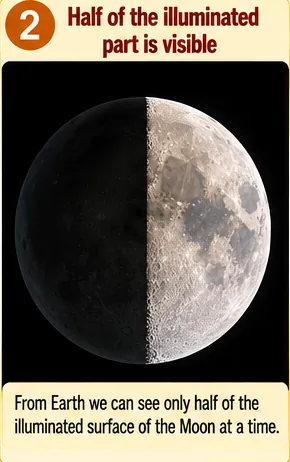
The Moon does not produce its own light; it reflects sunlight. At any time, the Sun lights up half of the Moon. As the Moon revolves around the Earth, we see different portions of this lit half — so the Moon appears to change shape. These shapes are called phases of the Moon.
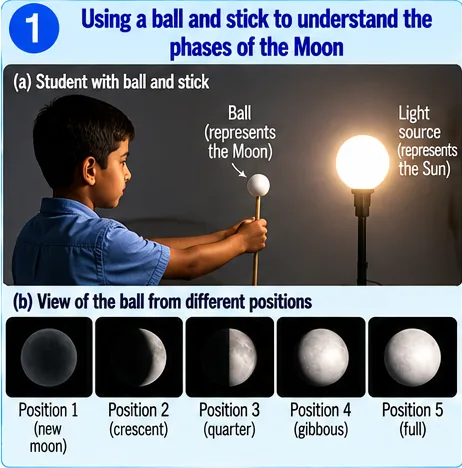
- New moon (amāvasyā) — Moon between Earth and Sun; its lit side faces away; the Moon is not visible.
- Waxing — the bright part grows night by night: crescent → first quarter (half) → gibbous.
- Full moon (pūrṇimā) — Earth between Sun and Moon (not in a straight line); the whole lit face is seen.
- Waning — the bright part shrinks: gibbous → last quarter → crescent → new moon.
The bright half is called śukla pakṣa (waxing fortnight) and the dark half kṛṣṇa pakṣa (waning fortnight). From one new moon to the next takes about 29.5 days — a lunar month.
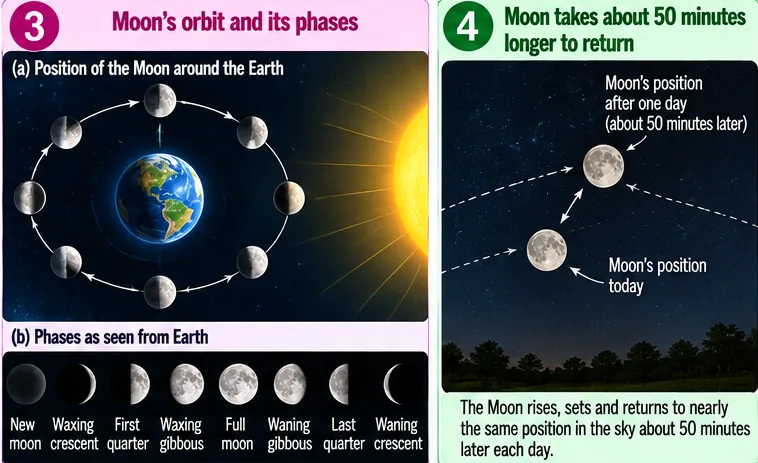
The Moon also moves eastward along its orbit by about 12–13° each day. So the Earth has to rotate a little extra for the Moon to come back to the same place in our sky — the Moon rises about 50 minutes later each day.
3. How Did Calendars Come into Existence?
A calendar organises days into months and years using repeating sky events.
| Calendar | Based on | Year length | Example |
|---|---|---|---|
| Lunar | Phases of the Moon; 12 lunar months | About 354 days | Islamic Hijri calendar |
| Solar | Earth’s revolution around the Sun; seasons | About 365¼ days | Gregorian calendar (with leap years) |
| Lunisolar | Months by the Moon, year kept in step with the Sun | Adjusted with an extra month | Many traditional Indian calendars (e.g. Vikram Samvat) |
Twelve lunar months fall about 11 days short of a solar year. In a purely lunar calendar, months slowly drift through the seasons — Ramzan, for example, comes about 11 days earlier each year. Farmers need calendars that match seasons, so lunisolar calendars add an extra month, called adhik māsa, roughly once every 2½–3 years (about 7 times in 19 years) to keep pace with the Sun.
India adopted the Indian National Calendar (based on the Śaka era) in 1957 for official use along with the Gregorian calendar. Its year begins on Chaitra 1, which normally falls on 22 March (21 March in a leap year).
4. Are Festivals Related to Astronomical Events?
- Diwali falls on the new moon (amāvasyā) of the month of Kārtika; Holi on the full moon of Phālguna; Buddha Pūrṇimā and Guru Pūrṇimā on full moons.
- Eid begins with the sighting of the new crescent Moon.
- Makar Sankranti is a solar festival (around 14 January), marking the Sun’s entry into the zodiac sign Makara; it falls on nearly the same Gregorian date every year. Pongal, Lohri and Bihu are also linked to the Sun’s yearly cycle and harvests.
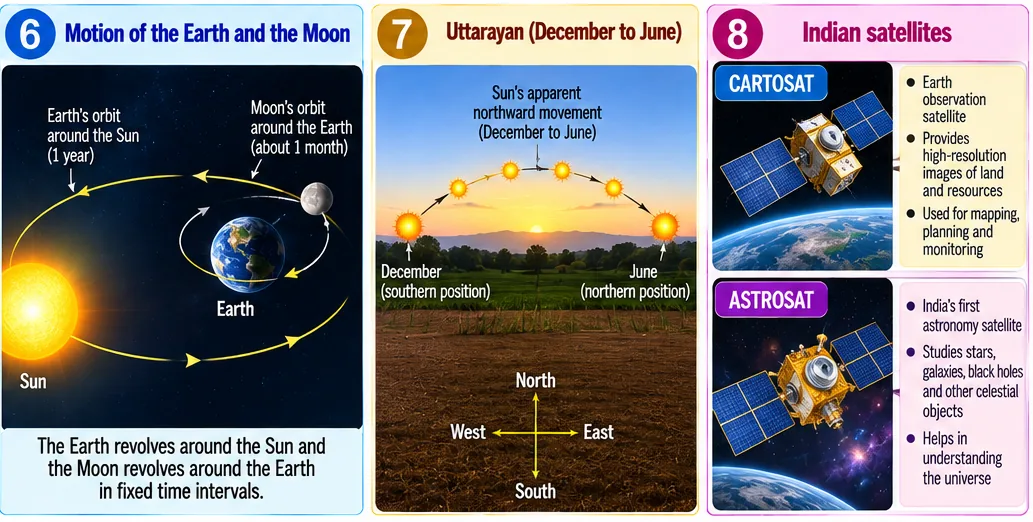
- Uttarāyaṇa: from the December solstice to the June solstice, the Sun’s rising point on the horizon appears to move northward; then it moves southward (dakṣiṇāyana).
Because lunar months and the solar year do not match exactly, Moon-based festivals shift by several days on the Gregorian calendar from year to year.
5. Moon, Earth and Eclipses
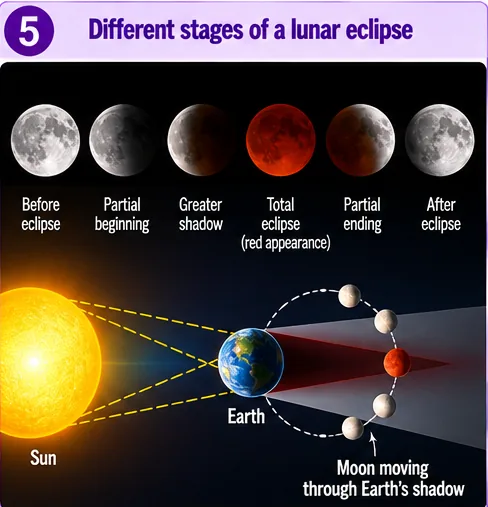
The Earth revolves around the Sun in about a year while the Moon revolves around the Earth in about a month. Occasionally, on a full moon, the Moon passes through the Earth’s shadow, causing a lunar eclipse; its stages are seen over a few hours, and during totality the Moon looks reddish.
6. Why Do We Launch Artificial Satellites?
A satellite is a body that revolves around another body. The Moon is the Earth’s natural satellite. Artificial satellites are human-made objects placed in orbit around the Earth by rockets. India’s space agency ISRO has launched many satellites.
| Use | What satellites do | Indian examples |
|---|---|---|
| Communication | TV, telephone, internet, DTH | INSAT and GSAT series |
| Weather and disaster warning | Track clouds, cyclones, rainfall | INSAT-3D series |
| Earth observation / mapping | High-resolution images for planning, crops, forests | CARTOSAT, RESOURCESAT |
| Navigation | Find location and direction | NavIC |
| Astronomy and space science | Study stars, galaxies, the Sun, Moon and Mars | ASTROSAT, Aditya-L1, Chandrayaan, Mars Orbiter Mission |
7. Master Table: Key Terms and Values
| Term | Meaning / value |
|---|---|
| Phases of the Moon | Changing shapes of the lit part we see |
| Lunar month | ≈ 29.5 days (new moon to new moon) |
| Lunar year | 12 lunar months ≈ 354 days |
| Solar year | ≈ 365¼ days |
| Adhik māsa | Extra lunar month added to keep pace with the solar year |
| Daily delay of moonrise | ≈ 50 minutes |
| Indian National Calendar | Śaka-based; adopted 1957; Chaitra 1 ≈ 22 March |
| Artificial satellite | Human-made object orbiting a planet |
8. Master Summary Table
| Phase | Moon’s position | Seen as | Festival example |
|---|---|---|---|
| New moon | Between Earth and Sun | Not visible | Diwali |
| First quarter | 90° from Sun (evening sky) | Right half bright (as seen from India) | — |
| Full moon | Opposite the Sun | Full disc | Holi, Buddha Pūrṇimā |
| Last quarter | 90° from Sun (morning sky) | Left half bright | — |
9. Mind Map
- Waxing, waning
- 29.5-day cycle
- Lunar, solar, lunisolar
- Adhik māsa, Śaka
- Diwali, Holi, Eid
- Makar Sankranti, Uttarāyaṇa
- Natural: Moon
- Artificial: ISRO
10. Tips and Tricks
- Lunar year is 11 days shorter than solar year — key to all calendar questions.
- New moon = Moon near the Sun in the sky; full moon = Moon opposite the Sun (rises at sunset).
- Waxing = growing (śukla); waning = shrinking (kṛṣṇa).
- Saying phases happen because the Earth’s shadow falls on the Moon — that is an eclipse, not a phase.
- Thinking the Moon makes its own light.
- Assuming all Indian festivals fall on fixed dates — Moon-based ones shift each year.
11. Important One-liners
- The Moon shines by reflecting sunlight.
- Half of the Moon is always lit by the Sun.
- A lunar month is about 29.5 days.
- The Moon rises about 50 minutes later each day.
- A lunar year is about 354 days; a solar year about 365¼ days.
- Adhik māsa keeps lunisolar calendars in step with seasons.
- India adopted the Śaka-based national calendar in 1957.
- Diwali falls on a new moon; Holi on a full moon.
- CARTOSAT maps the Earth; ASTROSAT studies the universe.
12. Exam-pattern Questions with Detailed Answers
The time from one new moon to the next is about:
- 7 days
- 15 days
- 29.5 days
- 365 days
Show answer
A lunar month (cycle of phases) is about 29.5 days.
Answer: (C) 29.5 days
What is a natural satellite? Give an example.
Show answer
A natural body revolving around a planet — the Moon around the Earth.
Answer: e.g. the Moon
On which phase of the Moon does Diwali fall?
Show answer
Diwali is celebrated on the new moon (amāvasyā) of Kārtika.
Answer: New moon
Why does the Moon appear to change its shape?
Show answer
The Sun always lights half of the Moon. As the Moon revolves around the Earth, we see different amounts of its lit half from Earth, so its shape seems to change.
Answer: We see varying parts of its sunlit half
Why does the Moon rise about 50 minutes later each day?
Show answer
In one day the Moon moves about 12–13° eastward in its orbit. The Earth must rotate this extra angle (about 50 minutes) for the Moon to come back to the same position in the sky.
Answer: Moon moves along its orbit; Earth must turn extra
Why is an adhik māsa added in lunisolar calendars?
Show answer
Twelve lunar months make about 354 days, roughly 11 days less than a solar year. Without correction, months drift through seasons. Adding an extra month every 2½–3 years keeps festivals and farming seasons aligned.
Answer: To make up the ~11-day yearly gap
Why does Makar Sankranti fall on nearly the same Gregorian date every year, but Holi does not?
Show answer
Makar Sankranti is based on the Sun’s position, as is the Gregorian calendar, so dates match. Holi is based on the full moon of a lunar month, and lunar months do not fit evenly into the solar year, so its date shifts.
Answer: Solar-based vs lunar-based festival
List three uses of artificial satellites.
Show answer
Communication (TV, phone, internet), weather forecasting and cyclone warnings, mapping and resource monitoring, navigation (NavIC), and astronomy.
Answer: Communication, weather, mapping/navigation
Can a full moon be seen at noon? Explain.
Show answer
No. At full moon, the Moon is on the opposite side of the Earth from the Sun. It rises around sunset and sets around sunrise, so at noon it is below the horizon.
Answer: No — it is opposite the Sun
Why does a lunar eclipse not occur every full moon?
Show answer
The Moon’s orbit is tilted by about 5° to the Earth’s orbit. On most full moons, the Moon passes above or below the Earth’s shadow. Only when full moon occurs near the points where the orbits cross does the Moon enter the shadow.
Answer: Tilted lunar orbit
A festival is celebrated on a fixed lunar date. If it was on 10 March this year, roughly when will it fall next year in a purely lunar calendar?
Show answer
A lunar year is about 11 days shorter than a solar year, so it would fall around 27–28 February next year (about 11 days earlier). In a lunisolar calendar, an adhik māsa may later push it forward again.
Answer: About 11 days earlier — around 27–28 February
13. Quick Revision Summary
- The Moon reflects sunlight; we see changing parts of its lit half — phases (new, crescent, quarter, gibbous, full).
- Lunar month ≈ 29.5 days; Moon rises ~50 min later daily.
- Lunar year ≈ 354 days, solar ≈ 365¼; lunisolar calendars add adhik māsa; India’s national calendar is Śaka-based (1957).
- Diwali (new moon), Holi (full moon), Eid (crescent), Makar Sankranti (solar).
- Artificial satellites serve communication, weather, mapping, navigation and astronomy (ISRO: CARTOSAT, ASTROSAT, NavIC).