
1. Chapter at a Glance
Look at your face in the inner side of a shiny steel spoon — it appears upside down; on the outer side it appears upright but small. The rear-view mirror of a bike shows a wide view of the road; a magnifying glass makes tiny letters look big. All these use curved mirrors and lenses. This chapter introduces spherical mirrors and lenses, the images they form, the laws of reflection, and their many uses.
- Spherical mirrors: concave and convex; pole, centre of curvature, principal axis, focus.
- Laws of reflection applied to curved mirrors.
- Images formed by concave and convex mirrors at different distances.
- Lenses: convex (converging) and concave (diverging); refraction through lenses.
- Uses of mirrors and lenses in daily life.
2. What Are Spherical Mirrors?
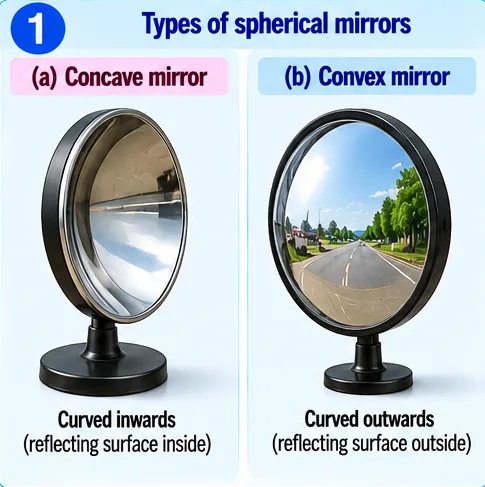
A spherical mirror is a mirror whose reflecting surface is part of a hollow sphere.
- Concave mirror — reflecting surface curves inwards (like the inside of a spoon or bowl).
- Convex mirror — reflecting surface bulges outwards (like the back of a spoon).
| Term | Meaning |
|---|---|
| Pole (P) | Centre of the mirror’s reflecting surface |
| Centre of curvature (C) | Centre of the sphere of which the mirror is a part |
| Principal axis | Straight line through P and C |
| Principal focus (F) | Point where rays parallel to the axis meet (concave) or appear to come from (convex) after reflection |
| Focal length (f) | Distance between P and F; about half the radius of curvature |
3. Laws of Reflection
Curved mirrors also obey the laws of reflection at every point: (1) the angle of incidence equals the angle of reflection; (2) the incident ray, the reflected ray and the normal lie in the same plane. For a spherical mirror, the normal at any point is the line joining that point to the centre of curvature C.
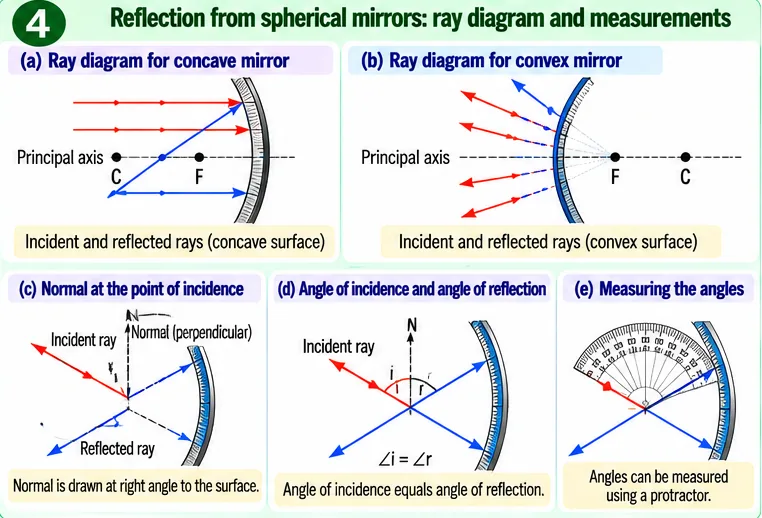
- A concave mirror makes parallel rays converge (meet) at the focus — it is a converging mirror.
- A convex mirror makes parallel rays diverge (spread out) as if coming from a focus behind it — a diverging mirror.
4. Images Formed by Spherical Mirrors
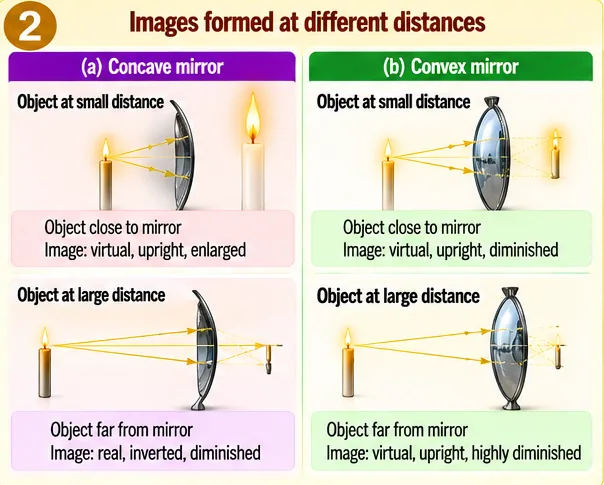
A real image is formed where reflected rays actually meet; it can be caught on a screen and is inverted. A virtual image is formed where rays only appear to meet; it cannot be caught on a screen and is upright.
| Mirror | Object position | Image |
|---|---|---|
| Concave | Very close (between P and F) | Virtual, upright, enlarged, behind the mirror |
| Concave | Far away | Real, inverted, smaller, in front of the mirror |
| Convex | Any distance | Always virtual, upright and smaller |
| Plane | Any distance | Virtual, upright, same size |
5. Uses of Spherical Mirrors
| Mirror | Use | Reason |
|---|---|---|
| Concave | Shaving and make-up mirrors | Enlarged upright image when close |
| Concave | Dentists’ and ENT doctors’ mirrors | Magnified view; focuses light |
| Concave | Torch and vehicle headlight reflectors | Sends a strong parallel beam |
| Concave | Solar cookers and furnaces | Concentrates sunlight at the focus |
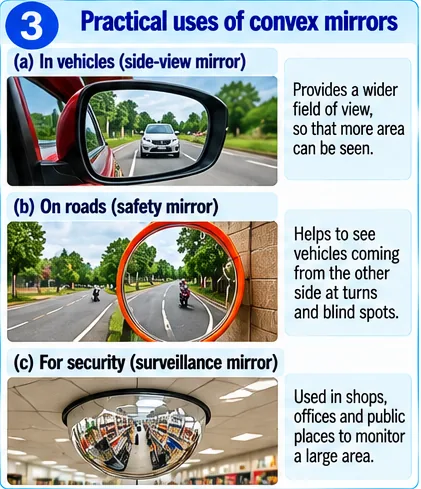
| Convex | Rear-view (side) mirrors of vehicles | Wider field of view; upright image |
| Convex | Mirrors at sharp road bends; shop security mirrors | Show a large area |
6. What Is a Lens?
A lens is a piece of transparent material (glass or plastic) with at least one curved surface. Light passing through a lens bends — this bending of light when it passes from one medium to another is refraction.
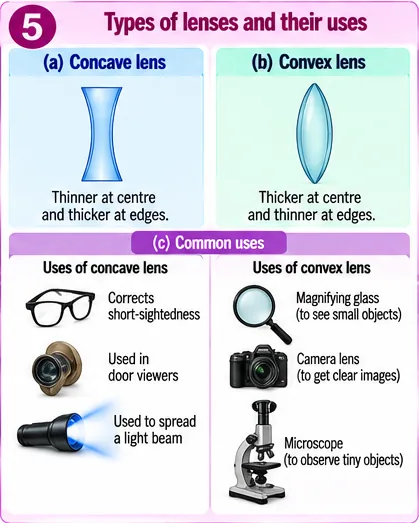
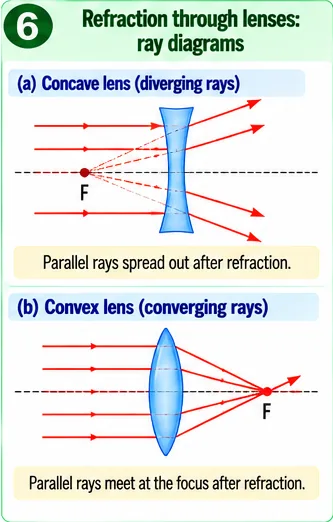
- Convex lens — thicker at the centre than at the edges; converges parallel rays to a focus. It can form real inverted images (on a screen) or a magnified virtual image when the object is close (magnifying glass).
- Concave lens — thinner at the centre, thicker at the edges; diverges rays; always forms a virtual, upright, smaller image.
You can burn a piece of paper by focusing sunlight through a convex lens at its focus (do this only under supervision; never look at the Sun through a lens).
| Feature | Convex lens | Concave lens |
|---|---|---|
| Shape | Thick in middle | Thin in middle |
| Action on parallel rays | Converges | Diverges |
| Images | Real inverted or virtual magnified | Always virtual, upright, small |
| Uses | Magnifying glass, camera, microscope, telescope, spectacles for far-sightedness | Spectacles for short-sightedness, door peep-holes |
7. Master Table: Key Terms
| Term | Meaning |
|---|---|
| Concave mirror | Curved inwards; converging |
| Convex mirror | Curved outwards; diverging |
| Focus (F) | Where parallel rays meet / appear to meet |
| Focal length | Distance PF ≈ ½ radius of curvature |
| Real image | Rays actually meet; on screen; inverted |
| Virtual image | Rays appear to meet; not on screen; upright |
| Refraction | Bending of light when it passes from one medium to another |
| Convex / concave lens | Converging / diverging lens |
8. Master Summary Table
| Device | Uses | Image |
|---|---|---|
| Plane mirror | Dressing mirror | Virtual, same size |
| Concave mirror | Headlights, shaving, solar cooker | Real or virtual |
| Convex mirror | Rear-view mirror | Virtual, small, wide view |
| Convex lens | Magnifier, camera, microscope | Real or virtual magnified |
| Concave lens | Myopia spectacles, peep-hole | Virtual, small |
9. Mind Map
- Concave: converge
- Convex: diverge
- Real: inverted, on screen
- Virtual: upright
- Convex: converge
- Concave: diverge
- Headlights, rear-view
- Magnifier, spectacles
10. Tips and Tricks
- “Concave = Cave” — curves inward like a cave.
- Convex mirror and concave lens both diverge and always give small upright images.
- Real images are always inverted; virtual images are upright (for single mirrors and lenses).
- Thinking a convex mirror can form a real image — it never does.
- Mixing up the thick-middle (convex) and thin-middle (concave) lens.
- Calling refraction “reflection” — refraction is bending through a medium.
11. Important One-liners
- Spherical mirrors are concave or convex.
- A concave mirror converges light; a convex mirror diverges it.
- Laws of reflection hold for curved mirrors too.
- A convex mirror always forms a virtual, upright, smaller image.
- Rear-view mirrors are convex.
- Headlight reflectors are concave.
- A convex lens is thicker at the middle and converges light.
- A magnifying glass is a convex lens.
- Concave lenses correct short-sightedness.
12. Exam-pattern Questions with Detailed Answers
The mirror used as a rear-view mirror in vehicles is:
- Plane
- Concave
- Convex
- None
Show answer
A convex mirror gives an upright image and a wide field of view.
Answer: (C) Convex
Which lens is used in a magnifying glass?
Show answer
A convex lens forms an enlarged, upright, virtual image of a nearby object.
Answer: Convex lens
Define a real image.
Show answer
An image formed where light rays actually meet; it can be obtained on a screen and is inverted.
Answer: Rays actually meet; on a screen
Why are concave mirrors used in torches and headlights?
Show answer
When the bulb is placed at the focus of a concave mirror, reflected rays travel out as a strong parallel beam, lighting far distances.
Answer: Bulb at focus gives a parallel beam
You see your face upside down in the inner side of a spoon and upright on the outer side. Explain.
Show answer
The inner side acts as a concave mirror; at a usual distance it forms a real, inverted image. The outer side is a convex mirror, which always forms an upright, smaller virtual image.
Answer: Inner = concave (inverted); outer = convex (upright)
Give two differences between a convex lens and a concave lens.
Show answer
Convex lens is thicker at the middle and converges light; concave lens is thinner at the middle and diverges light. Convex lens can form real images; concave lens forms only virtual images.
Answer: Shape and converging vs diverging
Why are convex mirrors placed at sharp turns on mountain roads?
Show answer
They show a wide area, so drivers can see vehicles coming from around the bend and avoid accidents.
Answer: Wide field of view for safety
Which mirror do dentists use and why?
Show answer
A concave mirror held close to the tooth gives an enlarged, upright image and also concentrates light on it.
Answer: Concave — enlarged image
How can you find the approximate focal length of a convex lens using sunlight?
Show answer
Hold the lens facing the Sun and move a sheet of paper behind it until the brightest, sharpest spot forms. Distant sunlight rays are nearly parallel and meet at the focus, so the distance between lens and paper is roughly the focal length. (Do not look at the Sun or the spot directly.)
Answer: Distance to the sharpest sunlight spot ≈ focal length
A student says “a convex mirror and a convex lens both converge light.” Is this right? Explain.
Show answer
No. A convex lens converges light, but a convex mirror diverges it. Conversely, a concave mirror converges and a concave lens diverges. The name describes shape, not action.
Answer: Wrong — convex mirror diverges
Why is a solar cooker fitted with a concave reflector?
Show answer
A concave mirror converges the parallel rays of sunlight to its focus. Placing the cooking vessel at the focus concentrates a lot of heat there, cooking the food.
Answer: It concentrates sunlight at the focus
13. Quick Revision Summary
- Spherical mirrors: concave (converging) and convex (diverging); pole, C, F, principal axis.
- Laws of reflection apply to curved mirrors.
- Concave: enlarged virtual image when close, real inverted when far; convex: always small, upright, virtual.
- Lenses refract light: convex converges, concave diverges.
- Uses: headlights, shaving mirrors, solar cookers (concave); rear-view and road mirrors (convex); magnifiers, cameras, spectacles (lenses).