
1. Chapter at a Glance
Lemonade, sea water, soda water and even the air we breathe are solutions. Why does sugar dissolve in water but not sand? Why do fish survive in water? Why does ice float while a coin sinks? This chapter explores solutes, solvents and solutions, how much can dissolve (solubility), how temperature affects it, dissolved gases, and the idea of density that decides whether things float or sink.
- Solute, solvent and solution; water as a universal solvent.
- Saturated and unsaturated solutions; solubility; effect of temperature.
- Concentration — dilute and concentrated solutions.
- Solubility of gases and its importance for aquatic life.
- Density = mass ÷ volume; floating and sinking; effect of temperature and pressure on density.
2. Solute, Solvent and Solution
When sugar dissolves in water, the sugar is the solute (the substance that dissolves), water is the solvent (the substance in which it dissolves), and the sugar water is the solution.
Solute + Solvent → Solution
- A solution is a uniform mixture; its particles are too small to see and do not settle.
- Solutes can be solids (salt), liquids (lemon juice) or gases (carbon dioxide in soda water).
- Water dissolves so many substances that it is called a universal solvent. Other solvents: alcohol (for medicines, perfumes), kerosene and turpentine (for paints), acetone (nail-polish remover).
- Soluble substances dissolve in a solvent (sugar in water); insoluble ones do not (sand, chalk in water).
3. How Much Solute Can Dissolve?
Add salt to 50 mL of water spoon by spoon, stirring well. At first it dissolves; after some time no more salt dissolves and it settles at the bottom. Such a solution, which cannot dissolve any more solute at that temperature, is a saturated solution. A solution that can dissolve more solute is unsaturated.
The maximum amount of a solute that can dissolve in a fixed amount of solvent (usually 100 g of water) at a given temperature is its solubility. Different substances have different solubilities — sugar is far more soluble in water than common salt.
Concentration
The amount of solute present in a given amount of solution is its concentration. A dilute solution has a small amount of solute; a concentrated solution has a large amount.
10 g of sugar is dissolved in 90 g of water. Mass of solution = 100 g. Concentration (by mass) = 10 ÷ 100 × 100 = 10%.
4. Effect of Temperature on Solubility
A saturated sugar solution at room temperature can dissolve more sugar when heated. For most solids, solubility increases with temperature. When a hot saturated solution cools, the extra solute comes out as crystals — this is how sugar candy (mishri) and pure crystals are made.
Chart — solubility of some solids in 100 g of water (approximate):
Approximate standard values; note that salt’s solubility changes only a little with temperature, while many other solids change a lot.
5. Solubility of Gases
Gases also dissolve in water. Oxygen dissolved in water allows fish and other aquatic animals to breathe through gills. Carbon dioxide is dissolved in soft drinks under pressure; opening the bottle releases pressure and the gas escapes as bubbles.
- Solubility of gases decreases as temperature rises — warm water holds less oxygen, which is why fish may die in ponds heated by hot weather or hot factory water.
- Solubility of gases increases with pressure — soda water is bottled under pressure.
6. Why Do Objects Float or Sink? — Density
A small iron nail sinks but a large block of wood floats. The answer is not just mass but density — how much mass is packed in a given volume.
Density = Mass ÷ Volume
The SI unit of density is kg/m³; in the laboratory we often use g/cm³ (or g/mL). The density of water is about 1 g/cm³ (1000 kg/m³).
- An object denser than the liquid sinks; one less dense floats.
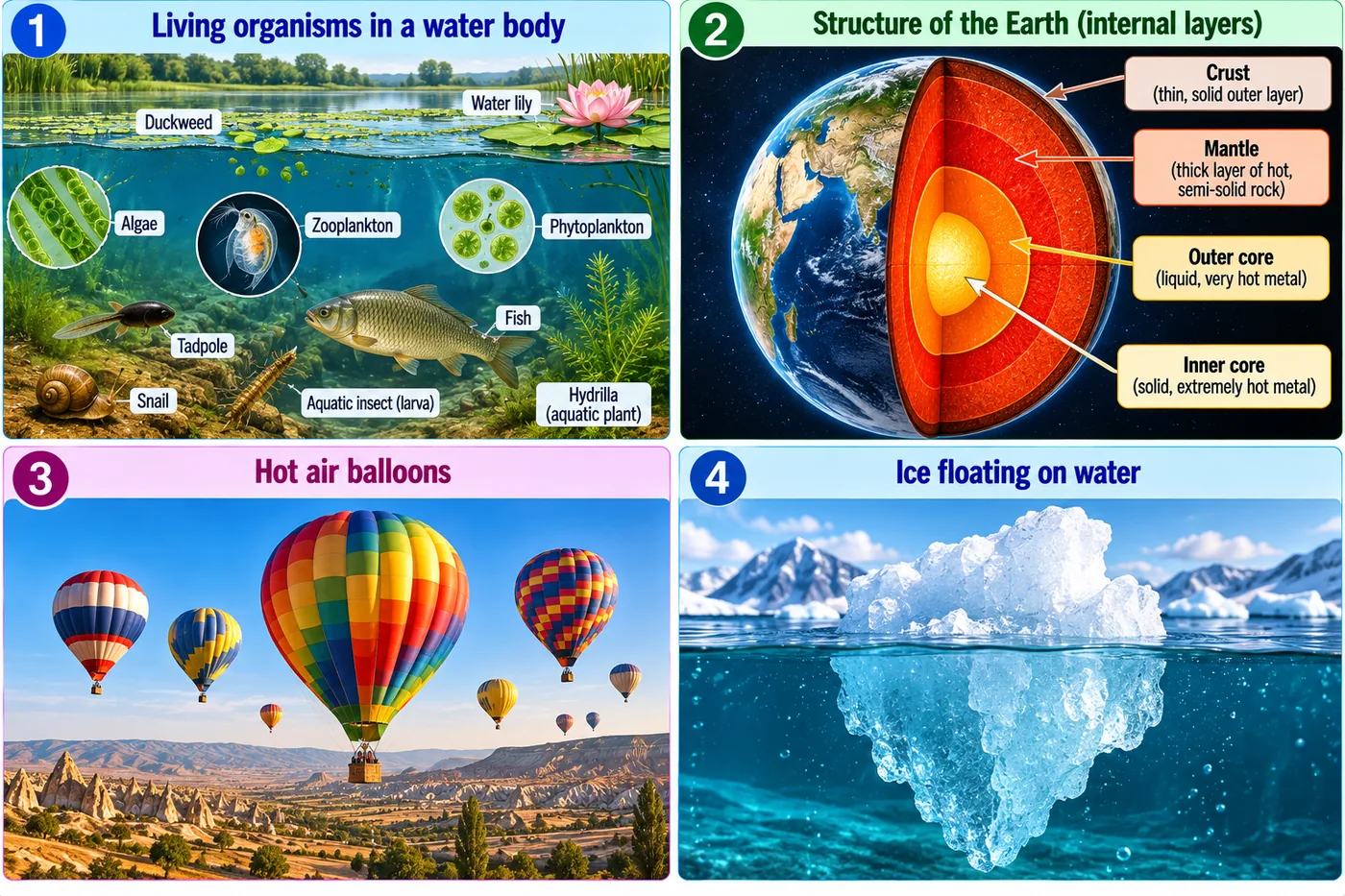
- Ice (about 0.92 g/cm³) is less dense than water, so it floats — only about 90% of an iceberg is underwater.
- Oil floats on water because it is less dense.
- Sea water is denser than fresh water, so it is easier to float in the sea.
Determination of density
- Measure the mass of the object with a balance.
- Find its volume: for a regular solid, multiply length × breadth × height; for an irregular solid, lower it into a measuring cylinder with water and note the rise in water level (displacement method).
- Density = mass ÷ volume.
A stone has mass 60 g. Water in a measuring cylinder rises from 50 mL to 70 mL when the stone is dropped in. Volume = 20 mL = 20 cm³. Density = 60 ÷ 20 = 3 g/cm³. Since 3 > 1, the stone sinks in water.
7. Effect of Temperature and Pressure on Density
- Heating makes most substances expand: volume increases, so density decreases. Hot air is less dense than cold air — hot-air balloons rise; warm water rises in convection.
- Pressure squeezes gases into smaller volumes: density of a gas increases with pressure (compressed gas in cylinders). Liquids and solids hardly change.
- Water is unusual: it is densest at about 4 °C. Ice is less dense than water, so ponds freeze from the top, and fish survive in the water below.
8. Master Table: Formulas and Key Terms
| Term | Meaning / formula |
|---|---|
| Solution | Solute + solvent; uniform mixture |
| Saturated solution | Cannot dissolve more solute at that temperature |
| Solubility | Max solute in 100 g solvent at a given temperature |
| Concentration (mass %) | (Mass of solute ÷ mass of solution) × 100 |
| Density | Mass ÷ Volume; kg/m³ or g/cm³ |
| Density of water | ≈ 1 g/cm³ = 1000 kg/m³ |
| Floats if | Density of object < density of liquid |
| Gas solubility | Falls with temperature; rises with pressure |
9. Master Summary Table
| Observation | Explanation |
|---|---|
| More sugar dissolves in hot tea | Solid solubility rises with temperature |
| Bubbles when soda bottle opens | Lower pressure → less CO₂ dissolves |
| Fish gasp in warm ponds | Less oxygen dissolves in warm water |
| Ice floats | Ice is less dense than water |
| Hot-air balloon rises | Hot air is less dense than cold air |
| Stone sinks | Denser than water |
10. Mind Map
- Solute + solvent
- Water: universal solvent
- Saturated, unsaturated
- Temperature effect
- O₂ for fish, CO₂ in soda
- Less when hot
- Mass ÷ volume
- Float or sink
11. Tips and Tricks
- Solids like heat; gases hate heat (solubility).
- Density triangle: M on top, D × V below.
- Compare with water (1 g/cm³): below 1 floats, above 1 sinks.
- Thinking heavy things always sink — a huge log floats; density matters.
- Saying gases dissolve more in hot water.
- Confusing concentration (amount in solution) with solubility (maximum possible).
12. Important One-liners
- A solution is made of a solute and a solvent.
- Water is called the universal solvent.
- A saturated solution cannot dissolve more solute at that temperature.
- Solubility of most solids increases with temperature.
- Solubility of gases decreases with temperature.
- Density = mass ÷ volume.
- Density of water is about 1 g/cm³.
- Ice floats because it is less dense than water.
- Hot air rises because it is less dense.
13. Exam-pattern Questions with Detailed Answers
In salt solution, salt is the:
- Solvent
- Solute
- Solution
- Residue
Show answer
Salt dissolves (solute) in water (solvent) to make salt solution.
Answer: (B) Solute
Write the formula for density.
Show answer
Density = Mass ÷ Volume.
Answer: D = M/V
What is a saturated solution?
Show answer
A solution that cannot dissolve any more solute at a given temperature.
Answer: Holds the maximum solute at that temperature
A block has mass 240 g and volume 300 cm³. Find its density. Will it float in water?
Show answer
Density = 240 ÷ 300 = 0.8 g/cm³. It is less than water’s 1 g/cm³, so it floats.
Answer: 0.8 g/cm³; floats
Why do fish find it hard to survive in very warm water?
Show answer
Less oxygen dissolves in warm water because gas solubility decreases with temperature. With less dissolved oxygen, fish cannot breathe properly.
Answer: Warm water holds less oxygen
15 g of salt is dissolved in 135 g of water. Find the concentration by mass.
Show answer
Mass of solution = 150 g. Concentration = 15 ÷ 150 × 100 = 10%.
Answer: 10%
How can you convert a saturated sugar solution into an unsaturated one without adding water?
Show answer
Heat it. Solubility of sugar increases with temperature, so at a higher temperature the same solution can dissolve more sugar — it becomes unsaturated.
Answer: By heating it
Why does a soft drink fizz when the bottle is opened?
Show answer
Carbon dioxide is dissolved under high pressure. Opening the bottle lowers the pressure, so less gas can stay dissolved and the excess escapes as bubbles.
Answer: Lower pressure reduces gas solubility
A stone of mass 75 g raises water in a measuring cylinder from 40 mL to 65 mL. Find its density and say whether it floats in a liquid of density 3.5 g/cm³.
Show answer
Volume = 65 − 40 = 25 cm³. Density = 75 ÷ 25 = 3 g/cm³. Since 3 < 3.5, the stone would float in that liquid.
Answer: 3 g/cm³; floats in the 3.5 g/cm³ liquid
Explain why lakes in very cold places freeze from the top and how this helps aquatic life.
Show answer
Ice is less dense than water, so it floats and forms a layer at the top. This layer insulates the water below, which stays liquid (near 4 °C, where water is densest). Fish and plants survive in the water underneath.
Answer: Floating ice insulates water below
How does a hot-air balloon rise and come down?
Show answer
A burner heats the air inside the balloon. Hot air expands and becomes less dense than the cooler outside air, so the balloon rises. When the air inside cools (burner turned down), its density increases and the balloon descends.
Answer: Heating lowers air density → rises; cooling → descends
14. Quick Revision Summary
- Solution = solute + solvent; water is the universal solvent.
- Saturated vs unsaturated; solubility depends on substance and temperature.
- Concentration: dilute or concentrated; mass % = solute/solution × 100.
- Gases dissolve less when hot, more under pressure.
- Density = mass ÷ volume; less dense floats; ice and hot air rise; use displacement to find volume.