
1. Chapter at a Glance
Milk, air, sea water, sugar, gold and water — are they all the same kind of matter? Scientists classify matter into mixtures and pure substances, and pure substances further into elements and compounds. This chapter explains these groups, how to tell them apart, simple tests for gases like hydrogen and oxygen, the uses of elements, compounds and mixtures, and the natural minerals from which many elements are obtained.
- Mixtures — uniform and non-uniform; components keep their properties.
- Pure substances — fixed composition and properties.
- Elements (metals, non-metals, metalloids) and their symbols.
- Compounds — formed in fixed proportions; properties differ from their elements; decomposition of water and sugar.
- Tests for hydrogen and oxygen; uses; minerals.
2. What Are Mixtures?
A mixture contains two or more substances mixed in any proportion, where each component keeps its own properties and can be separated by physical methods.
- Uniform (homogeneous) mixtures — same composition throughout; components cannot be seen separately: sugar solution, salt water, air, brass.
- Non-uniform (heterogeneous) mixtures — composition varies; components can be seen: sand and water, oil and water, soil, a fruit salad.
Mixing iron filings and sulphur powder gives a mixture: iron can still be pulled out with a magnet, and sulphur still looks yellow.
3. What Are Pure Substances?
A pure substance has only one kind of particle, a fixed composition and fixed properties (like a fixed melting and boiling point). Pure water boils at 100 °C at normal pressure; salt water boils at a higher temperature. Pure substances are of two types — elements and compounds.
4. Elements
An element is the simplest form of a pure substance; it cannot be broken down into simpler substances by chemical methods. It is made of only one kind of atom. About 118 elements are known; around 94 occur naturally. Each has a symbol — H (hydrogen), O (oxygen), C (carbon), N (nitrogen), Fe (iron, from Latin ferrum), Cu (copper), Na (sodium), Au (gold).
| Type | Properties | Examples |
|---|---|---|
| Metals | Lustrous, malleable, ductile, good conductors | Iron, copper, aluminium, gold |
| Non-metals | Dull, brittle, poor conductors (graphite is an exception) | Carbon, oxygen, sulphur, nitrogen |
| Metalloids | Properties in between | Silicon, boron, germanium |
5. Compounds
A compound is a pure substance made of two or more elements chemically combined in a fixed proportion. Its properties are completely different from those of its elements, and it can be broken into its elements only by chemical methods.
- Water (H₂O) — hydrogen (burns) + oxygen (supports burning) → water (puts out fire). Hydrogen and oxygen combine in a fixed mass ratio of 1 : 8.
- Common salt (sodium chloride) — sodium (a reactive metal) + chlorine (a poisonous gas) → harmless table salt.
- Carbon dioxide, sugar (carbon, hydrogen, oxygen), iron sulphide (formed when iron and sulphur are heated together — no longer attracted by a magnet).
Breaking down compounds
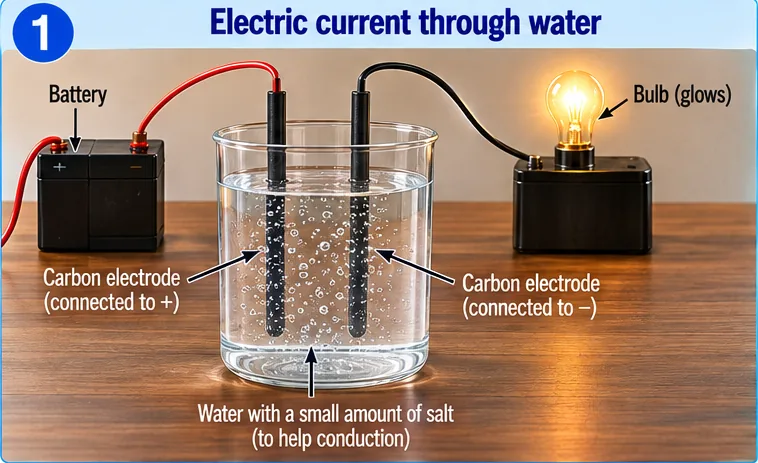
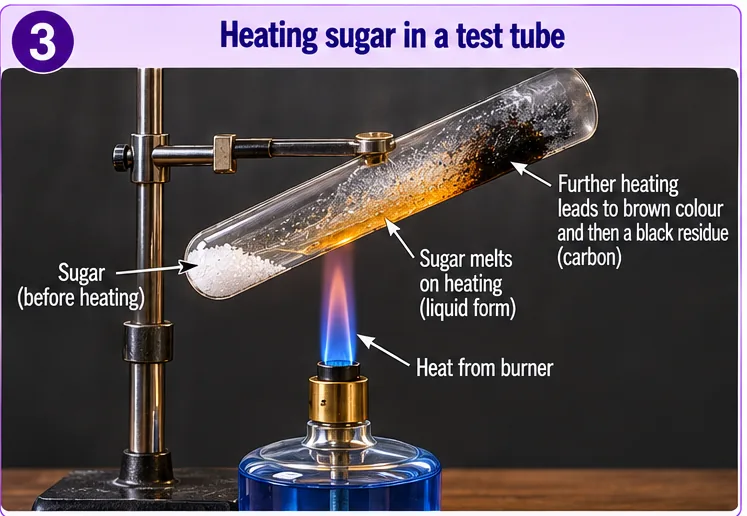
When electric current is passed through water (with a little salt or acid to help conduction), bubbles of hydrogen and oxygen gas form at the two electrodes — water is decomposed into its elements. When sugar is heated, it melts, turns brown and leaves a black residue of carbon while water vapour escapes — sugar is a compound of carbon, hydrogen and oxygen.
Tests for hydrogen and oxygen
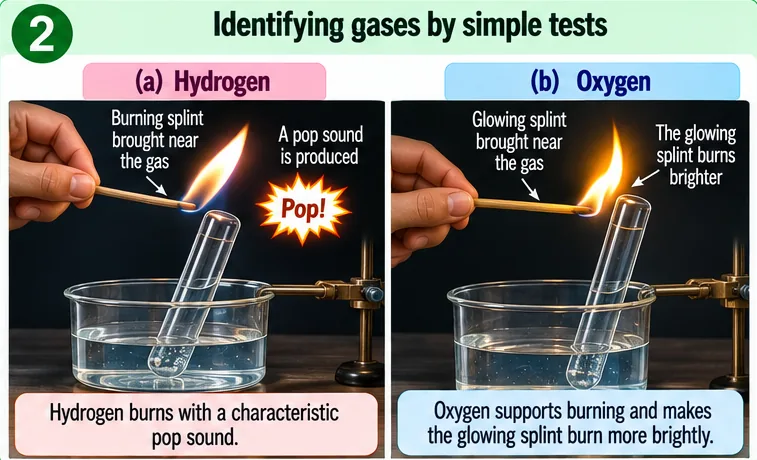
- Hydrogen — a burning splint brought near the gas produces a “pop” sound.
- Oxygen — a glowing splint bursts into flame or glows brighter.
6. Mixtures vs Compounds
| Feature | Mixture | Compound |
|---|---|---|
| Proportion | Any proportion | Fixed proportion |
| Properties | Components keep their properties | New properties, different from elements |
| Separation | Physical methods (magnet, filtration, evaporation) | Only chemical methods |
| Energy change on forming | Usually none | Heat or light often given out or taken in |
| Example | Iron filings + sulphur powder | Iron sulphide |
7. Uses of Elements, Compounds and Mixtures
- Elements: oxygen for breathing and hospitals; copper for wires; aluminium for foil and aircraft; carbon (graphite) in pencils; chlorine to purify water; silicon in computer chips.
- Compounds: water; sodium chloride (salt); sodium bicarbonate (baking soda); calcium carbonate (chalk, marble); medicines.
- Mixtures (including alloys): air; brass (copper + zinc); bronze (copper + tin); steel (iron + carbon); stainless steel (iron + chromium + nickel); toothpaste, paints, concrete.
8. What Are Minerals?
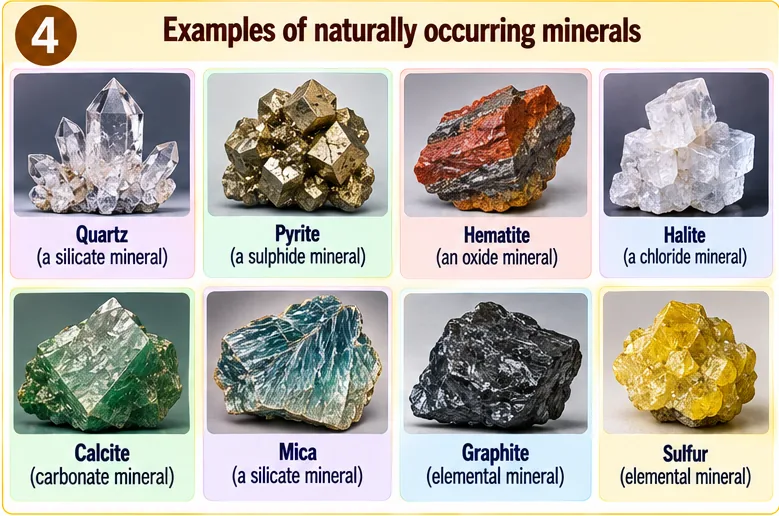
Minerals are naturally occurring solid substances found in rocks, usually with a definite composition and often a crystal shape. Metals are extracted from mineral deposits called ores (for example, haematite for iron, bauxite for aluminium). Some minerals contain a single element, like gold, graphite and sulphur; most are compounds.
| Mineral | Type | Use |
|---|---|---|
| Quartz, mica | Silicate (compound) | Glass, electronics, insulation |
| Haematite | Oxide (compound) | Ore of iron |
| Halite | Chloride (compound) | Rock salt |
| Calcite | Carbonate (compound) | Cement, lime |
| Pyrite | Sulphide (compound) | Source of sulphur |
| Graphite, sulphur | Elements | Pencils; matches, chemicals |
9. Master Table: Key Terms
| Term | Meaning |
|---|---|
| Mixture | Substances mixed in any proportion; keep their properties |
| Pure substance | Fixed composition and properties |
| Element | Cannot be broken into simpler substances chemically |
| Compound | Elements chemically combined in fixed proportion |
| Metalloid | Element with properties between metals and non-metals |
| Alloy | Uniform mixture of a metal with other elements |
| Mineral / Ore | Natural solid substance / mineral from which metal is extracted |
| Test for H₂ / O₂ | Pop sound / glowing splint relights |
10. Master Summary Table
| Substance | Class | Reason |
|---|---|---|
| Air | Uniform mixture | Gases in varying proportions |
| Sea water | Uniform mixture | Salts dissolved; separated by evaporation |
| Water | Compound | H and O in fixed ratio |
| Gold | Element | Only one kind of atom |
| Brass | Mixture (alloy) | Copper and zinc, variable ratio |
| Sugar | Compound | C, H, O combined; heating gives carbon |
11. Mind Map
- Uniform, non-uniform
- Physical separation
- Metals, non-metals
- Metalloids, symbols
- Fixed ratio, new properties
- Water, salt, sugar
- Minerals, ores
- Gas tests
12. Tips and Tricks
- Ask: “Fixed ratio + new properties?” Yes → compound; No → mixture.
- H₂ → Hears a pop; O₂ → Oh, the splint glows!
- Alloys are mixtures, not compounds.
- Calling air a compound — it is a mixture.
- Calling brass an element — it is an alloy (mixture).
- Thinking a compound shows its elements’ properties — salt is not poisonous like chlorine.
13. Important One-liners
- Components of a mixture keep their properties.
- Air and sea water are uniform mixtures.
- Elements cannot be broken down chemically.
- Compounds have elements in a fixed proportion.
- Water can be decomposed into hydrogen and oxygen by electricity.
- Heating sugar leaves carbon.
- Hydrogen burns with a pop sound.
- Oxygen relights a glowing splint.
- Brass is an alloy of copper and zinc.
- Ores are minerals from which metals are extracted.
14. Exam-pattern Questions with Detailed Answers
Which of these is a compound?
- Air
- Brass
- Water
- Gold
Show answer
Water is hydrogen and oxygen chemically combined in a fixed ratio. Air and brass are mixtures; gold is an element.
Answer: (C) Water
How is hydrogen gas identified?
Show answer
A burning splint brought near it produces a “pop” sound.
Answer: Pop sound with a burning splint
Give the symbols of iron and sodium.
Show answer
Iron — Fe (from ferrum); sodium — Na (from natrium).
Answer: Fe, Na
Iron filings and sulphur powder are mixed, and in another tube heated together. Give two differences between the products.
Show answer
The mixture: iron can be removed with a magnet; sulphur remains yellow; any proportion. The heated product (iron sulphide): not attracted by a magnet; a new grey-black substance with new properties; formed in a fixed proportion with heat given out.
Answer: Magnet test and properties differ
What happens when electricity is passed through water? What does it show?
Show answer
Bubbles of hydrogen and oxygen form at the two electrodes. It shows that water is a compound that can be broken into its elements by a chemical method.
Answer: Water splits into H₂ and O₂ — it is a compound
Why is sea water called a mixture and not a compound?
Show answer
Salts are dissolved in water in varying amounts, each keeps its properties, and the salt can be separated by evaporation — a physical method.
Answer: Variable composition; physical separation
Name two alloys and their components.
Show answer
Brass — copper and zinc; bronze — copper and tin; steel — iron and carbon.
Answer: Brass (Cu+Zn), bronze (Cu+Sn)
What are metalloids? Give an example and one use.
Show answer
Elements with properties between metals and non-metals. Silicon is used in computer chips and solar cells.
Answer: In-between elements, e.g. silicon in chips
Sodium is a reactive metal and chlorine is a poisonous gas, yet common salt is safe to eat. Explain.
Show answer
Sodium and chlorine combine chemically to form a compound, sodium chloride. A compound has entirely new properties, different from those of its elements, so salt is neither reactive like sodium nor poisonous like chlorine.
Answer: A compound has new properties
A student says “Heating sugar is a physical change because it melts.” Do you agree? Explain.
Show answer
Partly. Melting is physical, but on further heating sugar turns brown and leaves black carbon while water vapour escapes. New substances form, so it is mainly a chemical change, showing sugar is a compound of carbon, hydrogen and oxygen.
Answer: Disagree — it decomposes into new substances
How could you show that a sample of water is pure?
Show answer
Pure substances have fixed properties. Pure water boils at exactly 100 °C (at normal pressure) and leaves no residue on evaporation. If it boils at a higher temperature or leaves a residue, it contains dissolved impurities.
Answer: Boils at 100 °C, leaves no residue
15. Quick Revision Summary
- Matter = mixtures (uniform/non-uniform) + pure substances (elements, compounds).
- Elements: one kind of atom; metals, non-metals, metalloids; symbols.
- Compounds: fixed ratio, new properties, chemical separation (water → H₂ + O₂; sugar → carbon).
- Tests: H₂ pop; O₂ relights glowing splint.
- Alloys are mixtures; minerals and ores supply metals.