
1. Chapter at a Glance
Why does the smell of hot food reach you from the kitchen? Why does sugar seem to disappear in water? Why can you squeeze a balloon but not a stone? All these puzzles are solved by one powerful idea: matter is made of tiny particles that have spaces between them, attract one another and are always moving. This chapter builds the particle model of matter and uses it to explain the properties of solids, liquids and gases.
- Evidence that matter is made of tiny particles.
- Interparticle spaces and interparticle attractions.
- Particles are always in motion; diffusion.
- Arrangement and movement of particles in solids, liquids and gases.
- Explaining shape, volume, compressibility and flow with the particle model.
2. What Is Matter Composed of?
Break a piece of chalk into smaller and smaller bits — each bit is still chalk. Dissolve a crystal of potassium permanganate in water and keep diluting it; even after many dilutions the water stays slightly coloured. This shows that matter is made of extremely tiny particles, far too small to see even with an ordinary microscope. Ancient Indian thinker Kaṇāda suggested that matter is made of indivisible tiny particles called paramāṇu; much later, scientists confirmed the particle nature of matter through experiments.
3. Spaces, Attractions and Motion of Particles
(a) Particles have spaces between them
Dissolve a spoonful of sugar in a full glass of water — the water level hardly rises. The sugar particles fit into the interparticle spaces between water particles. Similarly, mixing 50 mL of alcohol with 50 mL of water gives slightly less than 100 mL.
(b) Particles attract each other
It is hard to break an iron nail but easy to break chalk, and very easy to move your hand through water or air. Particles are held together by interparticle forces of attraction, which are strongest in solids, weaker in liquids and weakest in gases.
(c) Particles are always moving
The smell of incense spreads through a room; a drop of ink spreads slowly in water even without stirring. Particles of one substance move and mix with particles of another — this is diffusion. Diffusion is fastest in gases, slower in liquids and very slow in solids. It becomes faster when temperature rises, because particles move faster when heated (ink spreads faster in hot water).
4. What Decides the State of Matter?
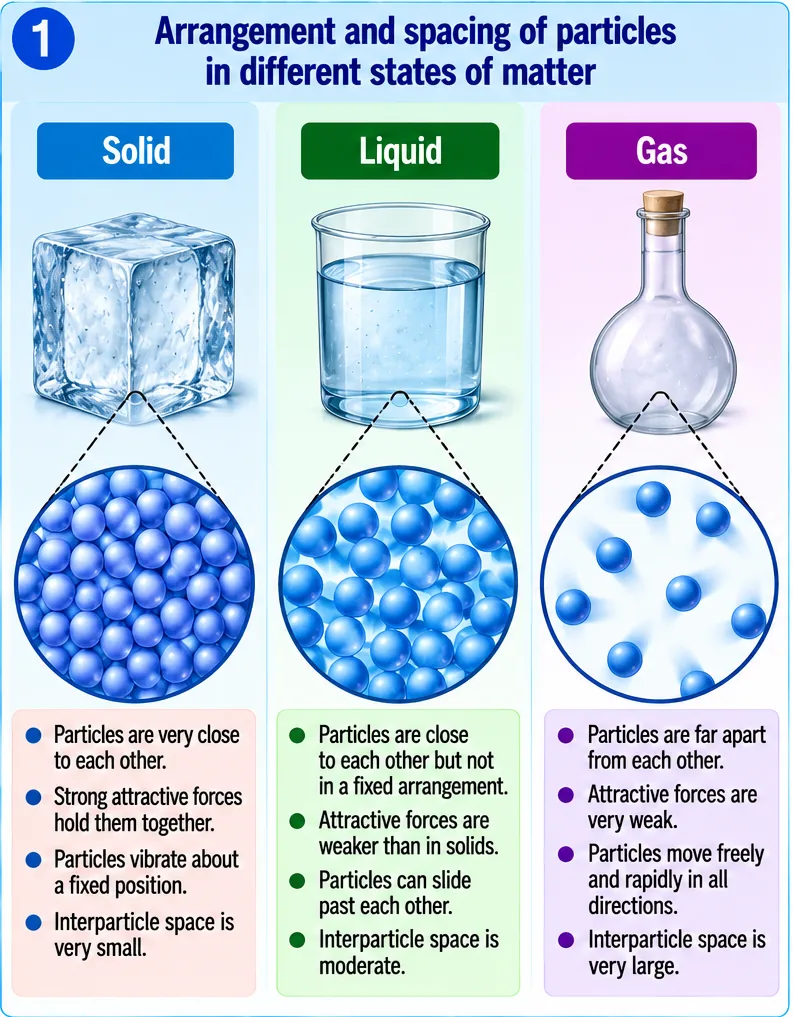
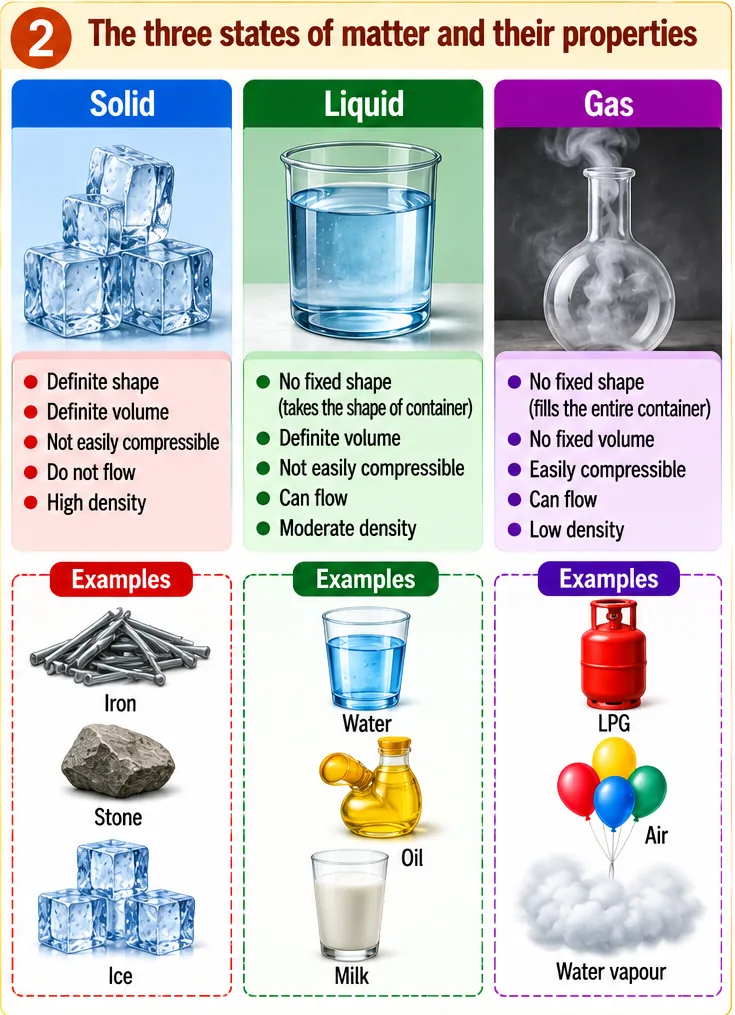
Whether a substance is a solid, liquid or gas depends on how strongly its particles attract each other compared with how fast they move.
| Property | Solid | Liquid | Gas |
|---|---|---|---|
| Arrangement | Closely packed in a fixed, regular pattern | Close but not in fixed positions | Far apart, random |
| Interparticle space | Very small | Small (more than solids) | Very large |
| Force of attraction | Strongest | Weaker | Weakest |
| Movement | Vibrate about fixed positions | Slide past one another | Move freely and rapidly in all directions |
| Shape | Definite | Takes the container’s shape | No fixed shape; fills the container |
| Volume | Definite | Definite | No fixed volume |
| Compressibility | Almost nil | Very little | Highly compressible |
| Flow | Does not flow | Flows | Flows |
5. Using the Particle Model
- Gases can be compressed because of large spaces between particles — LPG and CNG are stored compressed in cylinders; oxygen cylinders in hospitals hold a lot of gas.
- Liquids flow and take the container’s shape because particles can slide past each other.
- Solids keep their shape because particles are held tightly in fixed positions. (A sponge can be squeezed because air in its pores is pushed out — the solid itself is not compressed.)
- Gases exert pressure on the walls of their container because fast-moving particles keep hitting them — this is why a balloon stays inflated.
- Changing state — heating gives particles more energy; they move faster and overcome attractions: solid → liquid (melting) → gas (boiling/evaporation). Cooling reverses this.
In hot water, particles move faster, so water particles strike the sugar crystal more often and with more energy, separating its particles quickly; diffusion also spreads them faster. Hence sugar dissolves faster in hot water.
6. Master Table: Key Terms
| Term | Meaning |
|---|---|
| Particle nature of matter | All matter is made of extremely tiny particles |
| Interparticle space | Gap between particles |
| Interparticle attraction | Force holding particles together |
| Diffusion | Spontaneous mixing of particles of two substances |
| Compressibility | Ability to be squeezed into a smaller volume |
| Kaṇāda | Ancient Indian thinker; idea of paramāṇu |
7. Master Summary Table
| Observation | Particle explanation |
|---|---|
| Sugar dissolves without raising water level much | Spaces between water particles |
| Smell of perfume spreads | Gas particles move — diffusion |
| Ink spreads faster in hot water | Particles move faster when heated |
| Iron is hard to break | Strong attraction in solids |
| Gas fills any container | Weak attraction, free movement |
| CNG stored in small cylinders | Gases are highly compressible |
Chart — relative interparticle spacing:
8. Mind Map
- Very tiny
- Kaṇāda’s paramāṇu
- Spaces, attraction
- Always moving
- Gas > liquid > solid
- Faster when hot
- Solid, liquid, gas
- Shape, volume, compressibility
9. Tips and Tricks
- Going from solid → liquid → gas: spaces ↑, attraction ↓, motion ↑.
- For any “why” question, use three words: space, attraction, motion.
- Diffusion speed order: “Gas Laughs, Solid Sleeps” (gas fastest, solid slowest).
- Saying particles in solids do not move — they vibrate.
- Saying a sponge proves solids are compressible — it is air leaving the pores.
- Thinking a gas has a fixed volume — it fills the whole container.
10. Important One-liners
- Matter is made of extremely small particles.
- Particles have spaces between them.
- Particles attract each other; attraction is strongest in solids.
- Particles are always moving.
- Diffusion is the mixing of particles on their own.
- Diffusion is fastest in gases.
- Diffusion increases with temperature.
- Gases are highly compressible.
- Liquids have a fixed volume but no fixed shape.
11. Exam-pattern Questions with Detailed Answers
In which state are interparticle forces of attraction the weakest?
- Solid
- Liquid
- Gas
- Equal in all
Show answer
Gas particles are far apart and attract each other very weakly.
Answer: (C) Gas
What is diffusion?
Show answer
The spreading and mixing of particles of one substance with another on their own, due to their motion.
Answer: Spontaneous mixing of particles
Which state of matter has a definite volume but no definite shape?
Show answer
Liquids keep their volume but take the shape of the container.
Answer: Liquid
Why does the smell of hot food reach us faster than the smell of cold food?
Show answer
Heat gives particles more energy, so the particles carrying the smell move faster and diffuse into the air quickly.
Answer: Faster diffusion at higher temperature
When a spoonful of salt is dissolved in a glass full of water, the water does not overflow. Why?
Show answer
Salt particles occupy the spaces between water particles, so the volume hardly increases.
Answer: Interparticle spaces in water
Why can LPG be stored in cylinders in large quantities?
Show answer
Gas particles have large spaces between them, so a large amount of gas can be compressed into a small volume (it even becomes liquid under pressure in the cylinder).
Answer: Gases are highly compressible
Compare the movement of particles in solids, liquids and gases.
Show answer
Solids: vibrate about fixed positions. Liquids: move and slide past one another. Gases: move freely and rapidly in all directions.
Answer: Vibrate / slide / move freely
Why does a balloon stay inflated?
Show answer
Air particles inside move rapidly and keep striking the inner walls of the balloon, exerting pressure that keeps it stretched.
Answer: Gas particles exert pressure on the walls
50 mL of water and 50 mL of alcohol are mixed. The total volume is less than 100 mL. Explain.
Show answer
Particles of each liquid have spaces between them. On mixing, some particles of one liquid fit into the spaces of the other, so the combined volume becomes slightly less than the sum.
Answer: Particles occupy each other’s interparticle spaces
A drop of ink is put into a beaker of cold water and another into hot water. Predict and explain the difference.
Show answer
The ink spreads faster in hot water. Water particles in hot water have more energy and move faster, so ink particles are pushed around and mixed more quickly — diffusion increases with temperature.
Answer: Faster in hot water — particles move faster
A sponge can be squeezed, but it is called a solid. Explain using the particle model.
Show answer
A sponge has many tiny holes filled with air. On squeezing, air is pushed out of the holes, so the sponge gets smaller. The solid material itself, whose particles are tightly packed, is not compressed. It keeps its own shape when released, so it is a solid.
Answer: Air leaves pores; solid part is not compressed
12. Quick Revision Summary
- Matter is made of tiny particles (Kaṇāda’s paramāṇu idea).
- Particles have spaces, attract each other and keep moving.
- Diffusion: gas > liquid > solid; faster when hot.
- Solids: fixed shape and volume; liquids: fixed volume, flow; gases: fill container, compressible.
- Heating increases particle motion and changes state.