
1. Chapter at a Glance
From about the second millennium BCE, India's history can be read not only from archaeology but also from literature — beginning with the Ṛigveda. This chapter follows how small kin-based groups (jana, kula) grew into territorial states (janapadas and mahājanapadas), then into empires such as the Mauryas, Guptas and Cholas. It also explores how these states were run, the ideals of kingship and dharma, society (varṇa, jāti, family, women), religion and Bhakti, education, and the economy of farming, irrigation, trade and guilds — up to about 1000 CE.
- How did society and state organise themselves before 1000 CE?
- How did states emerge and spread across the subcontinent?
- How did ideas like dharma and the chakravarti samrāṭ promote unity?
- How did social, administrative and occupational groups take shape?
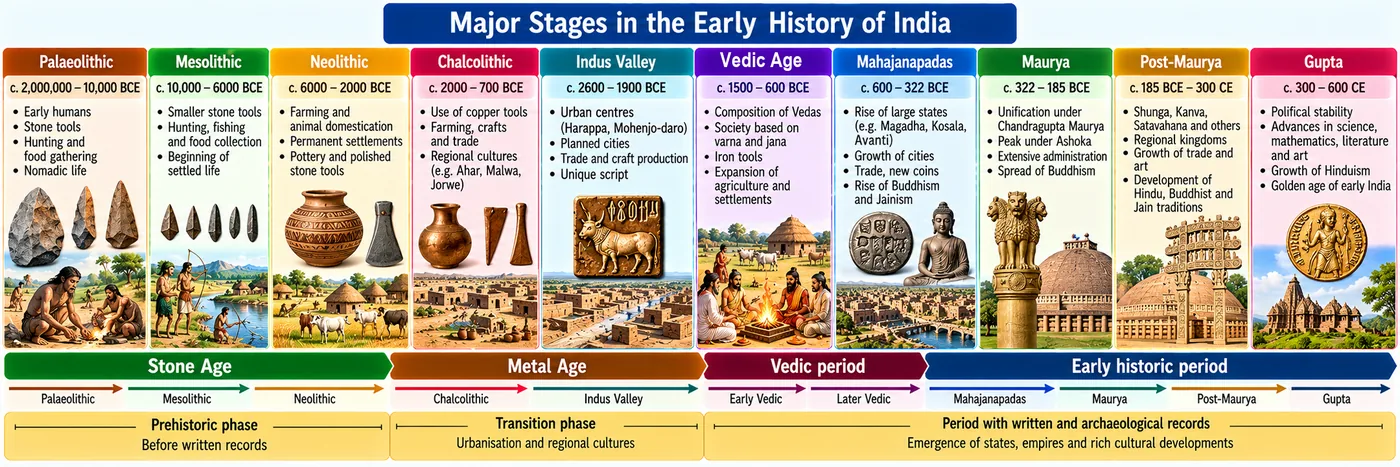
- Society: a web of relationships among people sharing a territory, culture and sense of belonging — families, marriage, customs. It is regulated mainly by customs, not formal laws.
- State: an organised political system based on rules and laws, with rights and duties of rulers and subjects, and institutions to enforce order.
2. The Vedic Period
The Vedas are India's oldest literature. They were passed on orally for centuries before being written down. The date of the Ṛigveda is debated (estimates range widely); it was composed in the north-west, in the Sapta-Sindhu region — the Indus, its five tributaries and the Sarasvatī.
| Veda | Content |
|---|---|
| Ṛigveda | Oldest; 1,028 hymns (sūktas) praising deities and reflecting on creation, life and death |
| Sāmaveda | Ṛigvedic hymns arranged for singing — a foundation of the seven svaras of Indian music |
| Yajurveda | Performance of yajñas, with prose explanations |
| Atharvaveda | Hymns to ward off evil and treat physical and mental ailments |
Each Veda has four layers: Saṁhitā (hymns), Brāhmaṇa (prose on rituals), Āraṇyaka (forest reflections) and Upaniṣhad (philosophy of Ātman and Brahman).
Political institutions
- Society was organised into janas (clans bound by kinship). The Ṛigveda names about thirty; five — Yadu, Turvaśha, Puru, Anu and Druhyu — were the pañchajana. The name "Bharata" first appears for the Bharata jana.
- The rājā was a clan chief who led in war and protected his people.
- Three assemblies checked and advised him: the sabhā (smaller, select elders, judicial work), the samiti (larger, broader population, policy) and the vidatha (popular gathering for discussion, including war).
- Structure: kula (family) → grāma (village) → viśh (group of villages, under a viśhapati) → jana (under the rājā).
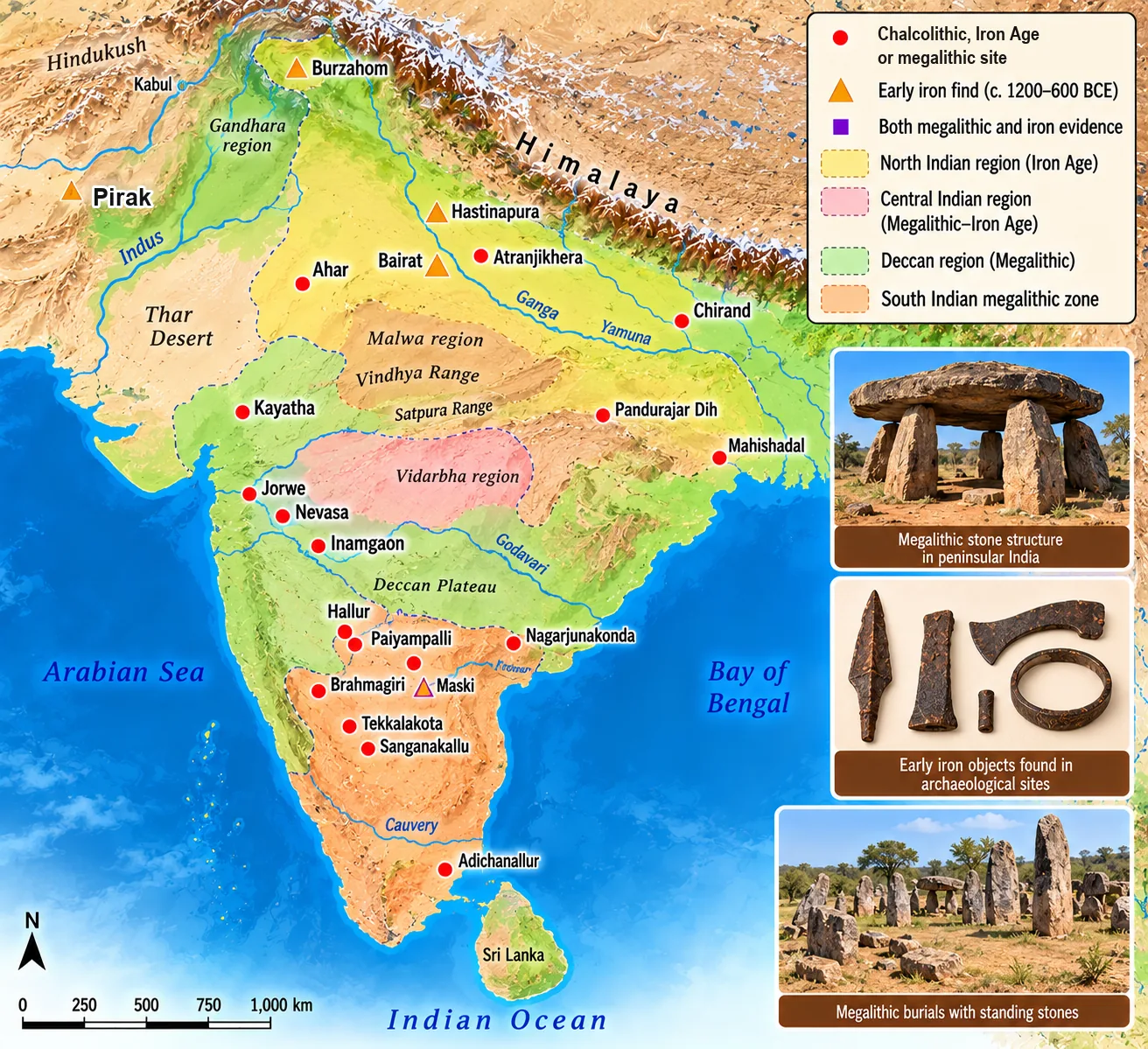
In the first millennium BCE, settlements multiplied in the Ganga plains. Archaeologists find more iron tools, more kinds of grain and the typical Painted Grey Ware (PGW). Later, in the middle Ganga region, a glossy deluxe pottery called Northern Black Polished Ware (NBPW) marks a richer material culture. Texts of the period speak of expanding farming, more paddy and iron implements — the base for bigger states.
3. Janapadas and Mahājanapadas
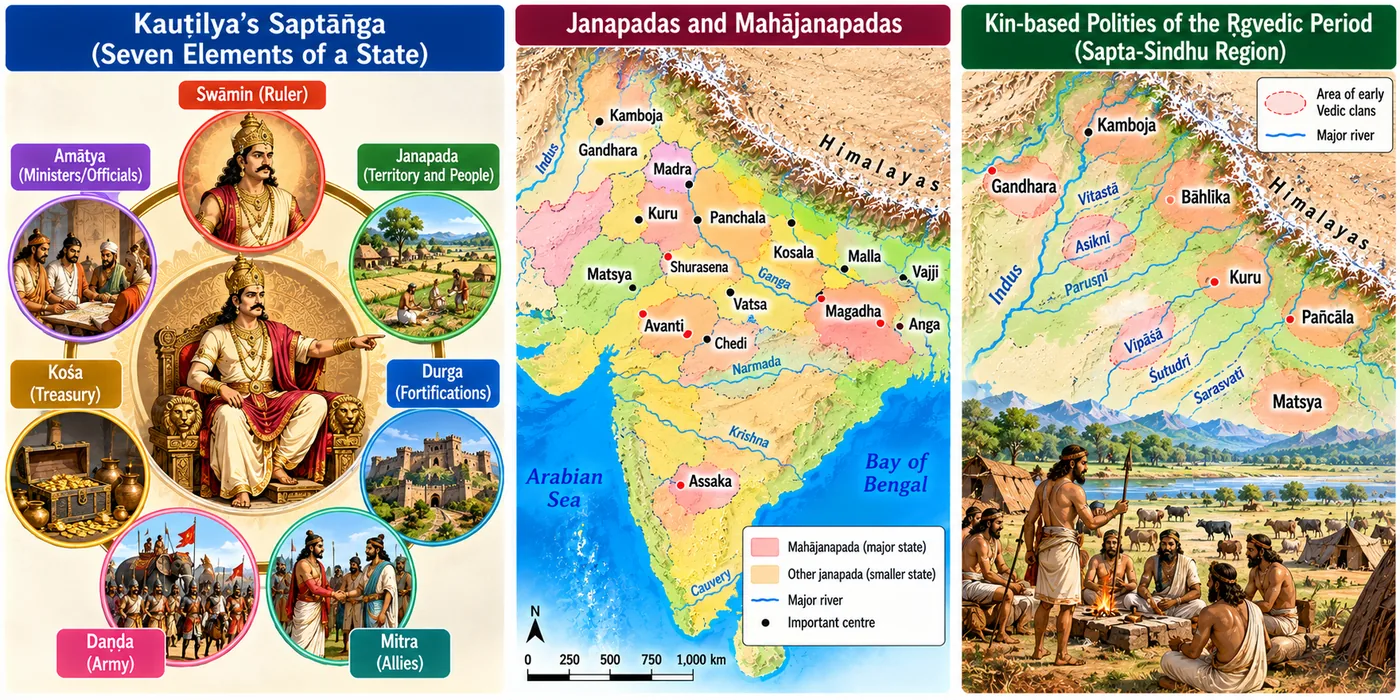
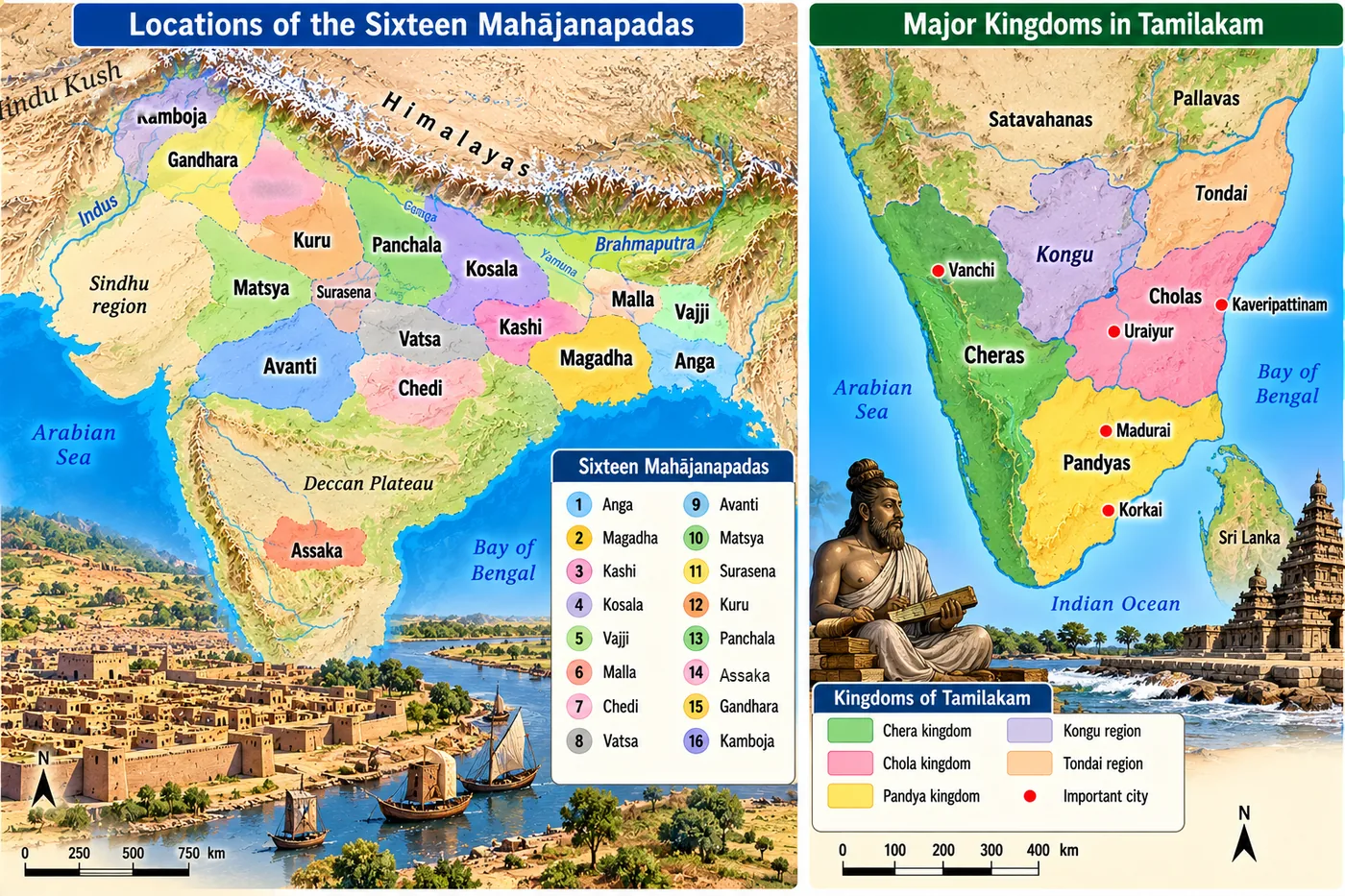
Janapada means "where a people (jana) set its feet". Between about 1000 and 600 BCE identity shifted from kinship to territory; control of land, crops and trade routes became important, and administration grew more complex. From about 600 BCE larger mahājanapadas appeared. Sources usually list sixteen: Aṅga, Magadha, Kāśhī, Kosala, Vṛijji (Vajji), Malla, Chedi, Vatsa, Kuru, Pañchāla, Matsya, Śhūrasena, Aśhmaka (Assaka), Avanti, Gandhāra and Kamboja.
- States were either monarchies (rājyas) or republics (gaṇas or saṁghas, such as the Vajji and Malla), governed by assemblies of clan leaders.
- Magadha (Bihar) became the most powerful thanks to its strategic location, fertile plains and strong rulers — eventually giving rise to the Mauryan Empire (founded by Chandragupta Maurya in 321 BCE).
- The centre of Vedic culture moved from the north-west to the Ganga plains.
The South and the Deccan
In the Deccan, the Sātavāhanas ruled for nearly 500 years (2nd century BCE to 3rd century CE). Further south lay the Cholas (lower Kaveri), Pandyas (Tamraparni and Vaigai valleys), Keralaputras (Cheras of Kerala) and Satiyaputras — all mentioned in Aśhoka's inscriptions. The Chera, Chola and Pandya kings were the "three crowned kings" (Vendar) of Tamilakam, known from Sangam literature (about 300 BCE–300 CE). Their emblems: bow (Cheras), tiger (Cholas) and fish (Pandyas). These early kingdoms are different from the later imperial Cholas.
4. Kingship and the Idea of One Land
- Titles like rājā, mahārāja and samrāṭ appear from the 6th century BCE.
- Kauṭilya's Arthaśhāstra: officers are energetic only if the king himself is energetic. The Yajurveda's coronation oath asks the king to judge strong and weak alike and protect the people; the Śhānti Parva of the Mahābhārata guides kings on justice and ethics.
- Kingship was usually hereditary, but texts mention kings being elected or even expelled — power was not absolute.
- Kings imagined the whole subcontinent as one sphere: Jambudvīpa, Bhāratavarṣha, the aśhvamedha and rājasūya yajñas, and the chakravarti kṣhetra — defined in the Arthaśhāstra as the land "between the Himalaya and the sea". Aśhoka speaks of his efforts across Jambudvīpa; the Chera king Nedunjeral Adan is praised for conquests up to the Himalaya; and the Chola Rajendra I took the title Gangaikonda after reaching the Ganga.
Kauṭilya's Saptāṅga — seven limbs of the state
| Limb | Meaning |
|---|---|
| Swāmī | The king |
| Amātya | Ministers and officials |
| Janapada | Territory and its people |
| Durga | Fortified towns |
| Koṣha | Treasury |
| Daṇḍa | Army and law-and-order forces |
| Mitra | Allies |
"One wheel does not move the carriage," says the Arthaśhāstra — the king ruled through a mantri-pariṣhad (council of ministers: treasurer, chief tax collector, chief legal adviser, commander-in-chief). An Aśhokan inscription even records the council deciding matters in the emperor's absence.
Near Girnar (Gujarat), one rock carries Aśhoka's edicts in Prakrit (3rd century BCE), a long Sanskrit inscription of the Western Satrap Rudradāman I (about 150 CE) on repairing the Sudarśhana lake, and a record of the Gupta emperor Skandagupta (5th century CE) restoring the same lake. The dam was first built by Puṣhyagupta, governor under Chandragupta Maurya.
5. How Empires Were Administered
- Kingdoms were split into provinces → districts → villages. Under the Sātavāhanas, āhāras had their own amātyas; villages were led by a grāmika; district officers consulted bankers, caravan leaders, artisans and scribes.
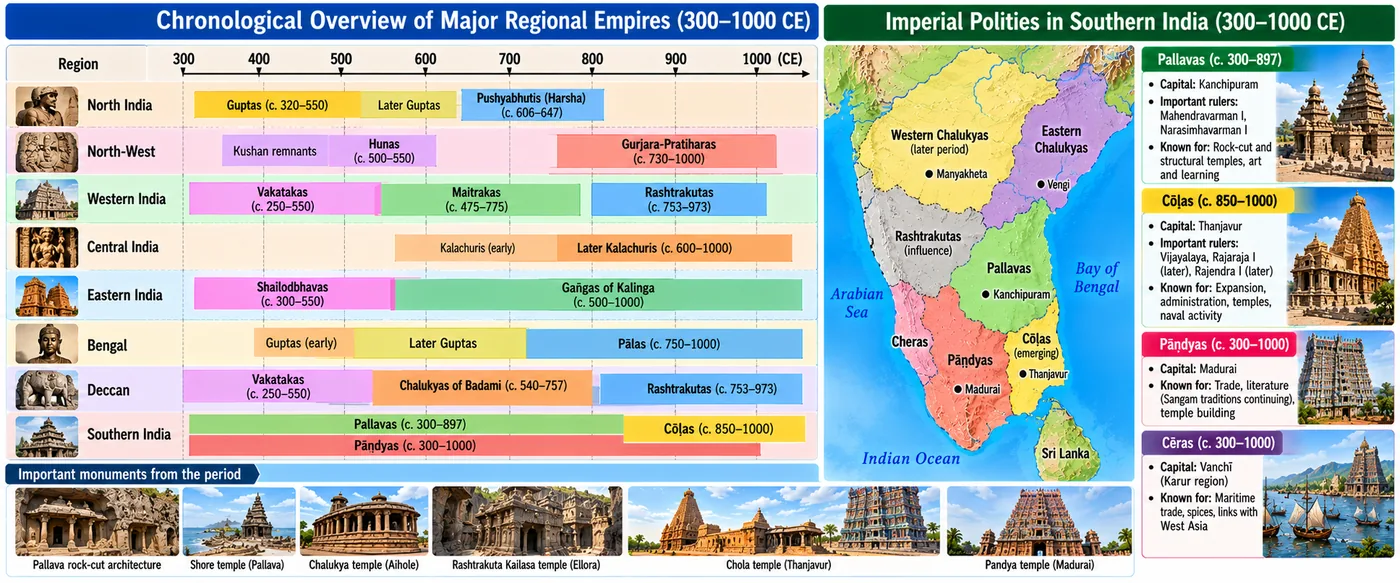
- From about 300–800 CE power was more decentralised. Provinces were bhuktis (north) or maṇḍalas/maṇḍalams (south); divisions were viṣhaya/bhoga or koṭṭams/valanāḍu; districts adhiṣhṭhāna/paṭṭana or nāḍu.
- Guptas: a new "minister of peace and war" (sāndhivigrahika); kumārāmātyas as provincial officers. The Damodarpur copper plates (Kumaragupta I) show a five-member district office: chief officer, chief banker, chief caravan trader, chief artisan and chief revenue officer.
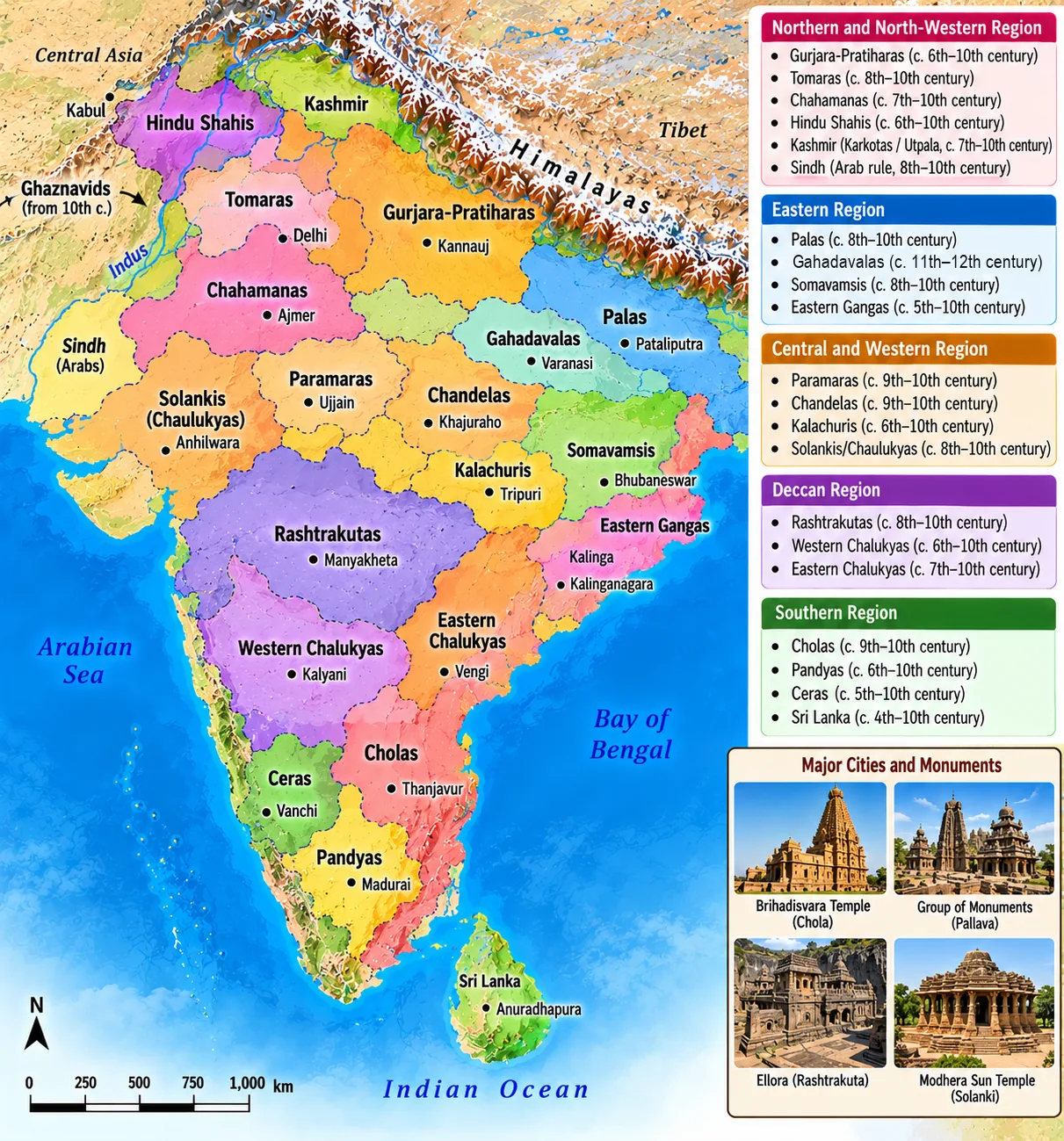
- Pallavas (c. 275–897 CE): tax-free brahmadeya villages; village committees (variyams) for irrigation, gardens and temples. Chālukyas of Badami (c. 543–753 CE) granted agrahārams, some of which (Aihole, Badami) became centres of learning.
- The tripartite struggle for Kannauj involved the Gurjara-Pratihāras, Pālas and Rāṣhṭrakūṭas.
- Imperial Cholas (9th–11th century): maṇḍalams → valanāḍus → nāḍus → ūrs. Village assemblies ran revenue, land, irrigation, roads and records.
The Uttaramerur inscription of the Chola king Parantaka I (10th century), in the Vaikuṇṭha Perumal temple near Kanchipuram, describes village elections. Names of eligible candidates were written on palm leaves and put into a pot (kuḍavolai); a young child drew them in public view. Those chosen joined committees (variyams) for tanks, justice and taxes. Candidates needed "honest earnings" and a clean record.
6. Ethics and Dharma
Early texts discuss right conduct and the nature of reality. Samatva (sameness) teaches that all beings share one underlying reality; ṛita in the Ṛigveda is the cosmic order that keeps nature and society in balance. Dharma does not mean "religion" here — it means duty, righteousness and moral conduct. It comes from the root dhṛ, "to hold": dharma is what upholds all beings. Aśhoka's dhamma stressed respect for elders, non-violence and compassion; texts like Kāmandaka's Nītisāra and Bāṇabhaṭṭa's Kādambarī also link ethics with good rule.
7. Society and Everyday Life
Varṇa and jāti
- Early Vedic texts show no fixed status by birth; identity came from many factors, especially occupation. A Ṛigveda verse (9.112.3) has a poet whose father is a physician and mother a grinder of corn — different jobs in one family.
- The four varṇas first appear in the Puruṣhasūkta (Ṛigveda, Book 10): brāhmaṇas (learning, teaching, rituals), kṣhatriyas (protection, justice), vaiśhyas (farming, herding, trade) and śhūdras (service, though in practice also farming, trade and crafts). The ranking valued knowledge above power and wealth.
- Over time roles became less flexible, and many jātis emerged — through intermarriage, migrating groups becoming endogamous (marrying within the group) and regional differences. Varṇas were four; jātis were countless.
- Mobility existed: dynasties like the Nandas, Mauryas, Śhuṅgas, Sātavāhanas, Guptas and Puṣhyabhūtis came from varied backgrounds. The Mandsaur inscription (473 CE) describes silk weavers from Lāṭa (Gujarat) at Daśhapura (Madhya Pradesh) who also practised archery and astrology. Sangam works like the Tolkāppiyam and Paṭṭinappālai show society organised mainly by occupation.
Family, āśhramas and puruṣhārthas
| Four āśhramas (stages of life) | Four puruṣhārthas (goals of life) |
|---|---|
| Brahmacharya — student | Dharma — righteousness |
| Gṛihastha — householder | Artha — material well-being |
| Vānaprastha — retreat to the forest | Kāma — fulfilment of desires |
| Saṁnyāsa — renunciation | Mokṣha — liberation |
Life was marked by the sixteen saṁskāras (rites of passage). The gotra traced a patrilineal line to a sage and guided marriage.
Women
Women composed Ṛigvedic hymns (Apālā, Viśhvavārā, Ghoṣhā, Lopāmudrā), studied and attended gatherings. Their status later varied and declined in places, but women kept working in farming, crafts and religion. Prabhāvatī Gupta ruled the Vākāṭaka kingdom as regent and issued land grants; Sangam poets like Avvaiyar were celebrated; and Chola queen Sembiyan Mahādevī patronised temples.
Religion and Bhakti
Vedic worship centred on nature deities and the sacred fire (yajña) — traces survive in Chhath and Makar Sankranti sun worship. Around the mid-first millennium BCE, renunciants (śhramaṇas, bhikṣhus, parivrājakas) grew in number; the Buddha and Mahāvīra were the best known. Worship then turned to personal deities — Viṣhṇu, Śhiva, Śhakti — and to Bhakti, a path of devotion open to all. From the 6th century the Tamil Āḻvārs (12 Vaiṣhṇava saint-poets) and Nāyanmārs (63 Śhaiva saint-poets) spread it widely.
8. The Quest for Knowledge
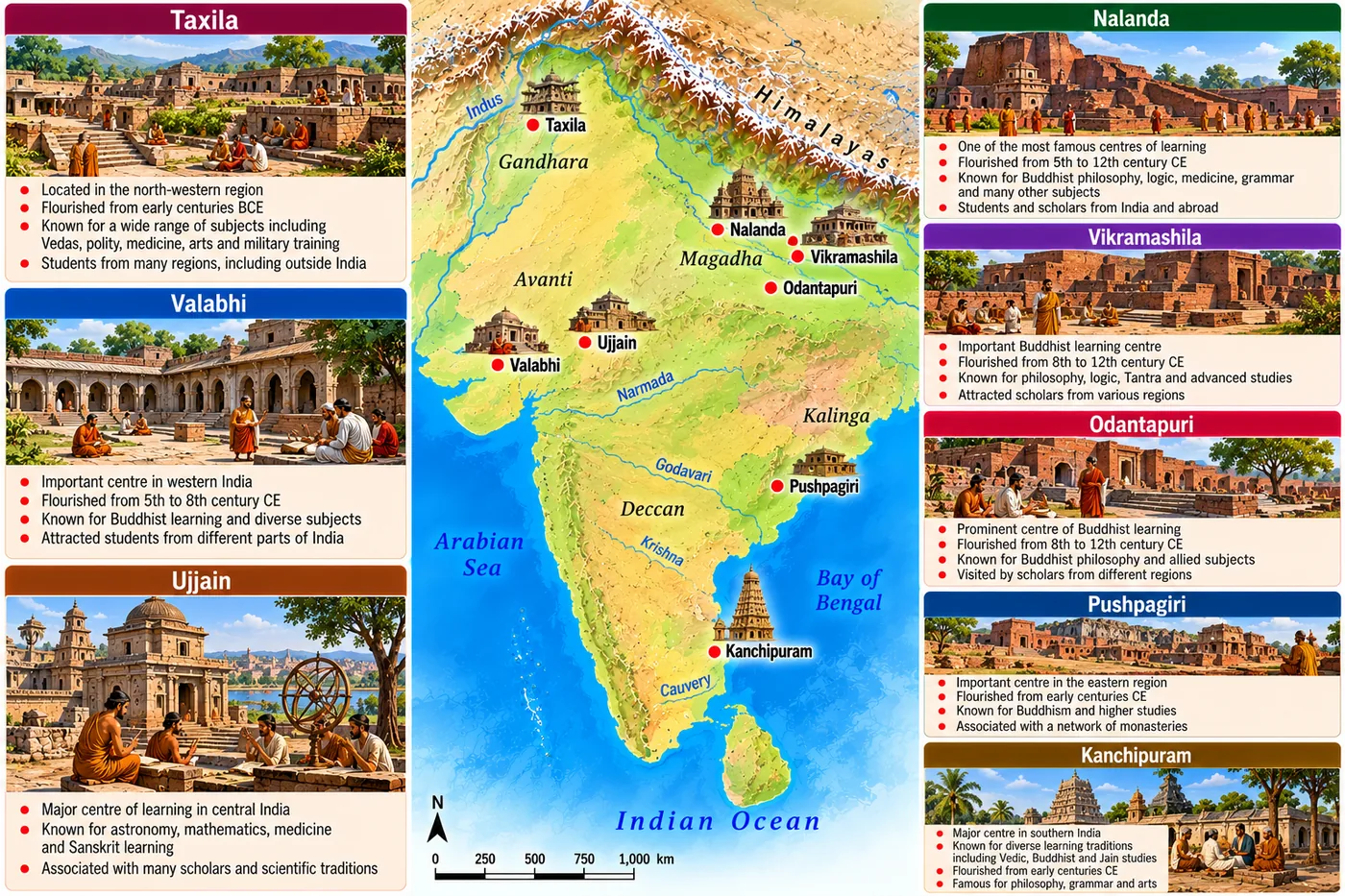
Education aimed at character as well as skills: truth, patience, humility, self-control and reverence for all beings, along with the Vedas, grammar, logic, mathematics, medicine, astronomy, music, painting, archery and yoga. In the gurukula the student lived as part of the teacher's family. Great centres — Takṣhaśhilā, Nālandā, Vikramaśhilā, Vallabhī, Kānchīpuram — drew students from India and abroad.
| Field | Famous works |
|---|---|
| Grammar | Pāṇini's Aṣhṭādhyāyī, Patañjali's Mahābhāṣhya, Piṅgala's Chhandaśhāstra |
| Medicine | Charaka Saṁhitā, Suśhruta Saṁhitā |
| Law and ethics | Manu, Yājñavalkya, Nārada and Viṣhṇu Smṛitis |
| Sanskrit poetry | Kālidāsa's Raghuvaṁśha, Kumārasambhava |
| Tamil | Tiruvalluvar's Tirukkural; epics Silappadikāram and Maṇimēkalai; Sangam poems on akam (love) and puram (war, public life) |
9. Economy
Agriculture and irrigation
- The Mauryan state supervised farming, cleared forests (protecting some by law) and usually took one-sixth of the produce as land tax. The Arthaśhāstra classifies land as cultivated, fallow, dry, sown fields and groves.
- The Milindapañho lists eight stages of farm work; the Amarakoṣha has a chapter on crops and manure; Sangam texts praise Chera pepper, jackfruit and turmeric. Deccan black soil boosted cotton.
- Irrigation works were recorded in inscriptions: the Sudarśhana lake (Junagadh) and the Chola Grand Anicut (Kallanai) of Karikala, still in use today.
Trade, ports and guilds
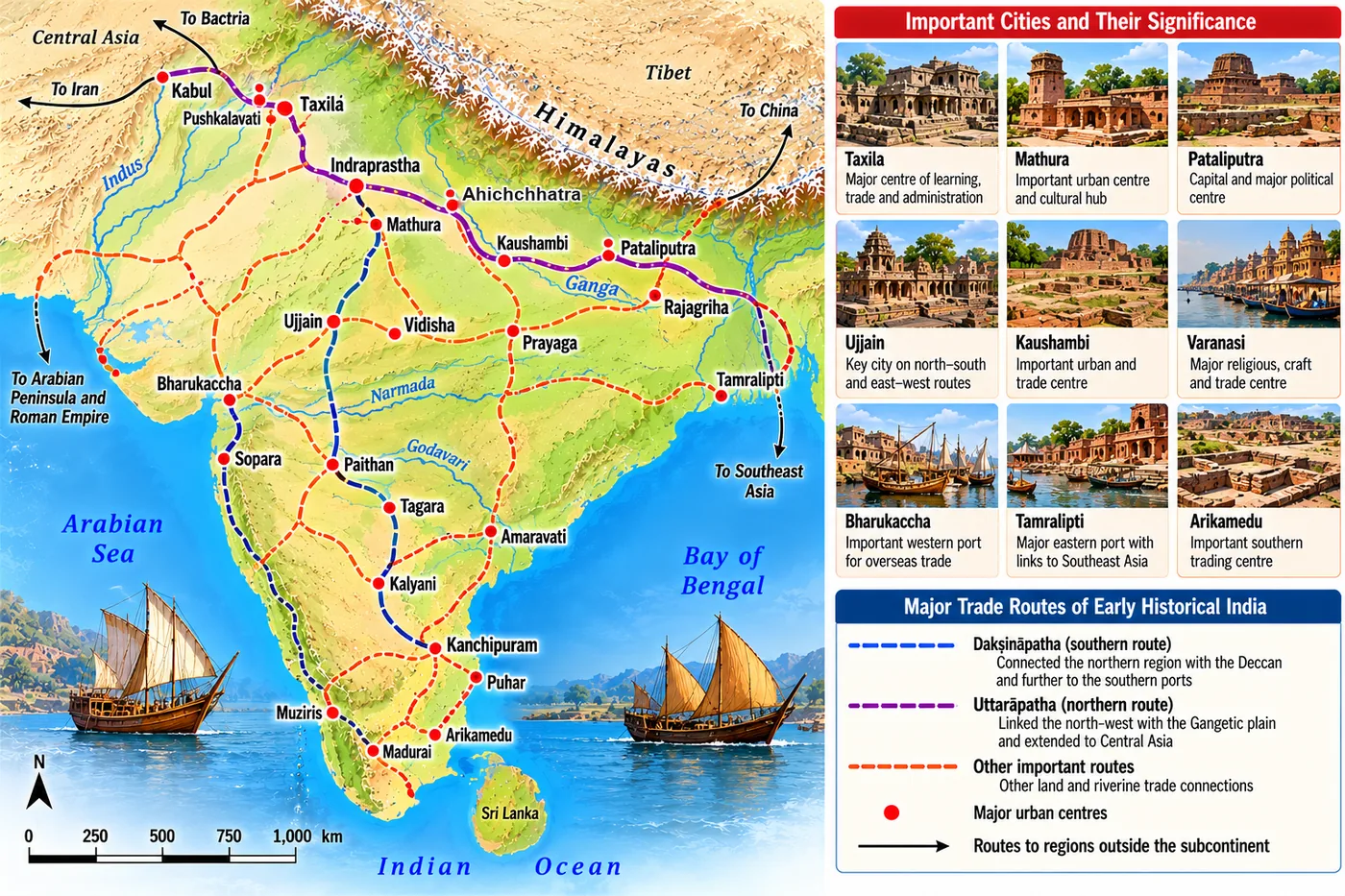
- By the 6th century BCE two great land routes had formed: Uttarāpatha (north-west to the Ganga plains) and Dakṣhiṇāpatha (Ganga plains to the Deccan and south).
- Ports such as Bharukachchha, Sopara, Muziris, Arikamedu, Kāveripaṭṭinam (Puhār) and Tāmralipti linked India to West Asia, Rome and South-East Asia.
- Guilds (śhreṇīs) of traders and artisans fixed quality and prices, ran guild courts and acted as banks. The Jātakas mention 18 kinds. Punch-marked silver coins came into use with the mahājanapadas.
- The Nashik cave inscription (2nd century CE) of Uṣhavadāta records 3,000 kārṣhāpaṇas deposited with weavers' guilds at Govardhana, whose interest supported monks. At Sanchi, the ivory workers' guild of Vidiśhā carved part of the stupa gateway.
10. Master Table: Key Terms
| Term | Meaning |
|---|---|
| Jana | Clan bound by kinship |
| Janapada | Territory where a jana settled |
| Gaṇa / saṁgha | Republic ruled by an assembly |
| Sabhā / samiti / vidatha | Vedic assemblies |
| Saptāṅga | Seven limbs of the state (Kauṭilya) |
| Mantri-pariṣhad | Council of ministers |
| Bhukti / maṇḍalam | Province (north / south) |
| Brahmadeya / agrahāram | Land granted to brāhmaṇas, often tax-free |
| Kuḍavolai | Palm-leaf lot system for Chola village elections |
| Śhreṇī | Guild of traders or artisans |
| Endogamy | Marrying within one's own group |
| Dharma | Duty, righteousness, moral order |
11. Master Summary Table
| Period | Approx. dates | Political form / key power |
|---|---|---|
| Early Vedic | 2nd millennium BCE | Kin-based janas under a rājā with assemblies |
| Janapadas | c. 1000–600 BCE | Territorial states |
| Mahājanapadas | from c. 600 BCE | 16 large states; rise of Magadha |
| Mauryas | 321–185 BCE | First near-pan-Indian empire; Aśhoka's dhamma |
| Sātavāhanas / Sangam kingdoms | c. 2nd BCE–3rd CE / 300 BCE–300 CE | Deccan empire; Chera, Chola, Pandya |
| Guptas | c. 320–550 CE | Empire with decentralised districts |
| Regional empires | c. 550–1000 CE | Chālukyas, Pallavas, Pālas, Pratihāras, Rāṣhṭrakūṭas, Cholas |
Chart — how long some dynasties lasted (approx. years):
12. Mind Map
- Jana → janapada
- Mahājanapada → empire
- Saptāṅga, council
- Chakravarti ideal
- Provinces, districts
- Village assemblies
- Varṇa, jāti, āśhrama
- Women, Bhakti
- Farming, irrigation
- Routes, ports, guilds
13. Tips and Tricks
- Saptāṅga: "She Always Jumps Down Keen Dog March" — Swāmī, Amātya, Janapada, Durga, Koṣha, Daṇḍa, Mitra.
- Chola units, big to small: Maṇḍalam, Valanāḍu, Nāḍu, Ūr — "My Village Needs Us".
- Tamil emblems: Bow–Chera, Tiger–Chola, Fish–Pandya.
- Dharma here means duty and moral order, not "religion".
- Assaka (Aśhmaka) is the only mahājanapada south of the Vindhyas.
- The early Sangam Cholas are different from the imperial Cholas of Rajaraja I.
14. Important One-liners
- The Ṛigveda has 1,028 hymns.
- The pañchajana were Yadu, Turvaśha, Puru, Anu and Druhyu.
- Magadha became the most powerful mahājanapada.
- Kauṭilya described the state as having seven limbs.
- The Guptas created the post of sāndhivigrahika.
- Junagadh rock has inscriptions of Aśhoka, Rudradāman I and Skandagupta.
- The Uttaramerur inscription describes the kuḍavolai system.
- The Purushasūkta first mentions the four varṇas.
- There were 12 Āḻvārs and 63 Nāyanmārs.
- The usual Mauryan land tax was one-sixth of produce.
- Guilds were called śhreṇīs.
15. Exam-pattern Questions with Detailed Answers
Which mahājanapada became the most powerful?
- Kosala
- Avanti
- Magadha
- Vatsa
Show answer
Magadha, in Bihar, had fertile plains, a strategic location along the Ganga and strong rulers, and grew into the Mauryan Empire. Kosala, Avanti and Vatsa were strong rivals but were eventually absorbed.
Answer: (C)
The emblem of the Pandyas was the:
- Tiger
- Bow
- Fish
- Elephant
Show answer
Fish was the Pandya emblem; the tiger belonged to the Cholas and the bow to the Cheras.
Answer: (C)
Name the three Vedic assemblies and one function of each.
Show answer
Sabhā — small body of elites with a judicial role; samiti — larger assembly representing people, deciding policy; vidatha — popular gathering for discussing war and other matters.
Answer: Sabhā, samiti, vidatha
How did political organisation change from the Vedic period to the age of empires?
Show answer
Early Vedic people lived in kin-based janas led by a rājā, advised by assemblies. Between 1000 and 600 BCE, identity shifted to territory, forming janapadas. From about 600 BCE, larger mahājanapadas — both monarchies and republics — emerged with taxes, armies and officials. Magadha grew into the Mauryan Empire, and later the Guptas and regional empires ruled through provinces, districts and villages.
Answer: Clan → territory → large state → empire
Explain Kauṭilya's Saptāṅga theory.
Show answer
Kauṭilya saw the state as an organic whole with seven limbs: the king (swāmī), ministers (amātya), territory and people (janapada), forts (durga), treasury (koṣha), army (daṇḍa) and allies (mitra). Like a body, the state works only when all limbs are healthy and integrated.
Answer: Seven interdependent limbs of the state
How did the kuḍavolai system work, and why is it important?
Show answer
Under the Cholas (Uttaramerur inscription of Parantaka I), names of eligible candidates were written on palm leaves and placed in a pot; a child drew them in public at the temple. Those chosen served on committees for tanks, justice and taxes. It shows organised, transparent local self-government with rules on who could stand (honest earnings, good conduct).
Answer: Public lot-drawing for village bodies — early local democracy
Differentiate between varṇa and jāti.
Show answer
Varṇa was a fourfold functional classification (brāhmaṇa, kṣhatriya, vaiśhya, śhūdra) first mentioned in the Puruṣhasūkta. Jāti refers to the many birth-based, usually endogamous groups that grew from intermarriage, migrating communities and regional and occupational differences. Varṇas were fixed at four; jātis kept multiplying.
Answer: Four broad categories vs countless specific groups
Read: Uṣhavadāta deposited 2,000 kārṣhāpaṇas with one weavers' guild and 1,000 with another at Govardhana, the interest to be used for monks living in a cave. What does this tell us about guilds?
Show answer
Guilds acted like banks: they accepted permanent deposits, invested them and paid a fixed monthly interest. People trusted them because guilds were stable, rich, rule-bound bodies with their own courts and reputation. The donor is Uṣhavadāta (son-in-law of the Śhaka king Nahapāna); the beneficiaries are the monks of the saṁgha living in the cave.
Answer: Guilds were trusted banking and credit institutions
How did ideas like the chakravarti and Jambudvīpa express the idea of the subcontinent as one political space?
Show answer
Terms like Jambudvīpa and Bhāratavarṣha named the whole land; the Arthaśhāstra defined the chakravarti kṣhetra as the area between the Himalaya and the sea. Rituals like the aśhvamedha and rājasūya proclaimed paramount rule. Aśhoka spoke of efforts across Jambudvīpa; the Chera Nedunjeral Adan was praised for reaching the Himalaya; the Chola Rajendra I called himself Gangaikonda. So rulers from north and south imagined authority over the whole subcontinent.
Answer: Shared geography, rituals and titles expressed pan-Indian ideals
Why were irrigation works recorded in inscriptions?
Show answer
Farming was the economy's backbone and the main source of revenue, so dams, tanks and canals were vital public works. Recording them on rock (Sudarśhana lake at Junagadh) honoured the ruler's care for subjects, told people who built or repaired them, and preserved responsibility for upkeep across generations. The Grand Anicut shows how such works could last for centuries.
Answer: They were vital, prestigious public works tied to revenue
What are the limitations of relying only on texts written by kings' advisers to understand early Indian society?
Show answer
Such texts (like the Arthaśhāstra) describe ideals — how the state should work — not always how it did. They reflect the views of the elite and rulers, and say little about ordinary farmers, women, labourers or forest people. So historians cross-check them with inscriptions, coins, archaeology and other literature such as Sangam poems and Buddhist texts.
Answer: Idealised, elite-centred — need other sources
16. Quick Revision Summary
- Vedas: four, each with Saṁhitā, Brāhmaṇa, Āraṇyaka, Upaniṣhad; janas, rājā, sabhā–samiti–vidatha.
- Iron, PGW, NBPW → janapadas (1000–600 BCE) → 16 mahājanapadas; monarchies and gaṇas; Magadha → Mauryas (321 BCE).
- South: Sātavāhanas; Chera–Chola–Pandya of Sangam age.
- Kingship: Saptāṅga, mantri-pariṣhad, chakravarti ideal; Junagadh rock.
- Administration: provinces–districts–villages; Gupta sāndhivigrahika; Pallava brahmadeya; Chola maṇḍalam–valanāḍu–nāḍu–ūr; kuḍavolai.
- Society: varṇa → jāti; āśhramas and puruṣhārthas; women scholars and queens; Bhakti of Āḻvārs and Nāyanmārs.
- Economy: one-sixth land tax; Kallanai; Uttarāpatha and Dakṣhiṇāpatha; ports; guilds as banks.