
1. Chapter at a Glance
Writing is only about 5,000 years old, yet human-like ancestors have been making tools for more than 3 million years. So more than 99 per cent of human history happened before writing, and we know it mainly through archaeology — tools, fossils, bones, pottery and cave art. This chapter traces our journey from the first stone tools in Africa, through the Old, Middle and New Stone Ages, to farming villages and finally the great Bronze Age civilisations of the Indus (Sindhu–Sarasvatī), Mesopotamia, Egypt and China.
- How did humans live before civilisation began?
- How did people communicate before writing?
- How does archaeology help us understand the past?
- How did early civilisations interact with each other?
2. Before and After Writing
| Feature | Before writing (prehistory) | After writing (history) |
|---|---|---|
| Share of human history | Over 99% — from about 3 million to 5,000 years ago | Under 1% — the last 5,000 years |
| Main sources | Artefacts: tools, implements, bones, pottery, art | Artefacts plus written documents |
| What we learn | How people lived; their thoughts are hard to know | Names, events, laws, beliefs, social and political life |
| Dating | Approximate | More exact — records mention coronations, wars, etc. |
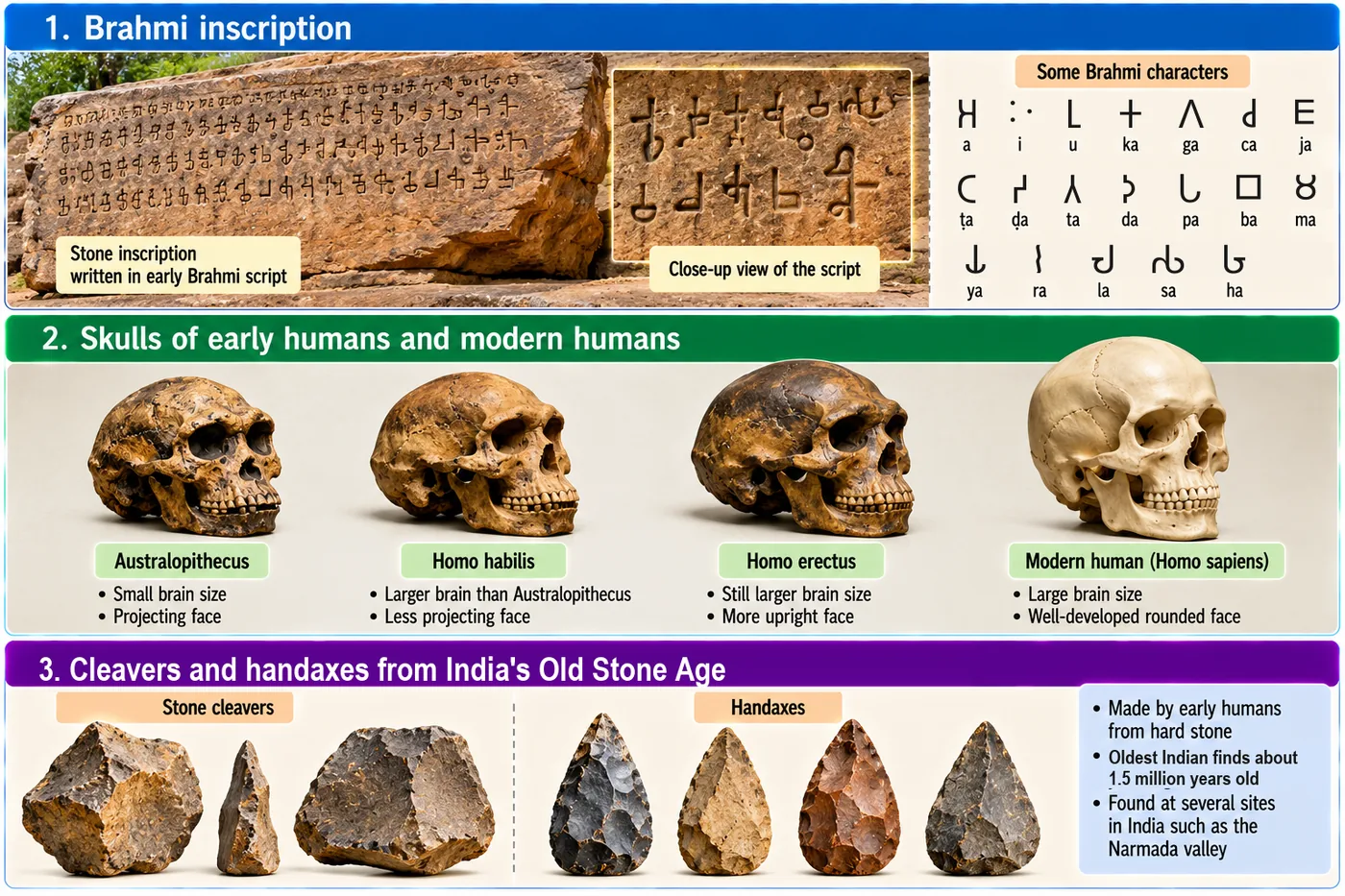
Three of the earliest writing systems appeared at roughly the same time: the Harappan (Sindhu) script on seals and pottery, the cuneiform of Sumer and the hieroglyphs of Egypt. Cuneiform and hieroglyphs have been deciphered; the Harappan script has not, so we still cannot read what the Harappans wrote. In India, the Brahmi script was in use from about 400 BCE in the Ganga valley and the south, and was used for Emperor Aśhoka's inscriptions in the 3rd century BCE.
3. Our Human Ancestors
Biological evolution is the slow physical and genetic change by which early ancestors such as the australopithecines ("southern apes") gave rise to modern humans, Homo sapiens. Cultural evolution is how humans learned to adapt — with tools, fire, shelter and new ways of getting food — during the Quaternary Period, the last 26 lakh (2.6 million) years.
| Ancestor | Where and when | Key features |
|---|---|---|
| Australopithecines | Africa, roughly 4–2 million years ago | Walked upright; small brains; projecting faces |
| Homo habilis ("handy man") | East Africa (e.g. Olduvai Gorge, Tanzania), about 2.4–1.5 million years ago | Made simple chopper tools |
| Homo erectus ("upright man") | From about 2 million years ago; first to leave Africa | Made handaxes and cleavers; spread into Asia and Europe |
| Homo neanderthalensis | Europe and South-West Asia, until about 40,000 years ago | Made Middle Palaeolithic flake tools |
| Homo sapiens | Evolved in Africa about 3 lakh (300,000) years ago | The only human species alive today; complex technology and art |
The earliest stone tools, about 3.3 million years old, mark the start of "human behaviour" — no animal makes such tools. Tools are sometimes called extra-corporal limbs because they extend what our hands can do. Africa, Asia and Europe, where the oldest settlements are found, are together called the Old World. Archaeologists dig sites, study fossils (remains turned to stone over long periods) and even make and use copies of ancient tools to understand how they worked.
Homo erectus left Africa about 2 million years ago, carrying handaxes into Asia and Europe. Much later, Homo sapiens moved out in waves — the textbook notes a major exit about 1,25,000 years ago — and by 50,000–12,000 years ago had reached Australia and the Americas.
4. The Stone Age in India and the World
| Period | Way of life | Tools |
|---|---|---|
| Palaeolithic (Old Stone Age) | Hunting and gathering; caves and open camps | Handaxes, cleavers, choppers → scrapers, borers, points → blades, burins |
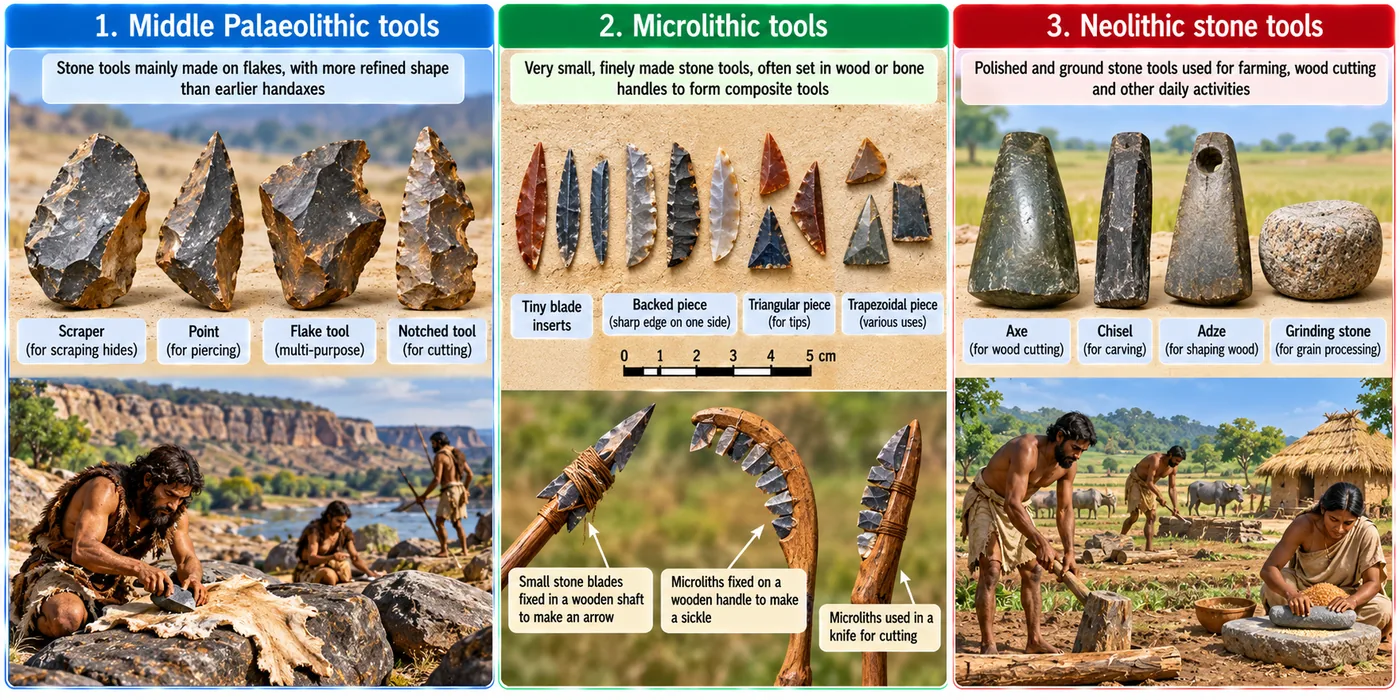
| Mesolithic (Middle Stone Age) | Hunting, fishing, gathering; transition to farming | Microliths (tiny stone tools) fixed in handles |
| Neolithic (New Stone Age) | Farming, herding, settled villages | Polished stone axes, grinding stones; pottery |
| Chalcolithic (Copper–Stone Age) | Farming villages using some copper | Copper with stone |
| Bronze Age | Towns, trade, writing — early civilisations | Bronze (copper + tin) |
| Iron Age | Larger states and societies | Iron tools and weapons |
Palaeolithic hunter–gatherers
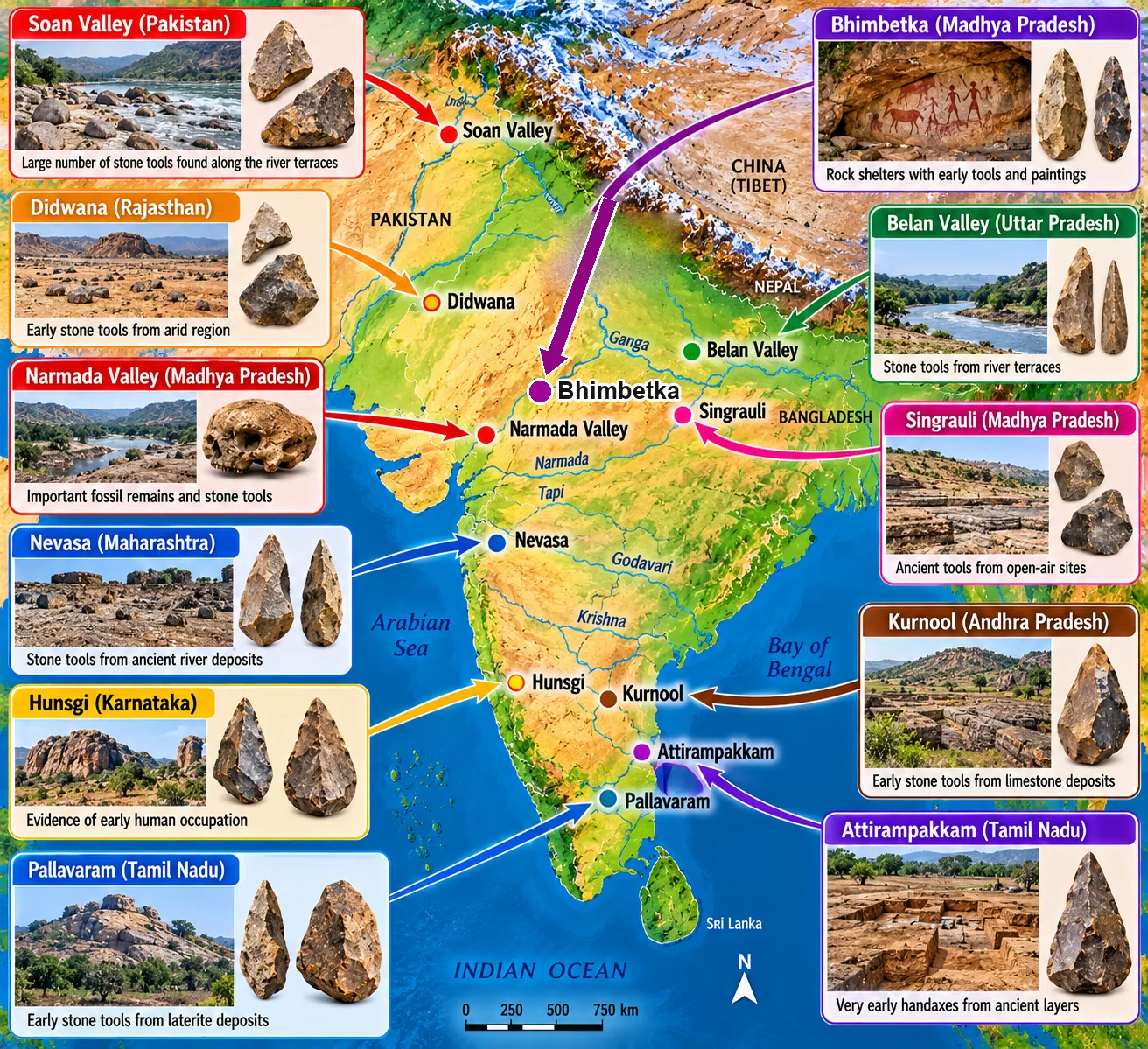
Humans lived in the Indian subcontinent from about 2 million years ago. Attirampakkam (Tamil Nadu) is dated to about 1.5 million years and Isampur (Karnataka) to about 1.2 million years; both yielded handaxes, cleavers, scrapers and choppers of quartzite and limestone, used to cut meat, dig tubers, scrape skins and crack bones for marrow. Later came smaller tools — scrapers, borers and points — and projectiles with sharp tips. In the Upper Palaeolithic, Homo sapiens invented the bow and arrow, made fine blades and microblades, engraved bones and ostrich-egg shells with burins, painted cave walls, decorated their bodies with pigments and made the first beads.
Mesolithic hunter–gatherers
About 12,000 years ago the climate warmed. Forests and grasslands spread where ice once lay, offering fish, small game and wild grains. Populations grew sharply — the first population explosion in history. Microliths fitted into handles made arrows, harpoons and sickles, and fishing became central. Art flourished: Bhimbetka (Madhya Pradesh), a UNESCO World Heritage Site, has hundreds of painted rock shelters with Mesolithic and older occupation.
5. The Neolithic Revolution
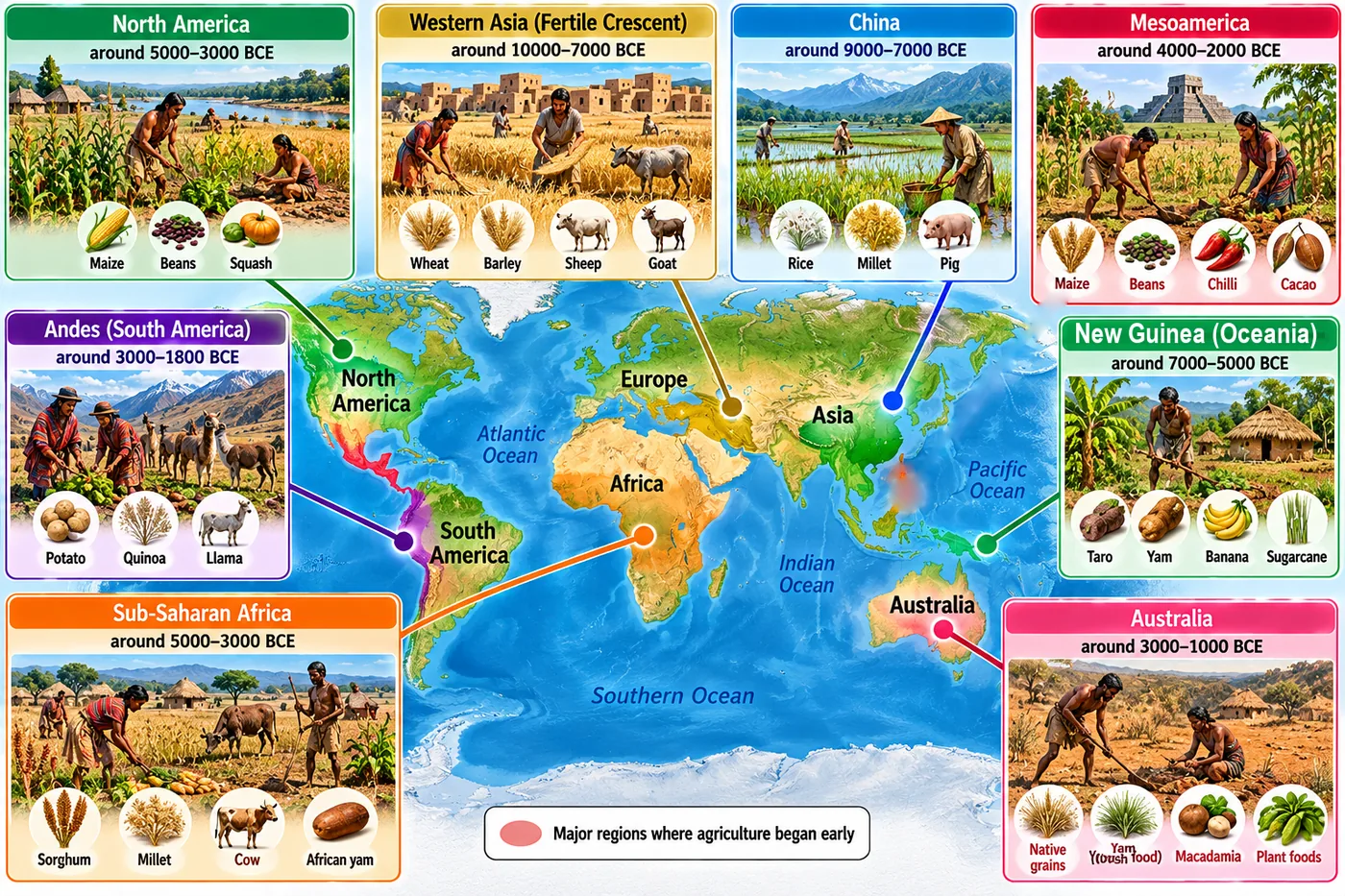
As hunter–gatherers came to know the seasons and the life cycles of plants and animals, they began to domesticate them — bringing them under human control and breeding new varieties. This change from collecting food to producing food is called the Neolithic Revolution. It was a revolution because it changed everything: people settled in villages, stored surplus grain, made pottery, wove cloth and, in time, built towns. It did not happen everywhere at once — wheat and barley in West Asia, rice and millets in China, millets and rice in India, pearl millet in West Africa, and maize in the Americas each have their own timelines.
Neolithic India
- Mehrgarh, on the Bolan river in Balochistan (Pakistan), is the oldest known farming village of the subcontinent, from about 7000 BCE. Its people built sun-dried mud-brick houses and granaries, grew wheat and barley, kept sheep, goats and humped zebu cattle, buried their dead and made ornaments of lapis lazuli, carnelian and shell. By about 4000 BCE they used copper — becoming Chalcolithic.
- By 2500 BCE most of the subcontinent had Neolithic farming communities — e.g. Burzahom (Kashmir), Sanganakallu (Karnataka, on a granite hilltop), Lahuradewa (Uttar Pradesh, rice) and Daojali Hading (Assam).
6. The Sindhu–Sarasvatī (Harappan) Civilisation
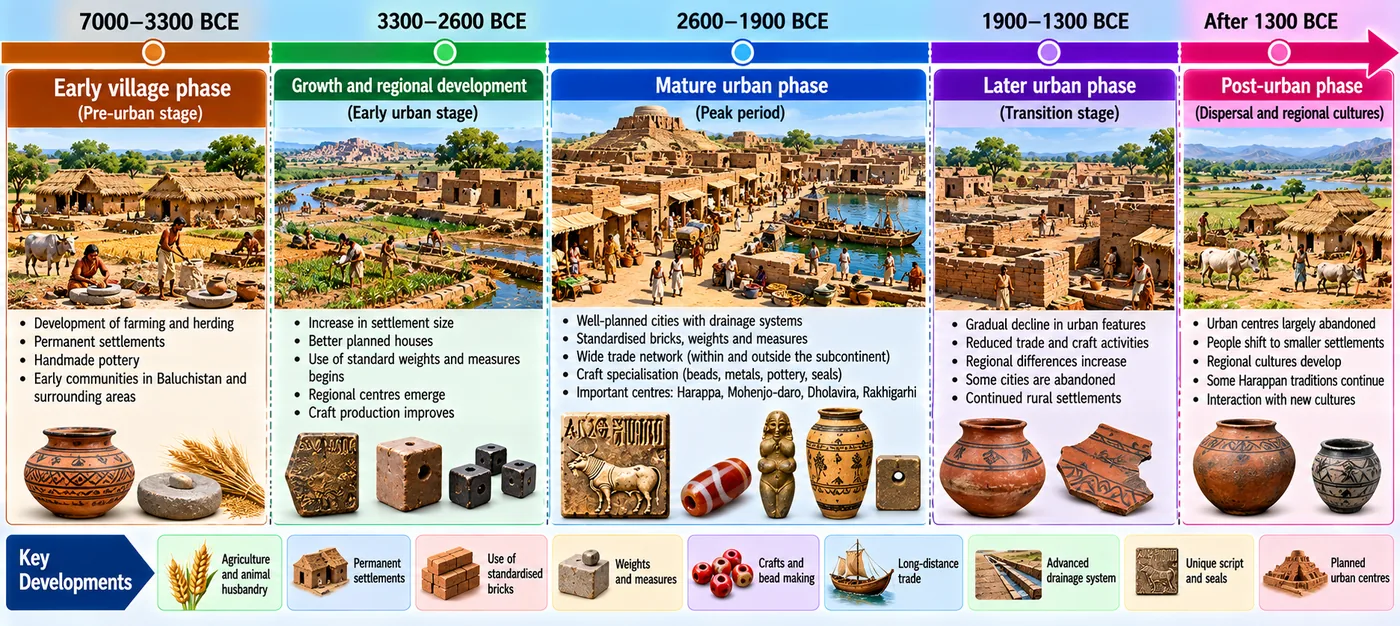
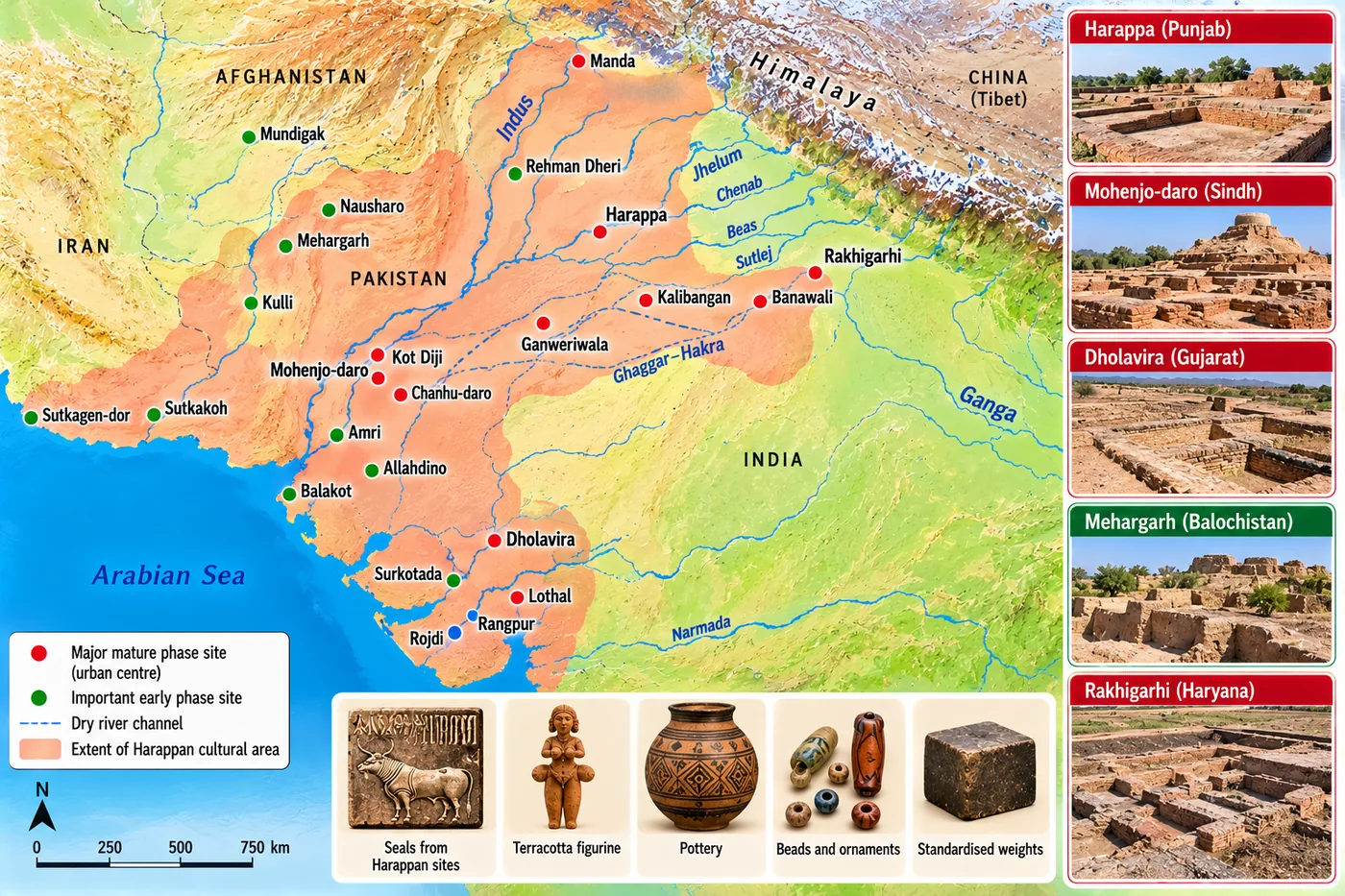
Farming spread from the Mehrgarh region into the Indus and Ghaggar–Sarasvatī plains. Copper tools raised productivity, pottery styles multiplied, and by about 2600 BCE cities had emerged. Some radiocarbon dates from Bhirrana and Kunal (Haryana) suggest that pre-Harappan settlement there began very early, between 7000 and 5500 BCE.
| Phase | Approx. dates | Features |
|---|---|---|
| Early Harappan | 3300–2600 BCE | Growing villages and towns; perimeter walls, early seals, graffiti that foreshadow the script; bead and shell crafts (Harappa, Kunal, Datrana) |
| Mature Harappan | 2600–1900 BCE | Planned cities, drains, standard bricks, weights, seals, script, long-distance trade |
| Late Harappan | 1900–1300 BCE | Decline of cities; smaller rural settlements and regional cultures |
- Kalibangan (Rajasthan) preserves an Early Harappan ploughed field with criss-cross furrows, suggesting two crops grown together — a practice like today's mixed cropping, nearly 5,000 years old.
- Standard cubical stone weights followed a binary series (1, 2, 4, 8, 16…) for small units and multiples of ten for large ones — vital for fair long-distance trade.
- Water skills: Early Harappans built gabarbands (check dams) in Balochistan; Dholavira (Kachchh) diverted two streams into a chain of stone reservoirs; Lothal (Gujarat) has a large burnt-brick basin often identified as a dockyard.
7. Mesopotamia
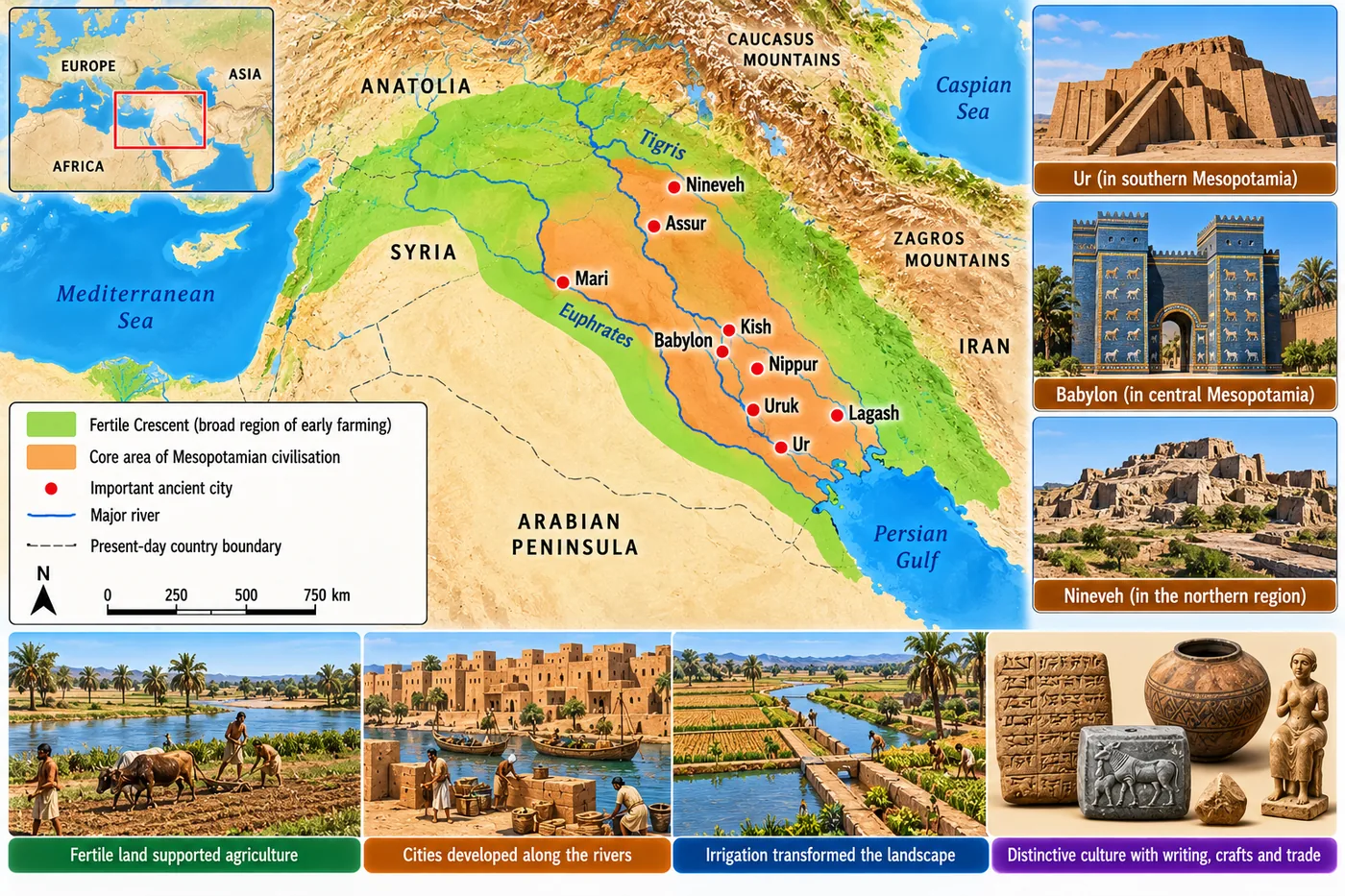
All four great early civilisations grew on river plains: the Indus and Sarasvatī, the Tigris and Euphrates (Mesopotamia), the Nile (Egypt) and the Huang He (China). Rivers gave water, fertile silt, fish and transport. Mesopotamia is Greek for "the land between the rivers" — mostly today's Iraq and Kuwait, with parts of Turkey and Iran. The arc of fertile land from the Mediterranean to the Persian Gulf is the Fertile Crescent, where farming began about 12,000 years ago. The earliest city-based civilisation arose here.
| Power | Highlights |
|---|---|
| Sumerians (Ur, Uruk, Lagash — south) | First cities; dams and canals; mud and burnt bricks; each city's chief god had a stepped temple, the ziggurat, at its centre; writing from about 3200 BCE |
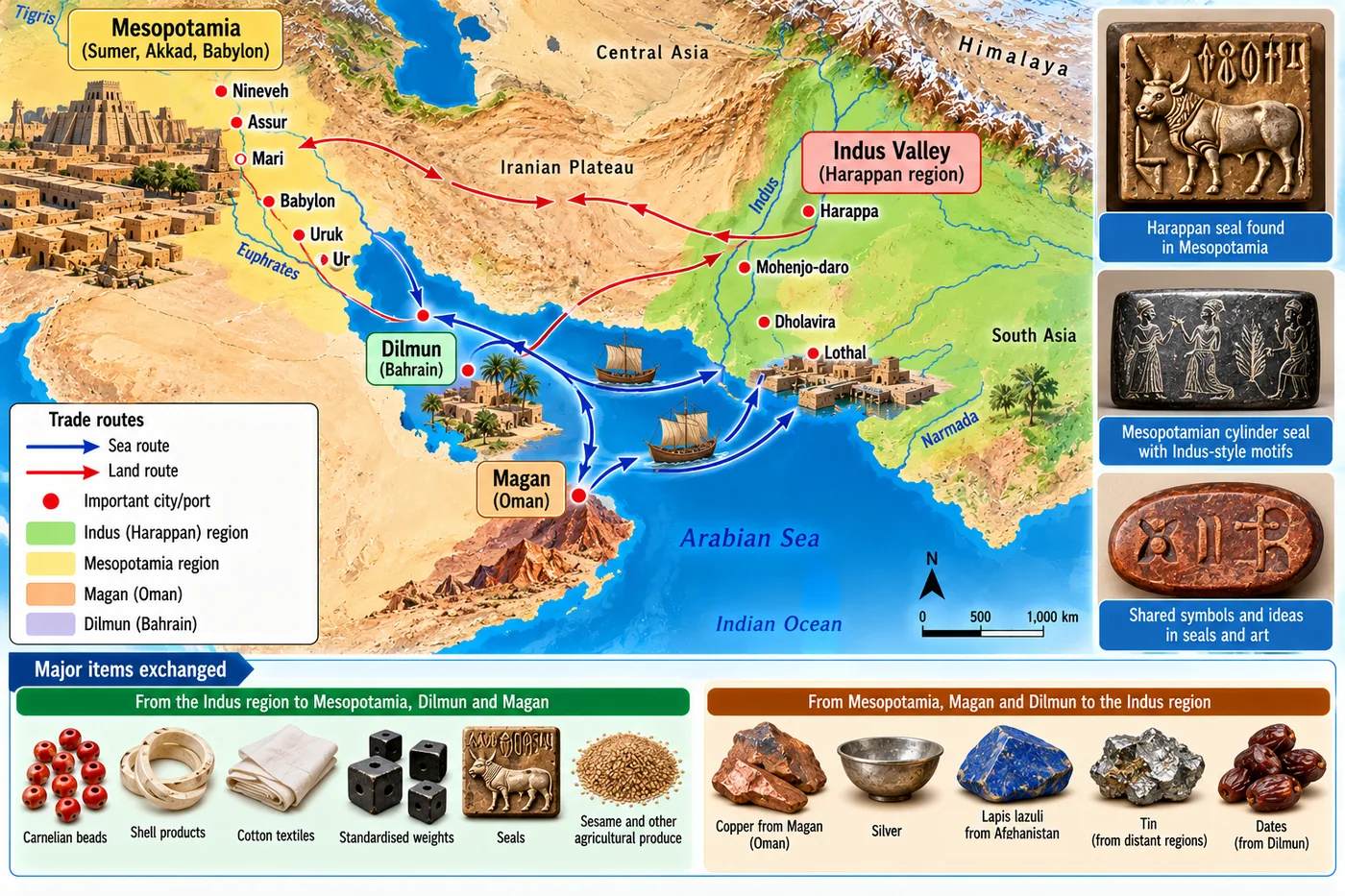
| Akkadians (from 2334 BCE) | Sargon of Akkad built the world's first empire; Akkadian language written in cuneiform; records of trade with Dilmun, Magan and Meluhha |
| Assyrians (city of Assur — north) | Rose to power in northern Mesopotamia and later built a vast empire with its capital at Nineveh |
| Babylonians (central) | Hammurabi (ruled from 1792 BCE) built an empire and issued the Code of Hammurabi; Babylon weakened after Hittite attacks (Babylon was sacked in 1595 BCE) |
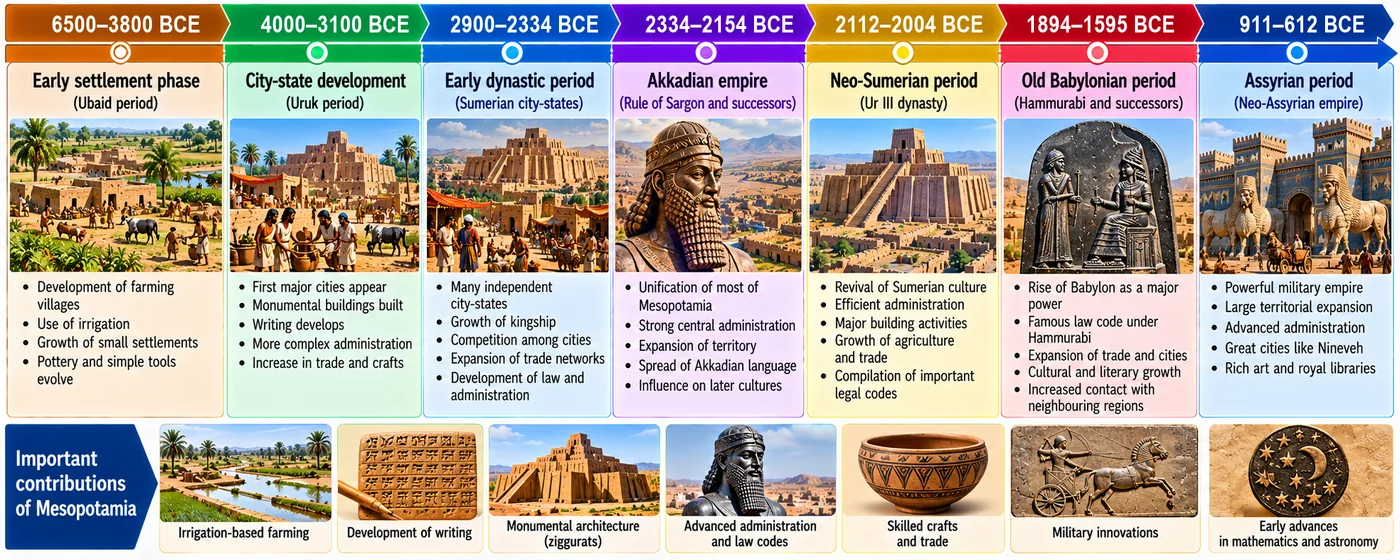
Society was hierarchical: kings in palaces, priests and priestesses with sole access to the temples, and most people living in small brick houses as farmers, potters, metalworkers, weavers and traders. Temples controlled much of the economy.
Cuneiform and Sumerian inventions
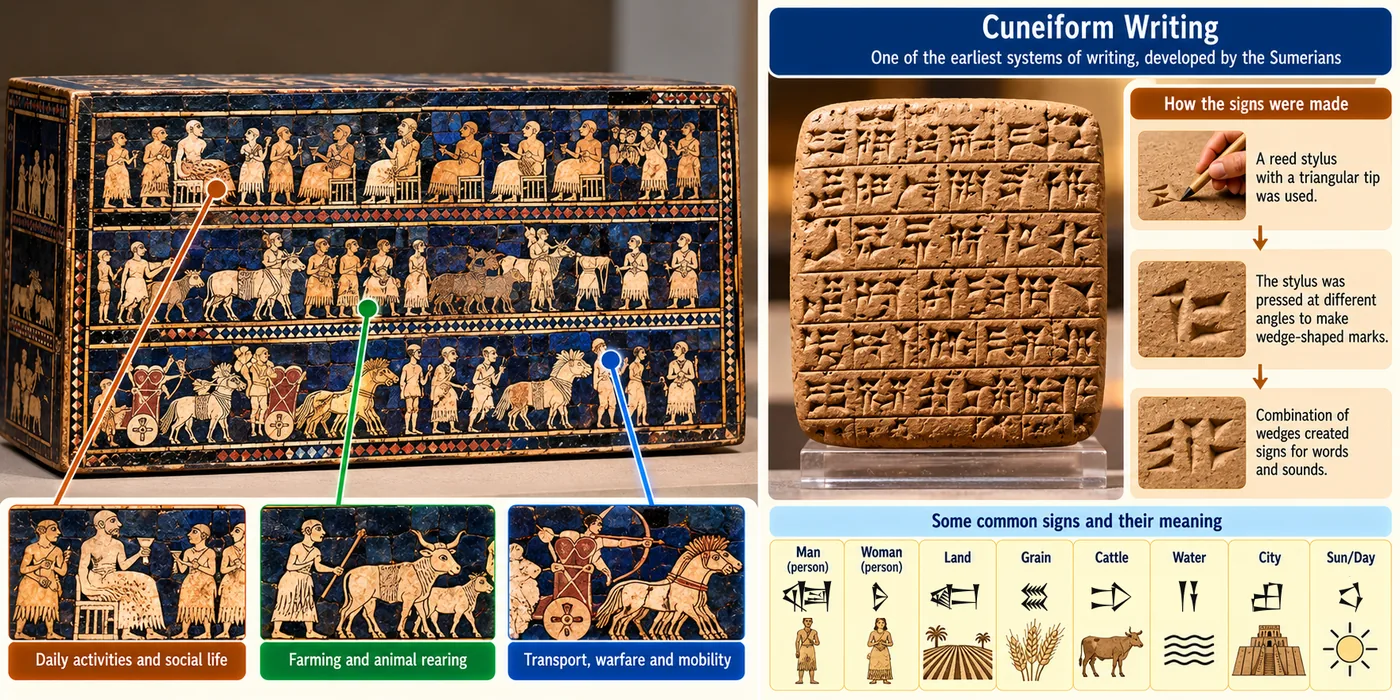
Cuneiform (from Latin cuneus, wedge) was written by pressing a reed stylus into soft clay tablets. Scribes enjoyed high status. By 3000 BCE many city-states used it, even for different languages. Tablets record myths and epics (the Epic of Gilgamesh), hymns, laws, schoolwork and accounts of farms and crafts. The Sumerians also gave us the wheeled cart, the sailboat, and a number system based on 60 — the source of the 60-minute hour, 60-second minute and 360-degree circle.
8. Egypt
Egypt is known from papyrus records, monuments and Greek writers like Herodotus (5th century BCE). The Nile flooded every summer, leaving black fertile silt — so Egyptians called their land Kemet, "the black land". Farmers dug ditches and reservoirs to store floodwater, and by counting the days between floods they made a 365-day calendar (12 months of 30 days + 5 extra days) linked to the rising of the star Sirius, with three seasons — inundation, growing and harvest. Such shared works needed organisation, helping local government grow. Because the Nile flows north, the delta in the north is Lower Egypt and the valley in the south is Upper Egypt.
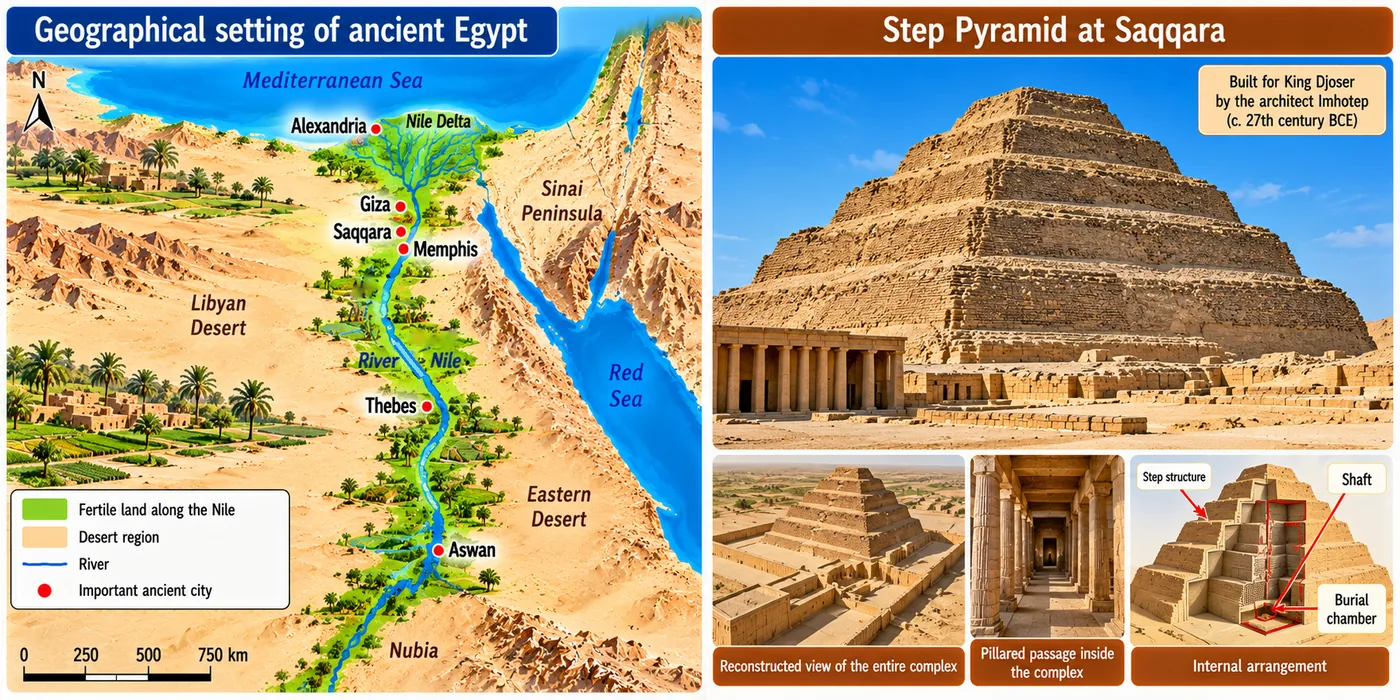
- Pharaohs ruled Egypt. Early burials had a flat-topped mastaba over the tomb; stacking mastabas produced the step pyramid at Saqqara, and later the true pyramids at Giza.
- Egyptians believed each person had a ka (spiritual double) that lived on if the body was preserved, so they practised mummification: organs (except the heart) removed, the body dried with natron, oiled and wrapped in linen.
- Society formed a pyramid: pharaoh → officials, nobles and priests → landholders, artisans and merchants → serfs and slaves.
- Women could own property and run businesses; Cleopatra (69–30 BCE) became queen at eighteen. Festivals such as the Sed festival marked a king's 30th year on the throne.
- Papyrus sheets were made from strips of the papyrus plant; the Papyrus Ebers lists over 700 medical remedies.
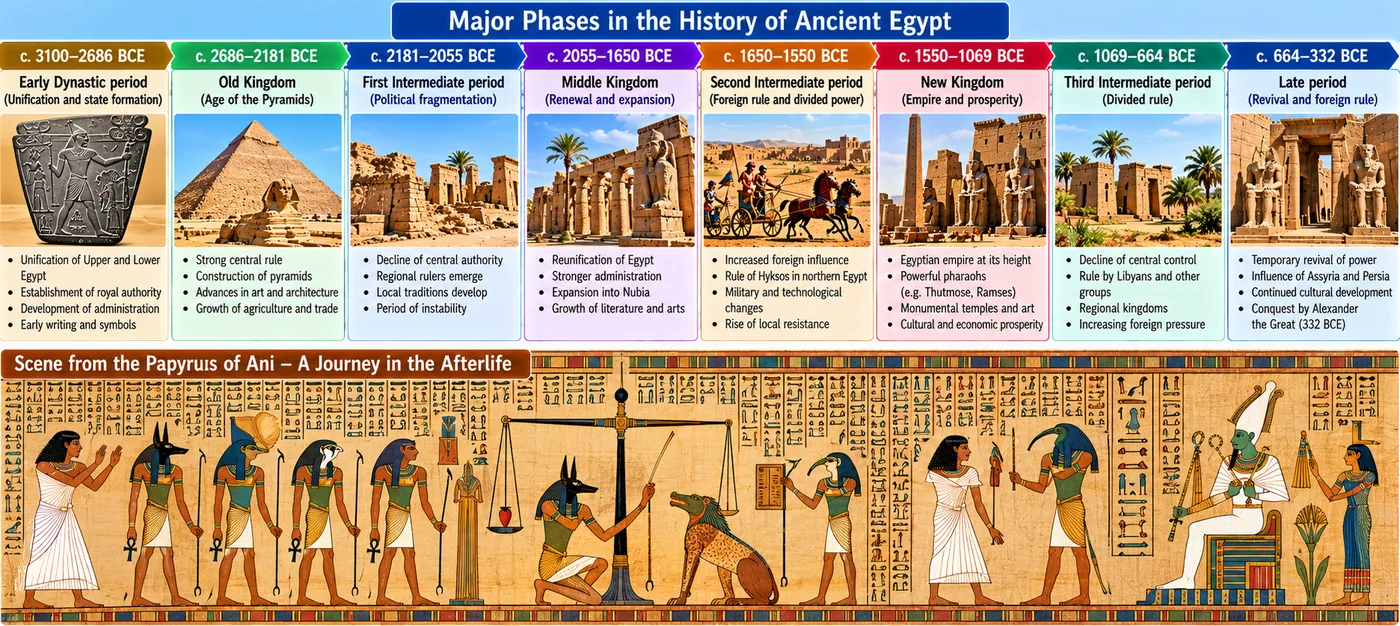
In 1799 a French officer, Pierre-François Bouchard, found the Rosetta Stone, carrying the same text in hieroglyphic, Demotic and Greek. Since Greek could be read, it worked like a bilingual dictionary, and in 1822 Jean-François Champollion deciphered hieroglyphs. No such "Rosetta Stone" has yet been found for the Harappan script.
9. China
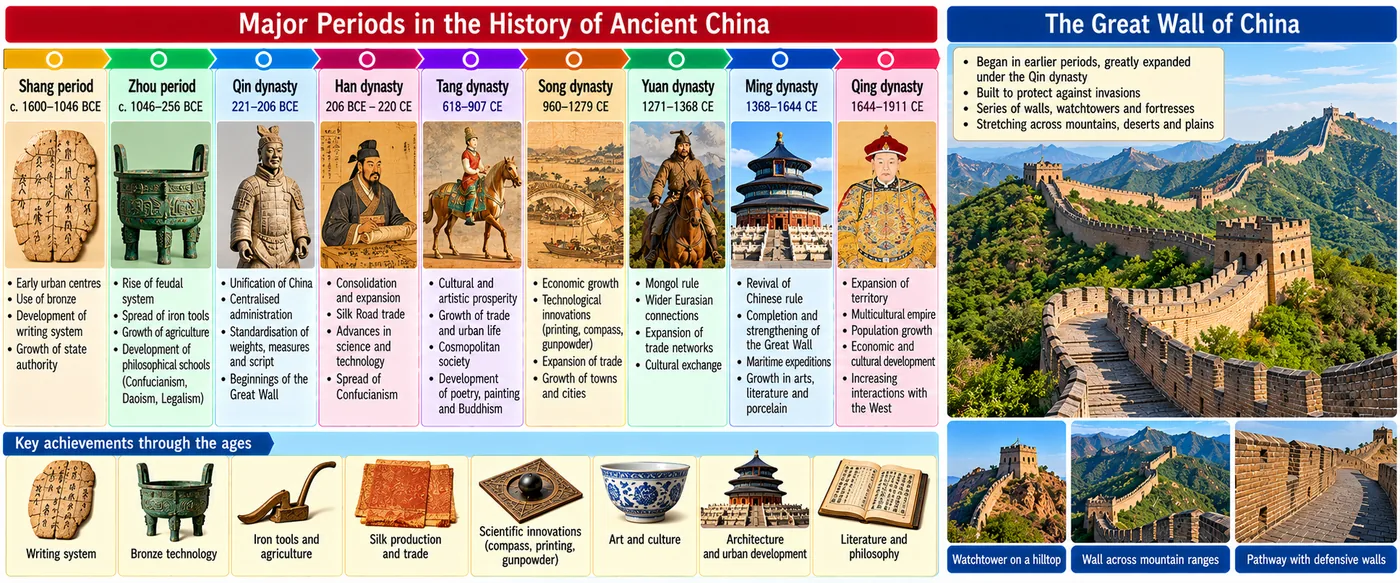
Chinese civilisation grew along the Huang He (Yellow River) and the Yangtze, centres of Neolithic farming from about 7000 BCE. Bronze working began around 2000 BCE, and cities emerged by about 1600 BCE.
| Dynasty | Dates | Notes |
|---|---|---|
| Shang | 1600–1046 BCE | Bronze vessels; oracle bones — the earliest Chinese writing |
| Zhou | 1046–256 BCE | Kings were also priests, believed chosen by heaven but removable if people suffered; iron in use by about 600 BCE; metal money |
| Qin | 221–206 BCE | First imperial dynasty; unified China; the name "China" probably comes from Qin |
| Han | 206 BCE–220 CE | Silk became a major export along the Silk Route |
- Oracle bones: symbols were carved on animal bones and tortoise shells, which were heated until they cracked; the cracks were read to foretell the future.
- Chinese script is logographic — characters stand for whole words or meaningful units, not sounds.
- Craftsmen carved jade (brought from outside China) into ritual and prestige objects — even musical chimes — and cast fine bronze vessels.
- The Great Wall began as separate walls from the 7th century BCE against nomadic raids; they were joined and extended over some 2,000 years, with major work continuing into the 17th century CE.
- Silk was known from Neolithic times. China was also the first to use paper money and to select officials through public examinations (tested in archery, riding, calculation, writing and music in early times).
All four civilisations arose independently in fertile river plains, yet share common features: surplus farming, cities, crafts, trade, writing, administration and social hierarchy. Many of our cultural roots go back to these Bronze Age societies.
10. Master Table: Key Terms
| Term | Meaning |
|---|---|
| Archaeology | Study of the past through material remains |
| Artefact | Object made by humans — tool, pot, bead |
| Fossil | Remains or traces of past life turned to stone |
| Hominin | Modern humans and our human-like ancestors |
| Microlith | Tiny stone tool fixed in a handle |
| Domestication | Bringing plants and animals under human control |
| Chalcolithic | Copper used along with stone |
| Ziggurat | Stepped temple tower of Mesopotamian cities |
| Cuneiform | Wedge-shaped writing on clay tablets |
| Meluhha | Mesopotamian name for the Indus region |
| Mastaba | Flat-topped Egyptian tomb structure |
| Oracle bones | Inscribed bones heated to foretell the future |
11. Master Summary Table
| Civilisation | River(s) | Script | Famous features |
|---|---|---|---|
| Harappan | Indus, Ghaggar–Sarasvatī | Sindhu script (undeciphered) | Planned cities, drains, weights, Dholavira reservoirs |
| Mesopotamian | Tigris, Euphrates | Cuneiform | Ziggurats, wheel, base-60, Code of Hammurabi |
| Egyptian | Nile | Hieroglyphs | Pyramids, mummies, 365-day calendar |
| Chinese | Huang He, Yangtze | Logographic (oracle bones) | Bronze, jade, silk, Great Wall |
Chart — share of human history (approx. %):
12. Mind Map
- Habilis, erectus
- Sapiens from Africa
- Palaeo, Meso, Neo
- Attirampakkam, Bhimbetka
- Neolithic Revolution
- Mehrgarh 7000 BCE
- 2600–1900 BCE mature
- Trade with Mesopotamia
- Mesopotamia, Egypt
- China
13. Tips and Tricks
- Ages in order: "People Made New Copper Bowls Inside" — Palaeolithic, Mesolithic, Neolithic, Chalcolithic, Bronze, Iron.
- Gulf trade partners: Dilmun = Bahrain (think "Docks in the Gulf"), Magan = Oman (Metal — copper), Meluhha = Indus.
- Scripts: Sumer — wedges (cuneiform); Egypt — pictures (hieroglyphs); China — words (logograms); Harappa — still a mystery.
- Homo erectus, not Homo sapiens, was the first to leave Africa.
- Lower Egypt is in the north (downstream), Upper Egypt in the south.
- The Harappan script has not been deciphered; cuneiform and hieroglyphs have.
14. Important One-liners
- The oldest known stone tools are about 3.3 million years old.
- Homo habilis means "handy man".
- Homo sapiens evolved in Africa about 3,00,000 years ago.
- Attirampakkam (Tamil Nadu) has tools about 1.5 million years old.
- Bhimbetka rock shelters are a UNESCO World Heritage Site.
- Mehrgarh is the earliest farming village of the subcontinent.
- Kalibangan has an Early Harappan ploughed field.
- The Sumerians began writing around 3200 BCE.
- Sargon of Akkad founded the first empire.
- Champollion deciphered hieroglyphs in 1822.
- Shang oracle bones are the earliest Chinese writing.
15. Exam-pattern Questions with Detailed Answers
Which human ancestor was the first to move out of Africa?
- Homo habilis
- Homo erectus
- Homo neanderthalensis
- Homo sapiens
Show answer
Homo erectus left Africa about 2 million years ago with handaxes and cleavers. Homo habilis stayed in Africa; Neanderthals lived in Europe and West Asia; Homo sapiens spread much later.
Answer: (B)
Mesopotamian records call the Harappan region:
- Dilmun
- Magan
- Meluhha
- Sumer
Show answer
Meluhha is generally identified with the Indus region. Dilmun is Bahrain, Magan is Oman, and Sumer is southern Mesopotamia itself.
Answer: (C)
What are microliths, and in which period were they typical?
Show answer
Microliths are very small stone tools — blades, points, triangles — fixed in wooden or bone handles to make arrows, harpoons, sickles and knives. They are typical of the Mesolithic period.
Answer: Tiny composite-tool parts; Mesolithic
Why is the shift to farming called a "revolution"?
Show answer
It changed almost every part of life: people moved from collecting to producing food, settled in permanent villages, stored surplus, made pottery and new tools, kept animals, and their populations grew. Surplus later supported crafts, trade, towns and states — so the change was deep and lasting, not a small step.
Answer: It transformed food, settlement and society
Describe Mehrgarh's importance in Indian history.
Show answer
Mehrgarh (Bolan river, Balochistan) is the earliest farming village of the subcontinent (about 7000 BCE). People grew wheat and barley, kept sheep, goats and zebu cattle, built mud-brick houses and granaries, and made ornaments of lapis lazuli and carnelian. By about 4000 BCE they used copper. This long development laid the base for the Harappan civilisation.
Answer: Earliest farming village; roots of the Harappan civilisation
Why were rivers important for early civilisations?
Show answer
Rivers supplied water for drinking and irrigation, fertile silt from floods for surplus crops, fish, and easy transport for trade. Surplus food allowed craftspeople, priests and rulers to live in cities. But floods and shifting courses were also dangers, so people built canals, dams and embankments.
Answer: Water, fertile soil, food and transport
How did the Rosetta Stone help decipher Egyptian hieroglyphs?
Show answer
Found in 1799, it carried one text in three forms — hieroglyphic, Demotic and Greek. Scholars could read the Greek, so they compared it with the hieroglyphs. In 1822 Champollion used it to decipher the script.
Answer: Same text in Greek acted as a key
"Bronze Age civilisations developed independently but shared common features." Examine.
Show answer
Independent: each arose in its own river valley with its own script, gods, art and political system — the Harappans had planned cities and drains, Mesopotamia ziggurats and city-states, Egypt pharaohs and pyramids, China dynasties and oracle bones. Common: all depended on farming surplus from fertile river plains, used bronze, had cities, crafts, long-distance trade, writing, administration and social hierarchy. Some also interacted — Harappans traded with Mesopotamia through Dilmun and Magan.
Answer: Separate origins, similar building blocks
Imagine the Harappan script is deciphered tomorrow. What might historians learn?
Show answer
The names of rulers, cities, gods and merchants; what the seals and their animal symbols meant; how trade was recorded; the language the Harappans spoke and its links to later Indian languages; their beliefs, laws and social organisation; and possibly why the cities declined. Archaeology tells us what they made; writing would tell us what they thought.
Answer: Their language, names, beliefs and institutions
Why was a standard system of weights important to the Harappans?
Show answer
Traders across a huge area — from Afghanistan to Gujarat and on to the Gulf — exchanged beads, metals, shell and grain. Cubical stone weights in a fixed binary-then-decimal series meant a unit meant the same everywhere, so exchanges were fair, taxes or dues could be measured, and trust in long-distance trade was maintained. Without them, disputes and cheating would have made trade unreliable.
Answer: Fair, uniform exchange over long distances
Was the Code of Hammurabi fair to all? Give reasons.
Show answer
For: it put rules in writing for everyone to know, covering trade, wages, property, family and crime, and protected the weak in some cases — a model for later legal systems. Against: punishments were often harsh ("an eye for an eye"), and penalties differed by social class — nobles, commoners and slaves were not treated equally. So it was an important step towards rule of law, but not equal justice by today's standards.
Answer: Written law, but unequal by class
16. Quick Revision Summary
- Over 99% of human history came before writing; archaeology is the key source.
- Habilis (choppers) → erectus (handaxes; first out of Africa) → Neanderthals → Homo sapiens (from Africa, ~3 lakh years ago).
- Palaeolithic (Attirampakkam ~1.5 million yrs), Mesolithic (microliths, Bhimbetka), Neolithic (farming, Mehrgarh ~7000 BCE).
- Harappan: early 3300–2600, mature 2600–1900, late 1900–1300 BCE; weights, Kalibangan field, Dholavira reservoirs; Mesopotamia called the region Meluhha.
- Mesopotamia: Sumerians (cuneiform 3200 BCE, ziggurats, base 60), Sargon, Hammurabi's Code.
- Egypt: Nile, Kemet, pyramids, mummies, Rosetta Stone. China: Shang oracle bones, Zhou, Qin, Han, Silk Route, Great Wall.